
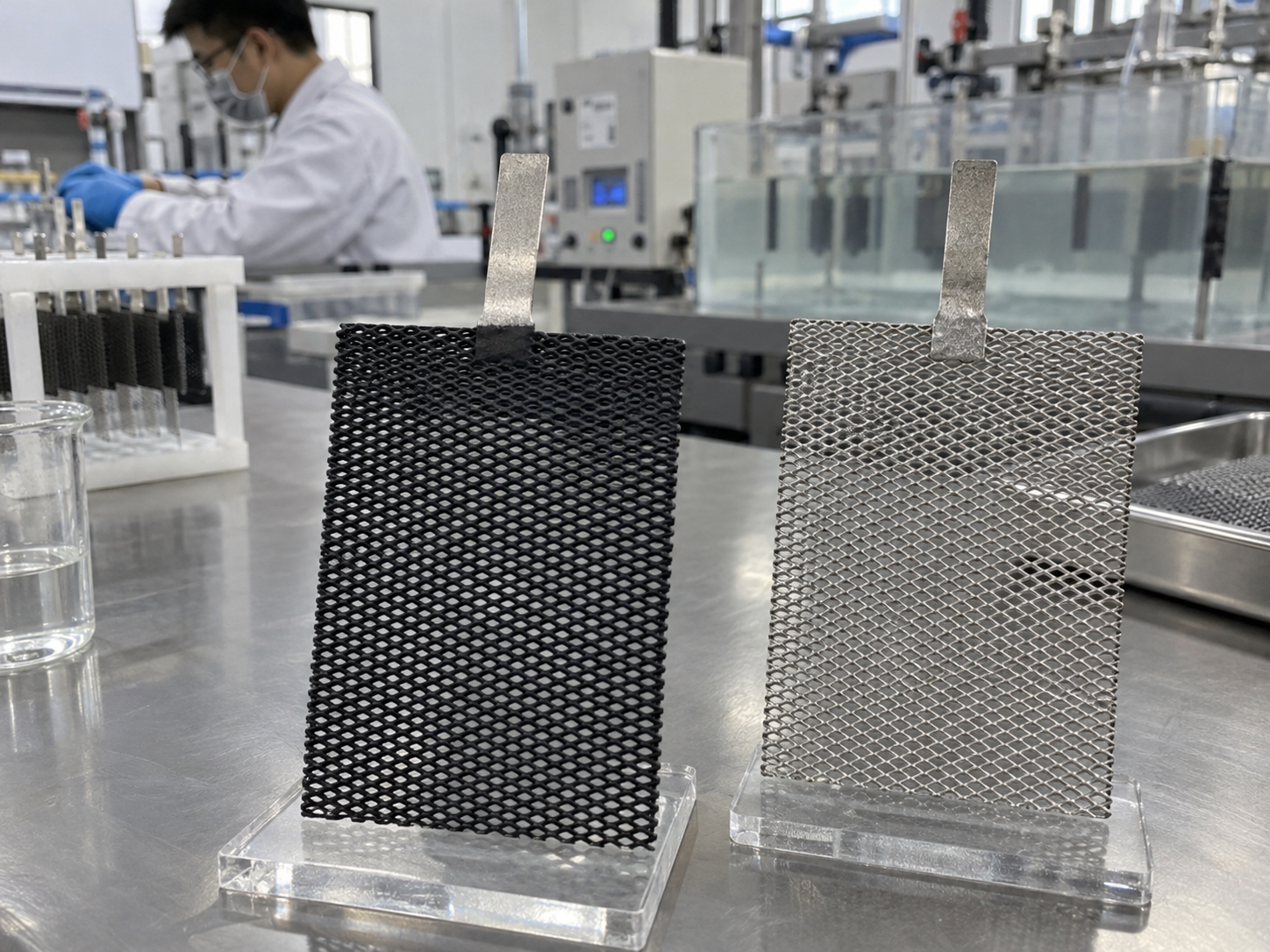
Custom MMO Titanium Anodes for ICCP Systems
Plate, mesh, expanded mesh, rod and tube anodes manufactured to your approved cathodic-protection drawing and operating data.
ARY Titanium manufactures and supplies the anode. System design, protection criteria, potential assessment and commissioning approval remain with your qualified cathodic-protection engineer.
Illustrative MMO coating comparison · final form follows project data
Where an MMO Titanium Anode Sits in an ICCP Circuit
In an impressed current system, the anode is the part that discharges protective current into the electrolyte. Follow the circuit to see what the anode does, and which decisions belong to your system designer, so responsibilities are clear before you request a quote.
1 · Rectifier
Supplies DC current. Output settings are defined by your CP design.
2 · Positive Connection
Links the rectifier to the anode. The connection method is agreed for each drawing.
3 · MMO Titanium Anode
Titanium substrate with a mixed metal oxide coating that discharges current into the electrolyte.

A titanium substrate with an active oxide coating
The titanium substrate gives a stable, conductive body. The mixed metal oxide coating carries out the anodic reaction. We match coating system, active area and form to the electrolyte, current density, driving voltage, temperature and design life in your approved design, so the anode is built for the duty it will actually see.
ARY Titanium provides anode manufacturing, customization and supply. We do not replace your cathodic protection engineer in system design, protection criteria, potential assessment or final commissioning approval.
6 · Negative Return
Completes the circuit from the structure back to the rectifier.
5 · Protected Structure
The steel your design protects. Protection criteria are set by your engineer.
4 · Electrolyte
Soil, backfill, water or concrete carries current from anode to structure.
Share your approved design basis and we will review whether the anode can be built to it.
Request a Manufacturing ReviewICCP Environments Where Our Titanium Anodes Can Be Evaluated
Each structure puts the anode in a different electrolyte, current demand and installation method. Open a panel to see which titanium forms can be evaluated for it. Starting from the right form shortens the review, while the final form and quantity follow your approved CP design.

Buried Pipelines
Anode beds designed by your CP engineer to protect pipeline routes. We review tube, rod or custom titanium forms against the bed design you provide.
Can be evaluated: tube · rod · custom structure
Storage Tanks
Tank bottoms and internal surfaces, depending on the design. Mesh and expanded mesh can spread current over wide areas when the layout calls for it.
Can be evaluated: mesh · expanded mesh · rod · custom
Harbor and Jetty Steel Piles
Sheet piles and pipe piles in seawater or brackish water. Rod, tube or mesh forms are reviewed against your mounting detail and current requirement.
Can be evaluated: rod · tube · mesh · custom
Offshore and Marine Steel
Fixed marine steel under an ICCP design. Plate, rod or custom titanium structures can be evaluated against your mounting drawing.
Can be evaluated: plate · rod · custom structure
Reinforced Concrete
Bridges, decks and marine concrete under a concrete CP design. Titanium mesh or expanded mesh can be evaluated for distributed current over the rebar.
Can be evaluated: mesh · expanded mesh
Water and Process Tanks
Steel water storage and process vessels with an ICCP design. Rod, tube or plate forms can be reviewed for internal installation.
Can be evaluated: rod · tube · plateWire, ribbon, mesh ribbon, disc, canister or deep-well string anodes require confirmation of actual supply capability before quotation.
Photos show typical ICCP environments and do not represent ARY project references.
Tell us your structure and design basis to check which titanium form can be built.
Discuss Your ApplicationICCP and Sacrificial Systems: Where MMO Titanium Anodes Fit
Sacrificial (galvanic) and impressed current systems are different designs, chosen by your corrosion engineer for different structures and conditions. MMO titanium anodes are used only in impressed current systems and are not a drop-in replacement for galvanic anodes. Knowing this upfront keeps your specification and our quote aligned.

Sacrificial Anode System
A galvanic metal such as zinc, aluminium or magnesium corrodes to supply current. No external power source.
Natural potential difference between metals
External DC rectifier set by the design
Output follows the environment
Output adjusted within design limits
The anode metal is consumed
Coating performs the reaction on titanium
Chosen by the CP engineer for suitable structures
Chosen where impressed current is specified
Outside our titanium anode range
We build the anode to the approved specification

MMO Titanium Anode in ICCP
A coated titanium anode driven by a DC power source, used when your design specifies impressed current.
Which system to use is a design decision for your cathodic protection engineer. Once ICCP is specified, we review whether a titanium anode can be made to that design.
Already working on an ICCP design? Send the anode specification for review.
Send Your ICCP SpecificationNine Design Inputs We Review Before Quoting an Anode
We do not offer one anode for every project. These values come from your approved CP design and site data. With them, we can tell you whether the anode can be made to the required form, coating direction and connection, and you avoid quotes built on guesses.

Each marker is one design input
The more inputs you provide, the more precise our manufacturing review and the fewer clarification rounds before a firm quotation.
Approved CP Design Basis
The design document and assumptions approved by your engineer.
Electrolyte and Resistivity
Soil, backfill, water or concrete, with measured resistivity.
Electrolyte Chemistry
Chloride content, pH and other conditions affecting the anodic reaction.
Operating Temperature
Ambient or elevated service temperature at the anode.
Required Current per Anode
The current your design assigns to each anode.
Current Density on the Active Area
Derived from the required current and the active surface.
Driving Voltage and Rectifier Limits
Output range from your design, reviewed against substrate limits.
Operating Cycle and Design Life Target
Duty pattern and the life your project requires.
Installation and Connection Conditions
Mounting method, space, connection position and joint environment.
All design values must be confirmed by a qualified cathodic protection or corrosion professional. If some are missing, we list the items still needed.
Have part of this data ready? Send it and we will tell you what is still needed.
Send Your Design DataOne Anode, Four Media: Coating Is Discussed, Not Assigned
There is no fixed coating for soil, fresh water, seawater or concrete. We discuss the coating direction against your electrolyte, target anodic reaction, current density, driving voltage, temperature and project design, so the coating you pay for answers your actual duty.
 Soil and Backfill
Points we discuss: backfill type, moisture, resistivity, gas venting and expected current density in the anode bed.
 Fresh Water
Points we discuss: low conductivity, water chemistry, temperature and the target anodic reaction.
 Seawater
 and Brackish Water
Points we discuss: chloride level, chlorine evolution, flow, temperature and driving voltage.
 Concrete
Points we discuss: concrete condition, current distribution over the rebar, anode spacing and installation method.
Iridium-Tantalum Based MMO
A coating family generally associated with oxygen-evolution conditions. Suitability depends on your project data.
Ruthenium-Iridium Based MMO
A coating family generally associated with chloride-containing electrolytes. Suitability depends on your project data.
Platinum-Coated Titanium
An option that can be discussed where your specification considers platinum. Suitability depends on your project data.
Any coating direction is a starting point for technical discussion. It is confirmed only after your design data has been reviewed.
Send your electrolyte and design data to start the coating discussion.
Start a Coating ReviewTitanium Forms That Can Be Evaluated for Your Installation
We work with titanium plate, mesh, expanded mesh, rod, tube and custom titanium structures. Hover an installation to see which forms can be evaluated for it. Starting from a form we already work with keeps your sample lead time and cost under control.
 Titanium Plate and Rod
 Mesh and Expanded Mesh
 Custom Titanium Structure
Flat anodes cut and formed to drawing.
Mesh for distributed current.
Expanded sheet for larger active areas.
Compact anodes for confined positions.
Specified diameter and length.
Fabricated to your drawing.
Connection method agreed per drawing · terminal, welded tab or other detail set with your engineer.
Factory cable connection and sealing · offered only where confirmed as actual production capability before quotation.
Connection details reviewed · position, current rating and joint environment checked against the drawing.
Wire, ribbon, mesh ribbon, disc, canister and deep-well string anodes are not listed as standard supply. Ask us to confirm actual capability before including them in your specification.
Send your installation drawing and we will review which titanium form can be built.
Review My Anode FormHow Anode Service Life Is Evaluated
Anode service life cannot be promised without operating conditions. It is evaluated from the factors below, using the values in your approved design. Because every assumption is stated, your engineer can check the result instead of relying on a catalogue figure.
Coating System
Coating families respond differently to oxygen- or chlorine-evolution conditions.
Coating Loading
The amount of active coating applied, agreed against the project requirement.
Current Density
Current per unit of active area. Higher density generally shortens coating life.
Electrolyte
Soil, backfill, water or concrete, and their chemistry, load the coating differently.
Temperature
Elevated temperature can increase coating consumption.
Driving Voltage
Must stay within limits suitable for the titanium substrate and electrolyte.
Operating Cycle
Continuous or intermittent duty, and output changes over time.
Installation Conditions
Backfill quality, spacing, mechanical stress and joint environment on site.

What we state with a quotation
Where a service-life assessment is requested, we list the assumptions behind it so your engineer can check them against the design. We do not give a fixed service-life promise that ignores operating conditions.
- Assumed current per anode
- Active area and current density
- Coating system and loading basis
- Electrolyte, temperature and operating cycle
Need a service-life assessment basis? Send your design life target with your data.
Request a Life Assessment BasisEarly Anode Problems and What Can Contribute to Them
Early anode problems rarely have one obvious cause. Each pair shows a field symptom, factors that may contribute to it, and the points we review during manufacturing. Root cause can only be established with operating data, photos and returned samples, which protects you from a quick but wrong conclusion.

Loss of current at an anode
Joint sealing, water ingress, strain on the lead or the field connection

Connection design and workmanship agreed for the drawing.

Faster-than-expected coating wear
Current density above the design assumption, electrolyte chemistry or temperature

Active area and coating basis against your design values.

Substrate attack in chloride service
Driving voltage, local current concentration or coating damage

Voltage limits and edge or joint details on the drawing.

Uneven current distribution
Anode spacing, form, backfill or structure geometry

Form and dimensions against the approved layout.

Coating damaged before installation
Handling, stacking or transport conditions

Packaging method agreed before shipment.

Anode does not fit on site
Drawing revision mismatch or missing dimensions

Drawing revision and key dimensions before production.
If a problem occurs, we review operating data, photos and returned samples with you before drawing conclusions or agreeing on corrective action.
Facing an early anode problem? Send the data and photos for a joint review.
Request a Problem ReviewProject Quality-Control Points
Quality requirements differ between projects. These are the control points we can apply. The specific inspection items, methods and records for your order are agreed before production starts, so your incoming inspection knows exactly what to expect.
Incoming Material
Titanium material checked on receipt.
Surface Preparation
Pretreatment before coating controlled.
Coating Process
Coating applied per the agreed requirement.
Dimensions
Key dimensions checked against the drawing.
Welding
Welded areas inspected where welding is used.
Visual Appearance
Coating surface checked for visible defects.
Connection
Connection checked as agreed for the drawing.
Drawing Revision
Production matched to the approved revision.
Packaging
Packing method checked before dispatch.

Inspection items and records are confirmed before ordering
Tell us which checks and documents your project requires. We confirm what can be provided, such as inspection records or material information where available, before you place the order.
List the quality checks your project needs, and we will confirm them before ordering.
Confirm Quality RequirementsPacked in Foshan for ICCP Projects Abroad
Coated titanium anodes need to arrive undamaged and clearly identified. Open the container to see who we are, how anodes are packed and where we already export, so you can plan receiving and installation with confidence.
- Cathodic Protection Contractors
- Engineering and EPC Companies
- Distributors and Importers
- Industrial Equipment Makers
- OEM / ODM Brands

ARY Titanium · Foshan, China
ARY Titanium is the customer-facing brand of Guangdong Lezhong Intelligent Technology Co., Ltd. We integrate R&D, manufacturing and sales of titanium electrodes and titanium components, and support custom development for overseas B2B customers.

Export Case and Labels
Part number and quantity marked on each case.

Fixed Separation
Anodes held apart to prevent bending and contact.

Connection Protection
Connection areas protected where anodes have terminals or leads.

Surface Protection
Coated surfaces wrapped against scratching and contamination.
Shipping to a new project site? Tell us the destination and required delivery date.
Plan My Delivery
Questions ICCP Buyers Ask Before Ordering
Engineers, purchasing teams and quality managers check different things. Choose your role and open a question to get a straight answer before you send an inquiry.
Which coating do you recommend for our project?
We do not give a general recommendation. The coating direction is discussed against your electrolyte, target anodic reaction, current density, driving voltage, temperature and approved design.
What information do you need before reviewing an anode?
Your approved CP design basis, electrolyte and resistivity, required current per anode, rectifier limits, temperature, design life target, installation method and drawing.
How long will the anode last?
Service life cannot be stated without operating conditions. Where an assessment is requested, we list the assumptions used so your engineer can check them.
Can you manufacture to our drawing?
We can evaluate your drawing and project requirements, and confirm before quotation whether the form, dimensions and connection fall within our actual production capability.
Are you a manufacturer?
Yes. ARY Titanium integrates R&D, manufacturing and sales of titanium electrodes and titanium components in Foshan, China.
Can we order samples first?
Samples and small pilot quantities can be discussed for design evaluation and supplier qualification.
What is the lead time?
Lead time depends on form, coating, connection and quantity. We give a lead time with the quotation once the scope is confirmed.
Will our drawings stay confidential?
Drawings and project information are used only for your project, and an NDA can be signed before files are shared.
How are repeat orders kept consistent?
Repeat orders are produced to the approved drawing revision, and proposed changes are communicated before production.
Can anodes be supplied with cables connected?
Factory cable connection is evaluated per project. If it is within our actual production capability, we confirm the method before quotation.
Which inspection records can you provide?
Inspection items and records are agreed before the order. We confirm which records can be provided for your project at that stage.
How do you handle a quality complaint?
We review operating data, photos and returned samples with you, then agree on the next steps and corrective action.
Your question is not listed? Send it with your project data.
Ask Your QuestionWhat to Send for an ICCP Anode Manufacturing Review
A complete inquiry avoids several rounds of email and gets you to a firm quotation sooner. Tick the items you already have. Missing items can be sent later.
 Your anode starts with your data
Design Basis
Electrical and Environment
Anode and Project
1–4: a start, we list what is still needed.
5–9: enough for an initial manufacturing review.
10–12: ready for a detailed quotation review.
Have most of the tag filled? Send it with your inquiry.
Continue to the Inquiry Form