Custom Titanium Anodes for Electroplating and Electrowinning Systems
Every electroplating titanium anode and electrowinning anode we make is built from your target metal, electrolyte, anodic reaction, current density and cell drawing. That way the titanium electrode fits your tank on the first delivery, carries your real current load, and supports the deposit or recovered metal your line is designed to produce.
Send us your bath and cell data, and our engineers will come back with a coating direction and a drawing review.
Target Metal and Cathodic ResultYour deposit or recovered metal sets the design goal.
Electrolyte and Anodic ReactionThe coating is matched to your bath, not to a catalogue.
Current Distribution and Cell GeometryArea, spacing and position are planned around your parts.
Drawing-Based OEM ManufacturingBuilt to your drawing, sample first, then repeat supply.
Step 1 · Process Path
Which Industrial Electrolysis Process Are You Building?
Electroplating, electrowinning and metal recovery ask very different things of the anode. Choosing your process path first tells our engineers which data really matters, so the quotation you receive is based on your reaction and cathode result instead of an assumption drawn from the metal name.
Technical fields our engineers will ask you to confirm
Highlighted for: Electroplating
Target coating
Bath or feed chemistry
Soluble or insoluble strategy
Workpiece geometry
Current distribution
Additives and agitation
Deposit quality criteria
Target cathode product
Anodic reaction
Electrical load
Circulation
Impurities
Gas handling
Acceptance method
Metal concentration
Recovery objective
Cathode or collection method
Downstream handling
Pilot-validation plan
Cell drawing and spacing
The target metal identifies the project category. It does not define the coating, geometry, electrical connection or anode life without your actual process data.
Not sure which path your line belongs to? Tell us what the cell must produce and we will help you classify it.
An insoluble titanium anode is one part of a complete electrolysis system. Seeing where it sits next to the cathode, the electrolyte and the busbars helps you decide which data to share, so the custom titanium electrode we build works with your bath instead of against it.
Tap a numbered point to see how each part of the cell influences the anode design.
1
Soluble and Insoluble Anode Roles
A soluble anode replenishes metal ions as it dissolves. An insoluble coated titanium anode keeps its shape and supports a defined anodic reaction while your bath system manages metal-ion concentration. Knowing which role you need stops you from buying an anode that upsets your bath balance.
2
Coated Titanium Anode and Anodic Reaction
We discuss an MMO titanium anode, a platinized titanium anode or another coated direction only after the electrolyte, reaction, current load, temperature and contamination limits are known, so the coating you pay for actually suits your bath.
3
Cathode Workpiece or Metal Deposit
Your cathode material, workpiece shape, rack or drum layout, deposit thickness, purity, appearance, adhesion or recovered-product target defines success. The anode is designed to serve that result.
4
Electrolyte, Additives, Flow and Gas Products
Metal-ion level, acid, chloride or sulfate, pH, temperature, additives, impurities, filtration, agitation and gas handling all act on the anode. Sharing them early helps you avoid coating mismatch and unexpected by-products.
5
Geometry, Spacing and Busbar Connections
Active area, count, position, anode-cathode gap, shielding, tabs, welding, conductor bars, busbar interfaces, supports and replacement access are confirmed from your drawing, so the anode fits your cell without on-site rework.
A titanium anode should not be selected from the metal name or outside dimensions alone.
Send your cell drawing and bath sheet, and we will mark up where each anode function sits in your system.
Soluble, Insoluble or Auxiliary: Compare the Engineering Role
Each anode type solves a different problem in the bath. Comparing them side by side shows you what each one changes in metal-ion control, geometry and validation, so you can brief us on the role you need rather than on a product name.
How does your system replenish metal ions?
Engineering Question
Soluble AnodeTops up metal ions as it dissolves
Insoluble Coated Titanium AnodeKeeps a stable shape and anode-cathode gap
Auxiliary AnodeReaches zones the main anode cannot
Primary Role
Supplies current and dissolves metal into the bath
Supplies current and supports the defined anodic reaction
Adjusts current distribution in selected workpiece areas
Metal-Ion Control
Linked to anode dissolution and bath control
Needs a separate metal-ion replenishment or bath-management strategy
Follows the primary process design
Main Selection Inputs
Metal purity, dissolution behavior, anode bags, geometry and bath
Electrolyte, reaction, gas, current density, temperature, additives and coating
Workpiece recesses, field distribution, geometry, position and connection
Geometry Focus
Area, positioning, dissolution and containment
Active area, spacing, gas release, flow, frames and connections
Rod, tube, plate or mesh shape, shielding and local placement
Validation Focus
Bath balance, sludge, deposit and current distribution
Voltage, gas, bath response, deposit result, coating and connections
Local thickness, coverage, appearance and current distribution
Switching Is Not a Like-for-Like Swap
Changing from a soluble anode to an insoluble coated titanium anode changes your bath-management logic. Metal-ion replenishment, anodic reactions, gas products, additives, current distribution and validation all need review. Planning this up front protects your deposit quality during the changeover.
Data Gaps We Will Help You Close
Current metal-ion top-up method
Intended anodic reaction and gas
Additive consumption history
Recessed or shielded workpiece zones
Existing anode area and spacing
Acceptance test for the deposit
Planning to change anode strategy? Let us review the bath-management impact before you change any hardware.
Use the Bath and Anodic Reaction to Guide the Coating Discussion
Four questions, answered in order, narrow the coating options faster than any catalogue. Working through them with our engineers gives you a coating direction that fits your electrolyte, gas handling and electrical window, which means fewer trial samples and a shorter route to an approved anode.
Q1Electrolyte
What Is the Electrolyte System?
Share the target metal, metal-ion concentration, acid, chloride, sulfate, pH, temperature, additives, impurities and normal operating ranges.
Q2Reaction
What Anodic Reaction Is Intended?
Confirm whether oxygen evolution, chlorine evolution, another oxidation reaction or an existing approved process is required.
Q3By-Products
What Gas or By-Product Must Be Controlled?
Define gas handling, ventilation interfaces, contamination limits, acid balance, metal-ion balance and downstream equipment.
Q4Operating Window
What Electrical and Thermal Window Applies?
Provide current density, total current, voltage, temperature, duty cycle, active area, connection and cooling conditions.
Coating directions we can discuss
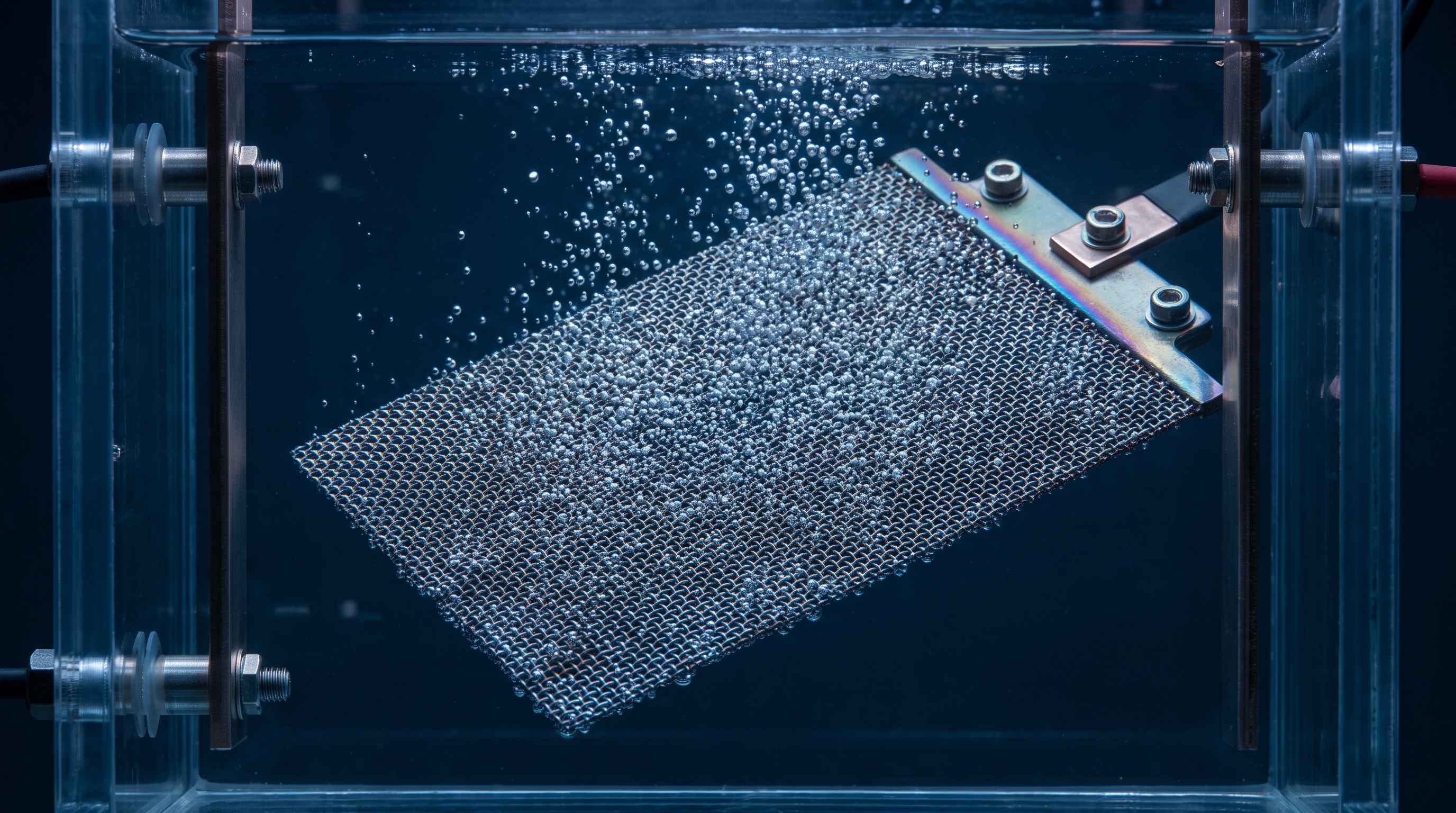
Direction A
Oxygen-Evolution Direction
Iridium-tantalum based or other oxygen-evolution coatings may be considered for selected sulfate, acidic, electrowinning or plating systems after review, helping you hold a stable anode surface where oxygen is the intended reaction.
Typical signals
Sulfate or acidic bath · oxygen at the anode · copper or nonferrous electrowinning
Direction B
Chlorine-Evolution Direction
Ruthenium-iridium based mixed metal oxide anodes may be considered for selected chloride systems where chlorine evolution is intended and controlled, so your gas handling and anode coating are planned together.
Typical signals
Chloride electrolyte · chlorine is intended · gas extraction already in the cell design
Direction C
Platinum-Coated Direction
A platinized titanium anode or platinum coated titanium electrode may be considered for selected specialty plating or electrolysis baths after review, where a noble, low-contamination surface supports your deposit quality.
Typical signals
Precious-metal or specialty plating · tight contamination limits · existing approved process
The tree identifies the next engineering discussion. It does not select a coating without the complete project data and validation plan.
Answer the four questions in your inquiry and we will reply with the coating directions worth testing in your bath.
Current always takes the shortest, most conductive route. These concept views show how anode area, position, gap, workpiece shape, shielding and connections redirect that route, so you can see why we ask for your drawings before proposing an anode layout that evens out thickness on your parts.
View 1
Flat Workpiece and Planar Anode
We review active-area overlap, edge effects, anode count, spacing, workpiece position, rack layout, electrolyte movement and connection balance.
Sizing the anode to the workpiece face helps you limit edge build-up and keep thickness within your tolerance band.
View 2
Recessed or Internal Surface with an Auxiliary Anode
We review the recessed zone, opening, depth, auxiliary-anode shape, position, shielding, insulation, local spacing and a safe connection route.
A correctly placed auxiliary anode helps you plate inside bores and pockets that the main anode leaves thin or bare.
View 3
Uneven Spacing or Connection Imbalance
We review workpiece geometry, anode flatness, position, conductor bars, busbar contacts, current-feeding points and cell-level electrical measurements.
Controlling flatness and feed points helps you avoid burnt zones, hot contacts and voltage drift between cells.
Titanium anode
Cathode or workpiece
Concept current path
Data We Need Before Designing the Layout
With these ten inputs, our engineers can propose anode area, count and position for your exact parts instead of a generic plate size.
Workpiece drawing
Cathode area
Target plating zones
Tank dimensions
Anode position
Anode-cathode spacing
Shields
Rack or drum movement
Total current
Busbar layout
These diagrams explain design inputs. They are not current-distribution simulation results or deposit-performance guarantees.
Send your workpiece drawing and rack layout to get a geometry review before any titanium is cut.
Build the Anode Assembly Around the Cell and Workpiece
An anode is more than a coated plate. Breaking the assembly into its five layers shows you exactly what we fabricate, weld and check, so every part arrives ready to bolt into your tank and connect to your rectifier without site rework.
12345Assembly layers
1
Titanium Substrate Forms
The right form gives your electrolyte room to flow and your gas a path to escape.
Plate
Mesh
Expanded mesh
Rod
Tube
Curved or fabricated
2
Active Area
Coating only where current is needed keeps cost down and current where your parts are.
Coated zone
Masked boundary
Edge treatment
Gas-release path
Flow access
3
Frames and Supports
Stiff frames hold flatness and spacing, so your current distribution stays repeatable.
Stiffening
Brackets
Frames
Spacers
Shields
Insulation clearance
Mounting holes
4
Tabs and Conductor Bars
Correctly sized feed points help you avoid hot contacts and uneven voltage.
Welded tabs
Feed points
Bar size
Position
Contact area
Reinforcement
5
Busbar and Equipment Interface
Matching your existing busbars and racks means faster installation and simpler replacement.
Busbar connection
Fasteners
Polarity marks
Cable clearance
Rack or tank interface
Replacement access
Three Ways to Give Us the Geometry
Option A
Customer Drawing
Send DWG, DXF, STEP or PDF files. We return a reviewed drawing with coating zones and connection details for your sign-off.
Option B
Existing Anode Sample
Ship a used or spare anode. We measure it and draft a replacement drawing, so you can second-source without the original file.
Option C
Cell and Workpiece Measurements
Share tank, rack and part dimensions with photos. We propose the anode geometry and confirm it with you before production.
Send the cell drawing before finalizing the anode geometry, and avoid costly fit problems at installation.
Prepare One Complete Bath, Cell and Electrode Blueprint
Incomplete data is the main reason anode quotations go back and forth for weeks. Collecting these six data groups on one sheet lets our engineers quote, draw and recommend in a single round, so you reach a sample faster and with fewer assumptions.
Sheet: EEW-Project BlueprintProcess · Mechanical · ElectricalRev. A
01
Target Metal and Cathodic Result
Defines what success looks like, so we design to your acceptance test.
Metal
Workpiece or cathode
Deposit thickness
Uniformity
Purity
Appearance
Adhesion
Recovered-product form
Acceptance method
02
Electrolyte, Additives and Impurities
Drives the coating direction and protects it from contaminants.
Metal-ion level
Acid
Chloride
Sulfate
pH
Temperature
Additives
Brighteners
Organics
Unwanted metals
Solids
Filtration
anode-cathode gap
03
Tank, Workpiece, Anode and Spacing
The center of the blueprint: it decides whether the anode fits and where the current goes.
Tank size
Liquid level
Cathode geometry
Anode form
Active area
Count
Position
Gap
Shields
Frames
Available space
04
Current, Voltage, Duty Cycle and Connections
Sizes conductor bars and coating load for your real electrical duty.
Current density
Total current
Voltage
Polarity
Rectifier
Duty cycle
Tabs
Welding
Conductor bars
Busbars
Contact condition
05
Flow, Agitation, Filtration, Gas and Maintenance
Shapes gas release and cleaning access, so the anode is easy to service.
Circulation
Agitation
Inlet and outlet
Flow rate
Filtration
Gas outlet
Deposits
Cleaning
Handling
Replacement path
06
Quantity, Validation, Delivery and Confidentiality
Lets us plan samples, documents and lead time around your launch date.
Sample quantity
Pilot plan
Repeat demand
Test criteria
Drawing revision
Delivery country
Target date
Documents
Labels
Packaging
NDA
Fill in one blueprint and receive a complete quotation instead of rounds of follow-up questions.
Start with the Observed Result, Then Collect the Right Evidence
Pick what you are seeing on the line. Each result opens the data our engineers check first, so you can gather the right records before the call and get to a corrective proposal for your anode, cell or connection much sooner.
Observed resultUneven Deposit or Poor Coverage
Uneven Deposit or Poor Coverage
Thin zones, bare recesses or heavy edges usually point to geometry and current distribution rather than the coating itself.
Data our engineers check first
Workpiece geometry
Rack position
Anode area
Spacing
Shields
Agitation
Bath conductivity
Current distribution
Auxiliary-anode need
With a rack photo and part drawing, we can propose anode area, position or an auxiliary anode that targets the thin zones directly.
Burning, Roughness or Appearance Change
Local overheating and rough deposits often follow high local current, additive imbalance or contamination.
Data our engineers check first
Current density
Additives
Temperature
Agitation
Metal-ion level
Contamination
Workpiece position
Process control
Anode-cathode gap
Sharing bath analysis and rectifier logs helps us separate anode-related causes from bath-related ones, so you only change what needs changing.
Rising Voltage or Connection Heating
A slow voltage climb or warm contacts can come from spacing, deposits, contact wear or an undersized conductor path.
Data our engineers check first
Spacing
Conductivity
Current load
Tabs and welding
Conductor bars
Busbar contacts
Deposits
Corrosion
Fasteners
Voltage trend data and contact photos let us size tabs and conductor bars for your real current, reducing energy loss and hot spots.
Low Recovery or Throughput Change
Falling output can trace back to feed changes, cathode area, flow, impurities or a shift in the anode reaction.
Data our engineers check first
Feed concentration
Current
Voltage
Cathode area
Flow
Impurities
Gas behavior
Anode reaction
Test method
Comparing your production records against the original design point helps us see whether the anode, the feed or the cell layout has moved.
Gas or Bath-Balance Concern
Unexpected gas, acid build-up or additive loss often means the anodic reaction and the coating direction need a second look.
Data our engineers check first
Electrolyte type
Chloride or sulfate
Anodic reaction
Coating direction
Additives
Ventilation
Acid balance
Metal-ion top-up
Circulation
Matching the coating to the intended reaction can help you reduce unwanted by-products and keep additive consumption predictable.
Coating Damage or Early Anode Failure
Short anode life usually has an operating cause: current, temperature, polarity, impurities, handling or the wrong coating for the bath.
Data our engineers check first
Current density
Temperature
Electrolyte
Polarity events
Impurities
Cleaning method
Deposits
Physical impact
Coating suitability
Send the failed anode or clear photos with operating history; our review shows what to change so the next batch lasts longer in your conditions.
Fit, Position or Replacement Problem
Holes that do not line up, bent frames or the wrong active-area boundary come from drawing revision and handling gaps.
Data our engineers check first
Drawing revision
Dimensions
Flatness
Frames and holes
Supports
Active-area boundary
Tabs and busbars
Labels
Packaging
We lock each part to an approved drawing revision and label it by position, so replacements drop straight into your cell.
The atlas prepares the investigation. It does not assign root cause without operating records, inspection and project-specific analysis.
Seeing one of these results now? Send photos and operating records for a structured anode review.
Map Your Metal Process to the Anode Role and Validation Plan
Find the row closest to your project to see the result we design for, the electrolyte inputs we need, the anode role to confirm and what to validate. Starting from the right row saves you a round of questions and keeps the quotation focused on your actual process.
Application
Target Result
Electrolyte Inputs
Anode Role to Confirm
Validation Focus
Start
Copper Electrowinning or Recovery
Cathode copper or recovered metal product
Copper, acid, chloride or sulfate, impurities, temperature, flow
Insoluble Counter-reaction, coating, area, gas and connection
Cathode result, current, voltage, gas, bath behavior and surface
You should be able to see how your anode is made before you order it. These photos from our Foshan workshop show the coating, fabrication, inspection and packaging steps behind every batch, so you know who is building your parts and how they are checked.
Team and CompanyARY Titanium is the titanium electrode brand of Guangdong Lezhong Intelligent Technology Co., Ltd. in Foshan, combining manufacturing, sourcing, sales and export support in one team.Coating and SurfaceControlled coating and sinteringFabrication and ConnectionWelded tabs and conductor barsDimension and Flatness CheckMeasured against your drawingInspection and PackagingLabelled, separated and fixed
Company Facts
Integrated manufacturing and trading capability with approximately 100 employees, based on company-provided information. One contact handles engineering questions, production follow-up and export documents for you.
Confidentiality by Default
Bath formulations
Additive information
Workpiece drawings
Cell designs
Customer identities
Private part numbers
Sales-Country Experience
United States
India
Germany
Australia
United Kingdom
United Arab Emirates
Saudi Arabia
OEM Delivery Chain
Process Data Review
Your bath, cell and electrical data checked first
Drawing and Specification
A reviewed drawing you sign off
Sample
Built to the approved revision
Controlled Cell Test
Tested in your process
Pilot Batch
Repeatability confirmed
Repeat Supply
Same specification, every order
What Customers Tell Us
They asked for our bath analysis and rack drawing before quoting. The first sample fitted our tank without any modification.
Short, practical answers to the questions plating and electrowinning teams ask us most. Each answer lists the data to prepare, so you can bring the right information to your first technical call and shorten the path to a quotation.
Filter by topic, then open a question to see the answer and the data checklist.
Anode StrategyHow does switching from soluble to insoluble anodes change my bath control?
A soluble anode replaces metal ions as it dissolves; an insoluble titanium anode does not. After the switch, metal-ion replenishment, the anodic reaction, gas products, additive behavior and validation all need a new plan. The benefit is a stable anode geometry and gap, which can make current distribution more predictable once the bath strategy is set.
Reaction and CoatingHow do MMO, platinized and platinum coated titanium electrodes differ?
Mixed metal oxide anodes use iridium- or ruthenium-based oxide coatings matched to oxygen or chlorine evolution. A platinized titanium anode carries a platinum layer often considered for specialty plating where a noble, low-contamination surface matters. The bath and reaction, not the name, decide which one we discuss for you.
Current DistributionHow do workpiece geometry, spacing and auxiliary anodes affect current distribution?
Current concentrates on edges and near surfaces and avoids recesses. Anode area, position, gap, shielding, agitation and rack layout redirect it; an auxiliary anode can reach internal zones the main anode cannot. Reviewing these together helps you approach uniform thickness without over-plating edges.
Reaction and CoatingShould my anode support oxygen evolution or chlorine evolution?
It depends on the electrolyte and the reaction your process intends. Sulfate and many acidic baths usually point to an oxygen-evolution discussion; chloride systems where chlorine is intended point to chlorine-evolution coatings. Gas handling, acidity, current density, temperature and downstream equipment confirm the choice.
ElectrolyteWhich electrolyte, additive and impurity data should I send?
Send metal-ion concentration, acid, chloride, sulfate, pH, temperature, additives, organics, known impurities, solids and filtration details with normal operating ranges. Complete data lets us avoid coatings that are sensitive to your contaminants and quote in one round.
TroubleshootingWhat should I check when voltage rises or an anode fails early?
Start with current, voltage trend, contacts, conductor bars, deposits, gas behavior, cleaning practice, bath history, coating surface and physical handling. This checklist separates connection and operating causes from coating suitability, so the next batch is changed only where it needs to be.



 Direction A