
Calculate Titanium electrode current efficiency by dividing useful electrochemical output by the theoretical output from the charge supplied. Your current log can look steady while production samples disagree. Before changing a coating, check whether flow, dilution or stored inventory entered the calculation. A clear charge-and-product balance lets you compare electrodes without confusing measurement errors with reaction losses.
1. What does Titanium electrode current efficiency measure?

Titanium electrode current efficiency measures the fraction of supplied charge represented by a defined useful electrochemical product. You must name that product and its reporting basis.
Which product are you counting?
Start with the chemical basis. Available chlorine, a particular dissolved species and collected gas are different measurands. Keep the chosen basis unchanged across feed, outlet and theoretical calculations.
- Name the reaction product.
- State mass or molar units.
| Check | Decision |
|---|---|
| Defined product | Supports a charge balance |
| Mixed reporting bases | Invalidates the comparison |
Resolve product identity before calculating a percentage. Key Takeaway: Use one chemical basis throughout your efficiency calculation.
2. How do you calculate Titanium electrode theoretical yield?
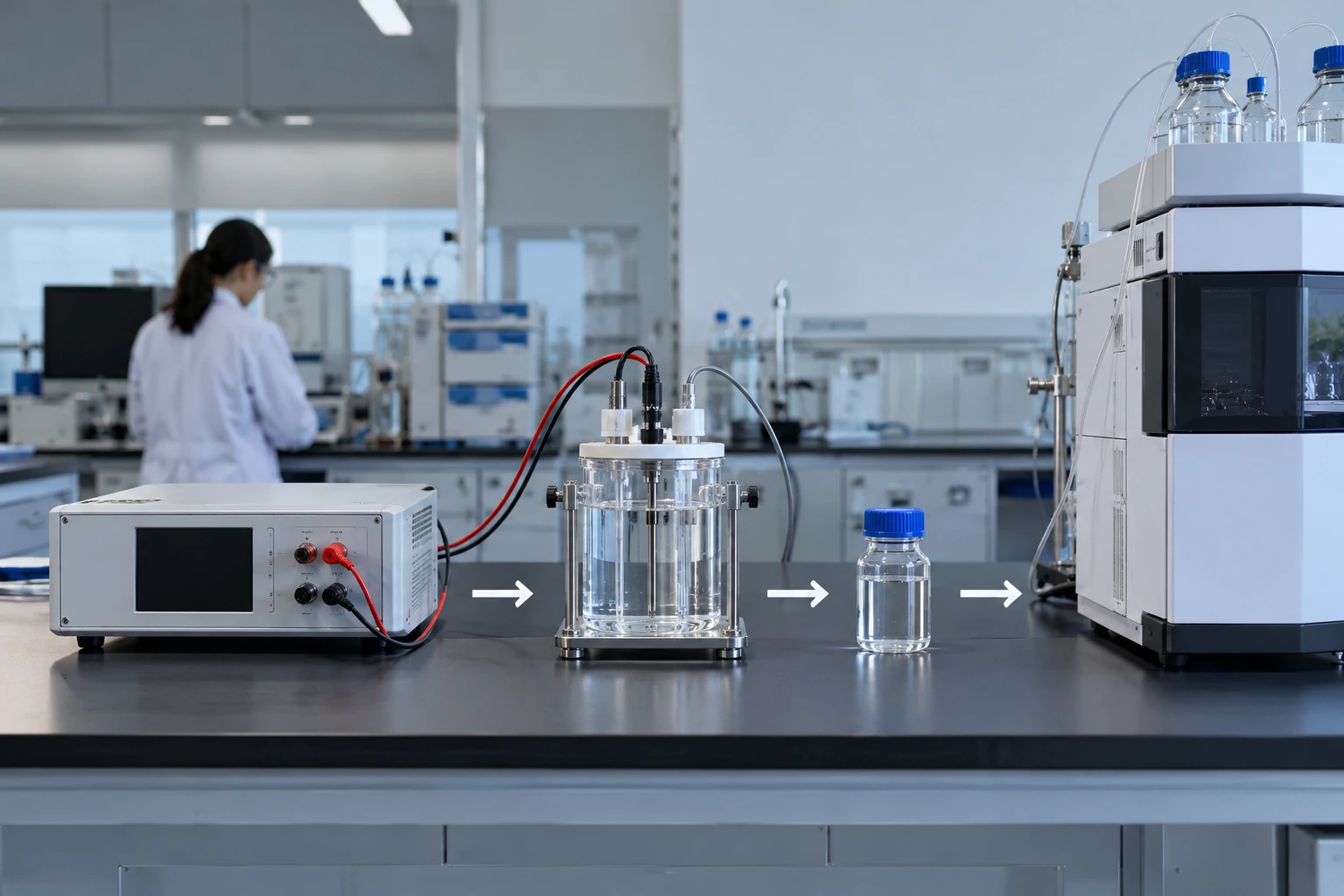
Theoretical Titanium electrode yield follows Faraday's law: product amount in moles equals charge divided by nF. Here n is electrons per product molecule and F is Faraday's constant.
How does charge become theoretical output?
Write the reaction balance. For mass, multiply theoretical moles by the corresponding molar mass. Have the reaction stoichiometry checked before applying a formula to an equivalent-based laboratory result.
- Balance electrons and product.
- Keep charge in coulombs.
| Check | Decision |
|---|---|
| Moles | Q divided by nF |
| Mass | Moles multiplied by molar mass |
Check units before substituting measured values. Key Takeaway: The theoretical denominator depends on the reaction you actually defined.
3. Which charge belongs in a Titanium electrode calculation?

Titanium electrode charge should come from measured current integrated over the same period used for product collection. A setpoint multiplied by planned runtime may miscount outages or compliance events.
What current actually reached the cell?
Use the operating record. Constant current permits Q = I × t when current truly remains constant. Variable duty requires a suitable time integral, with consistent time units and documented missing intervals.
- Include actual powered duration.
- Identify current-measurement boundaries.
| Check | Decision |
|---|---|
| Commanded current | Intended electrical duty |
| Integrated measured current | Delivered-charge evidence |
Align electrical and product timestamps. Key Takeaway: Calculate from actual charge rather than a nominal recipe.
4. How do you measure Titanium electrode useful output?

Useful Titanium electrode output requires a measured product amount over the selected boundary and period. Continuous-flow measurements need consistent concentration and flow data, plus relevant inlet contributions.
Where does the product balance close?
Draw the sampling boundary. Include dilution, recirculation and inventory changes in a custom cell review. A single outlet concentration cannot establish how much new product was generated during a changing batch.
- Account for incoming product.
- Record collected or delivered volume.
| Check | Decision |
|---|---|
| Stable flow-through boundary | Concentration and flow can support mass rate |
| Changing inventory | Requires an inventory balance |
Choose a balance appropriate to the process state. Key Takeaway: Count newly generated output, not unexamined material already in the system.
5. Can a Titanium electrode result exceed theoretical yield?

An apparent Titanium electrode efficiency above theoretical yield usually signals an inconsistent balance, analytical basis or charge record. It should trigger investigation rather than a claim of exceptional coating performance.
Which assumption could inflate the result?
Audit the numerator and denominator. Check background oxidant, dilution factors, sample timing and current calibration. Chemical production outside the defined electrochemical reaction can also invalidate a simplistic interpretation.
- Recheck concentration conversions.
- Compare charge-log completeness.
| Check | Decision |
|---|---|
| Unexpectedly high percentage | Investigate method and boundary |
| Reconciled balance | Supports a defensible result |
Resolve discrepancies before making supplier comparisons. Key Takeaway: An implausible percentage is a diagnostic clue, not a marketing advantage.
6. How do side reactions affect Titanium electrode efficiency?

Side reactions reduce Titanium electrode useful current efficiency when part of the charge produces something other than the selected product. Net output can also fall through subsequent consumption of generated product.
Was product never formed, or later lost?
Separate reaction and recovery losses. Define whether your measurement captures generation near the electrode or recovered output downstream. Those boundaries answer related but different engineering questions.
- Identify plausible competing reactions.
- Track downstream product losses separately.
| Check | Decision |
|---|---|
| Reaction selectivity | Allocation of electrochemical charge |
| Recovered output | Also reflects subsequent process history |
Keep the interpretation tied to the sampling boundary. Key Takeaway: A low recovered yield does not identify the loss mechanism alone.
7. Does Titanium electrode efficiency equal energy efficiency?

Titanium electrode current efficiency does not equal energy efficiency because electrical energy also depends on voltage and system losses. Two cells can use similar charge but require different energy per unit of product.
What does the current percentage omit?
Add the energy boundary. Compare measured energy and useful output when judging operating consumption. Do not rank complete systems from a current-efficiency percentage that ignores rectifier and auxiliary loads.
- Report cell voltage with current.
- Define included auxiliary equipment.
| Check | Decision |
|---|---|
| Current efficiency | Useful output relative to charge |
| Specific energy | Energy per defined useful output |
Use both metrics for a broader comparison. Key Takeaway: Charge utilization and energy consumption are separate purchasing questions.
8. What makes Titanium electrode trials comparable?

Comparable Titanium electrode trials need matched chemistry, temperature, geometry, product methods and electrical boundaries. A coating comparison becomes ambiguous if feed preparation changes between samples.
Which variables stay fixed?
Freeze the comparison basis. In water-treatment duty, keep sampling and dilution methods consistent alongside the operating duty. Record unavoidable deviations so a buyer can see which claims the trial supports.
- Use traceable electrode samples.
- Retain raw electrical and analytical records.
| Check | Decision |
|---|---|
| Matched conditions | Supports a focused comparison |
| Uncontrolled differences | Limits attribution to the electrode |
Interpret the result within the tested conditions. Key Takeaway: A narrower controlled comparison is more useful than an unexplained percentage.
9. How should Titanium electrode uncertainty be reported?

Titanium electrode efficiency uncertainty should reflect relevant current, time, flow and analytical uncertainties. Reporting more decimal places does not compensate for weak sampling or an incomplete mass balance.
Is the difference larger than the measurement uncertainty?
Review repeatability before ranking. Ask the laboratory or test engineer to assess uncertainty using the actual measurement method. Include replicate results and any unresolved systematic errors.
- State method and calibration status.
- Keep qualifiers with reported values.
| Check | Decision |
|---|---|
| Small difference | May be unresolved by the method |
| Supported uncertainty estimate | Helps judge practical significance |
Compare differences against measurement capability. Key Takeaway: Avoid supplier rankings that the test cannot reliably distinguish.
10. What Titanium electrode efficiency evidence should you request?

A useful Titanium electrode efficiency report includes reaction basis, raw charge records, product balance, conditions and uncertainty. These details distinguish genuine process evidence from an isolated percentage.
Request a reproducible calculation
Send the complete balance. When you contact us today, we can review electrode duty and drawing requirements against your test objective. We favor measurable operating evidence over unsupported efficiency claims.
- Attach sampling and calculation methods.
- Identify conditions outside the test scope.
| Check | Decision |
|---|---|
| Percentage alone | Cannot be reproduced |
| Complete calculation package | Supports technical review |
Agree on a shared acceptance basis. Key Takeaway: Ask for the records behind a current-efficiency claim before selecting an electrode.
Frequently Asked Questions
Can I calculate efficiency from current alone? No. You also need measured useful output on a defined chemical and sampling basis.
What's the best efficiency target? Use an application-specific requirement. Coating, chemistry and the selected product determine a meaningful target.
How do I know if a result above 100% is credible? Recheck the balance. Background product, unit conversions or missing charge can inflate apparent efficiency.
Can I compare different product reporting units? Only after a valid conversion. Chemical equivalents and actual species masses must not be mixed casually.
Can I use current efficiency as an energy guarantee? No. Energy also depends on voltage, conversion losses and included auxiliary equipment.