
Choose a Titanium electrode base grade from forming requirements, mechanical loads, chemistry and verified material properties. Grade 1 generally favors ductility while Grade 2 provides higher strength. Your sample may fit perfectly yet distort during assembly if the substrate specification ignores clamping and fabrication. Review the grade, product form and finished geometry together before approving repeat supply.
1. How Do You Choose a Titanium electrode Base Grade?

Choose a Titanium electrode base grade by checking fabrication demands and service loads against documented material properties. A grade number does not identify coating performance.
Which requirement should drive selection?
Start with the part's mechanical job. A deeply formed blank and a loaded support frame can need different material behavior. Put those requirements on the drawing.
- Describe bends, forming and support loads.
- Identify the material condition and product form.
| Check | Decision |
|---|---|
| Forming demand | Check ductility and fabrication route |
| Service loading | Check strength and geometry |
A suitable grade still needs a suitable section thickness. Key Takeaway: Select substrate and geometry together.
2. How Do Titanium electrode Base Grades Differ?
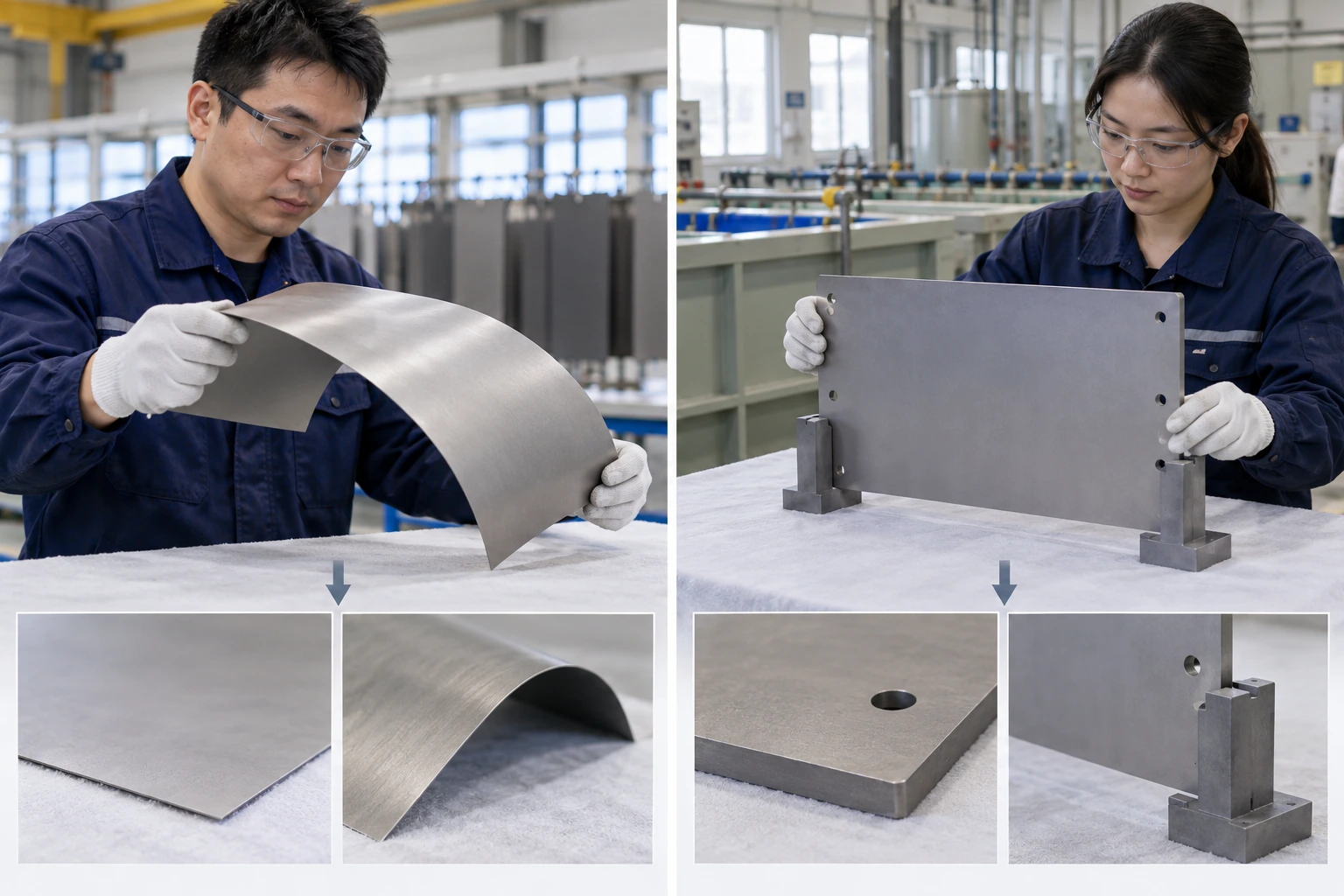
Grade 1 and Grade 2 Titanium electrode substrates have different chemical and mechanical specifications. Grade 1 generally offers greater ductility; Grade 2 generally offers higher strength.
What should you avoid assuming?
Check the actual material certificate. Product form, condition and specification determine acceptance values. Higher strength does not automatically produce a better electrochemical surface.
- Compare the same product form.
- Keep coating requirements separate from base-metal requirements.
| Check | Decision |
|---|---|
| Grade 1 | Often useful for demanding forming |
| Grade 2 | Often useful where higher strength matters |
The comparison supports a fabrication decision rather than a coating ranking. Key Takeaway: Use certified properties for the selected product.
3. Does Titanium electrode Grade Determine Cell Performance?

A Titanium electrode substrate grade alone does not determine cell voltage, selectivity or durability. The active surface, electrolyte and cell design also control performance.
How should you compare finished electrodes?
Test the finished component under matched duty. Changing grade may also change fabrication and geometry. Keep those differences visible when interpreting a trial.
- Record active area and coating designation.
- Match chemistry, current and temperature.
| Check | Decision |
|---|---|
| Material test | Checks base-metal conformity |
| Cell test | Checks application behavior |
A passing material certificate cannot replace an application trial. Key Takeaway: Approve both material and finished-part performance.
4. How Does Forming Affect Titanium electrode Grade Choice?

Forming can affect Titanium electrode grade selection through bend severity, thinning, springback and the chosen fabrication route. Review the finished dimensions after processing.
Which details should the fabricator receive?
Show the formed shape and its datums. A custom engineering review can identify tooling and inspection needs before coating. Do not assume a flat-sheet tolerance survives every forming step.
- Mark bend locations and mating interfaces.
- Specify the dimensions checked after forming.
| Check | Decision |
|---|---|
| Flat blank | Defines starting material |
| Finished shape | Defines installation acceptance |
Forming history can explain dimensional differences between apparently identical grades. Key Takeaway: Qualify the actual fabrication route.
5. How Does Coating Affect a Titanium electrode Substrate?

A Titanium electrode coating requires a suitable prepared substrate, but coating family and base grade remain distinct specifications. Surface condition and preparation consistency also matter.
What should the coating review include?
Define the surface before it enters coating. Oil, fabrication residue and uncontrolled surface changes can affect preparation. Keep the approved substrate condition tied to the coating process.
- Identify active and masked areas.
- Record preparation and handling requirements.
| Check | Decision |
|---|---|
| Substrate condition | Supports repeatable preparation |
| Coating designation | Defines the working surface |
Specifying grade alone leaves the coating interface incompletely defined. Key Takeaway: Agree preparation requirements with the active-surface specification.
6. Which Titanium electrode Dimensions Need Rechecking?

Recheck Titanium electrode dimensions that control flatness, mounting, gap and electrical contact after fabrication. Mechanical properties cannot compensate for an out-of-position tab.
Which measurements matter most?
Measure against the mating assembly. A fixture can reveal fit problems that isolated dimensions miss. Define datums and measurement locations before ordering samples.
- Check hole patterns and tab positions.
- Inspect flatness and frame alignment.
| Check | Decision |
|---|---|
| Drawing inspection | Checks individual dimensions |
| Mating fixture | Checks assembled fit |
A small local deviation can affect spacing across a cell. Key Takeaway: Include finished-part geometry in grade approval.
7. Can Titanium electrode Grades Share a Platinum Coating?

Both base grades may be used in a platinum-coated Titanium electrode when the manufacturing process and application are qualified. The substrate choice does not establish platinum loading or chemical compatibility.
What belongs in the combined specification?
Keep the two material descriptions explicit. State the titanium grade and active coating separately. Ask how coating measurements apply to the selected shape.
- Identify substrate grade and condition.
- Define coating basis and active boundaries.
| Check | Decision |
|---|---|
| Titanium specification | Controls the structural base |
| Platinum specification | Controls the active surface |
A coating description without its substrate leaves part identity incomplete. Key Takeaway: Approve the combined finished-electrode specification.
8. How Does Chemistry Affect Titanium electrode Grade Review?

Chemistry can limit Titanium electrode suitability even when mechanical properties are satisfactory. Temperature, impurities and local conditions need review alongside the full electrolyte composition.
What should you send for compatibility review?
Describe the liquid the part will actually contact. For water-treatment applications, include cleaning exposure and seasonal changes. A generic corrosion statement cannot establish suitability for every operating condition.
- List relevant chemicals and concentration ranges.
- Include normal and abnormal temperatures.
| Check | Decision |
|---|---|
| Bulk chemistry | Defines normal exposure |
| Cleaning and upset conditions | Reveal additional compatibility questions |
Mechanical grade selection does not close the chemical review. Key Takeaway: Confirm the full exposure window.
9. What Titanium electrode Material Records Should You Request?

Request Titanium electrode material records that connect grade, product form, condition and batch identity with the delivered parts. The required evidence should match your purchasing specification.
How do you keep records useful?
Trace the certificate to the part. A certificate for unrelated stock proves little about a finished electrode. Agree the identification method before production.
- Match batch references with receiving records.
- Retain approved substitutions and deviations.
| Check | Decision |
|---|---|
| Certificate | Describes the supplied material |
| Traceability | Connects that material with the electrode |
Documentation supports acceptance only when the delivered batch can be identified. Key Takeaway: Keep material identity through fabrication and inspection.
10. How Do You Specify a Titanium electrode Grade Trial?

Specify a Titanium electrode grade trial with mechanical fit, forming results, coating requirements and relevant operating checks. Select acceptance criteria before comparing samples.
How can we support the review?
Send the drawing and the duty together. We can review substrate and fabrication options; contact us today with the required geometry. Our position is that material choice should follow a documented component requirement.
- Define which grade-related uncertainty needs testing.
- Retain drawing, certificate and trial results.
| Check | Decision |
|---|---|
| Mechanical trial | Checks fabrication and fit |
| Application trial | Checks the finished component |
This package prevents a grade label from replacing an engineering decision. Key Takeaway: Approve the complete part rather than the grade alone.
Frequently Asked Questions
Can I replace Grade 1 with Grade 2 without review? Not automatically. Forming, strength, dimensions and the qualified manufacturing route may change.
What's the best titanium grade for a coated anode? It depends on the part. Compare fabrication, mechanical and chemical requirements with the coating specification.
How do I know if the supplied grade is correct? Check traceable material records against the purchase specification. Appearance cannot establish grade.
Can I infer coating life from titanium grade? No. Coating, chemistry, current distribution and maintenance require separate evidence.
Can I approve a grade using a flat coupon? Only for the properties that coupon represents. A fabricated assembly also needs dimensional and functional checks.