
Set Titanium electrode spacing by balancing electrical resistance, flow, deposits, alignment and mechanical tolerances. A narrower gap may reduce solution resistance but leave too little clearance for distortion or solids. Your prototype can run well with clean liquid and still struggle after installation. Validate the installed gap under representative duty before freezing the cassette drawing.
1. What Determines Titanium electrode Spacing?

Titanium electrode spacing depends on electrolyte conductivity, current, flow, gas release and the assembly's dimensional limits. A universal gap cannot cover every cell.
Which dimensions should your drawing distinguish?
Define the installed working gap. Nominal spacer thickness may differ from local face-to-face clearance after clamping. Identify the smallest permitted clearance and its measurement method.
- Show active surfaces and counter-electrode positions.
- Include flatness and assembly tolerances.
| Check | Decision |
|---|---|
| Nominal gap | States the intended spacing |
| Local clearance | Checks the assembled geometry |
A nominal dimension can conceal a tighter local region. Key Takeaway: Specify how the installed gap will be verified.
2. How Does Titanium electrode Gap Affect Resistance?
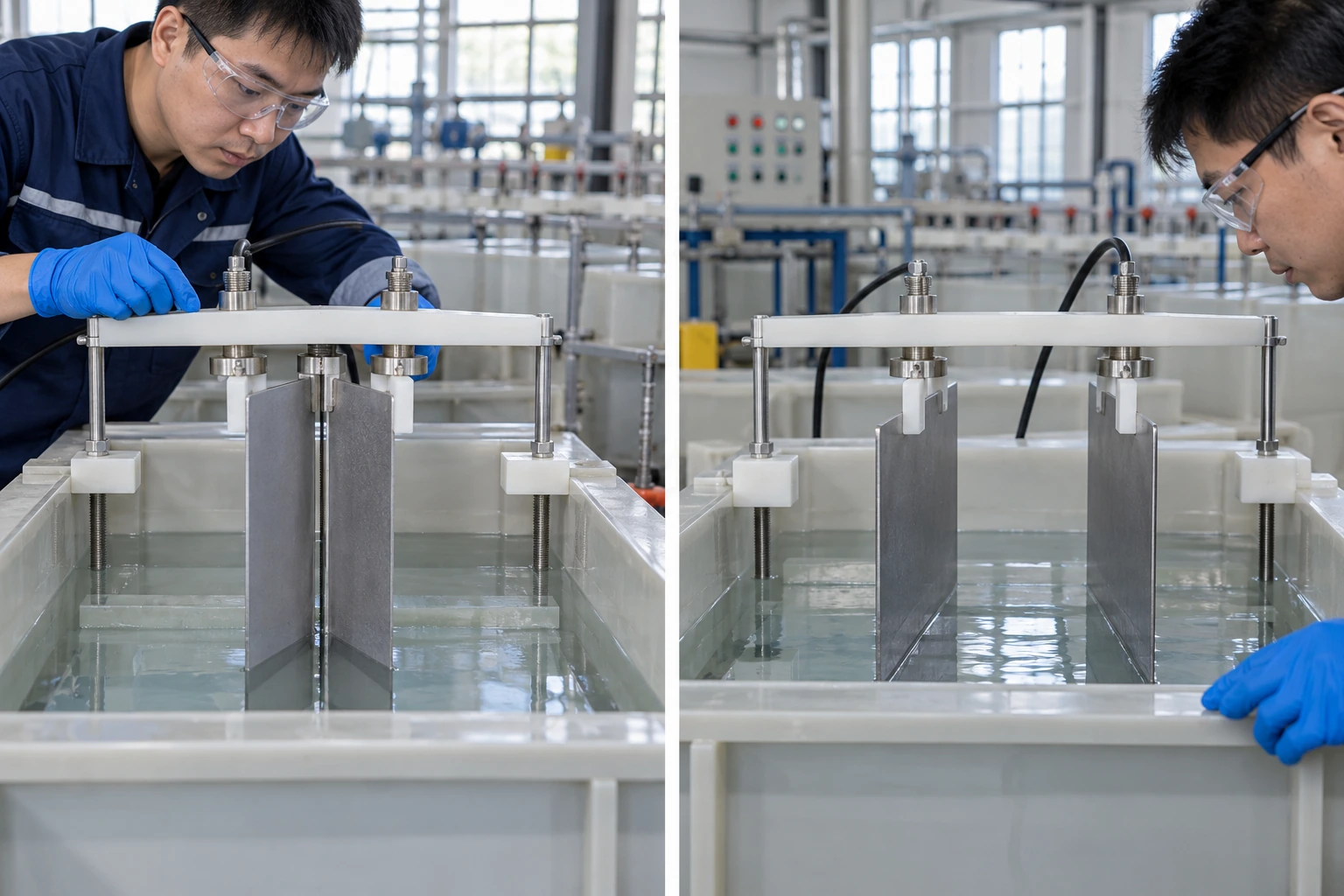
A Titanium electrode gap affects the electrolyte's resistive path, so reducing distance can reduce solution resistance under comparable conditions. Other voltage contributions remain present.
What should a comparison hold constant?
Compare matched operating points. Keep chemistry, temperature and current consistent. Changing gap can also change transport, so measure output and flow behavior.
- Record conductivity and operating temperature.
- Measure current and useful output.
| Check | Decision |
|---|---|
| Solution path | Changes with spacing |
| Total cell voltage | Includes additional contributions |
A voltage change does not isolate every effect of spacing. Key Takeaway: Evaluate the complete cell response.
3. Can a Titanium electrode Gap Be Too Narrow?

A Titanium electrode gap can be too narrow when particles, deposits, movement or dimensional variation compromise clearance. Contact or blocked passages can outweigh an electrical benefit.
Which failure modes should you review?
Check the worst local condition. Look at plate edges, mounting points and unsupported spans. A clean dry fit cannot establish clearance throughout service.
- Consider expected deposit growth.
- Review vibration and thermal movement.
| Check | Decision |
|---|---|
| Narrow clean gap | May reduce solution resistance |
| Restricted service gap | Can create mechanical or flow problems |
The minimum usable gap depends on conditions beyond clean assembly. Key Takeaway: Include service variation in the tolerance review.
4. How Do Deposits Change Titanium electrode Clearance?

Deposits reduce free space around a Titanium electrode and can alter both flow and current distribution. Design clearance with a realistic maintenance condition in mind.
How should maintenance influence the drawing?
Review the cassette after simulated service. A custom engineering review should consider removal and cleaning access. Do not assume deposits remain evenly distributed.
- Identify likely deposit locations.
- Check tool and withdrawal clearance.
| Check | Decision |
|---|---|
| Clean geometry | Establishes the starting condition |
| Fouled geometry | Tests maintenance and flow margin |
Uneven fouling can create a tighter local region than average buildup suggests. Key Takeaway: Qualify clearance across the maintenance interval.
5. Does Titanium electrode Coating Change Gap Selection?

Titanium electrode coating choice affects permitted duty but does not independently determine an acceptable gap. Reaction behavior and geometry must be reviewed together.
What should coating and cell suppliers agree?
Use one operating basis for both reviews. State area convention, current, chemistry and spacing. A coating qualified elsewhere may face different loading in a new cassette.
- Share the installed geometry.
- Record the intended reaction and current profile.
| Check | Decision |
|---|---|
| Coating review | Checks surface suitability |
| Gap review | Checks electrical and hydraulic integration |
Neither specification can replace the other. Key Takeaway: Approve coating and spacing against the same duty.
6. How Do You Measure an Installed Titanium electrode Gap?

Measure an installed Titanium electrode gap at defined locations using an approved method that protects active surfaces. A single reading may miss bowing or misalignment.
Where should inspection points be placed?
Sample the geometry where it can vary. Include edges, midspan and mounting zones where appropriate. Record the assembly condition during measurement.
- Use suitable non-damaging gauges.
- Measure after specified clamping.
| Check | Decision |
|---|---|
| Multiple locations | Reveal local variation |
| Defined assembly state | Makes measurements repeatable |
Gap measurements change meaning if clamp condition or support differs. Key Takeaway: Keep an inspection map with the drawing.
7. How Do Titanium electrode Edges Affect Local Loading?

Titanium electrode edges and projections can affect local current distribution even when the average gap appears satisfactory. This applies to platinum-coated and other active surfaces.
Which features deserve a closer look?
Inspect the nearest opposing features. A projecting tab or bent edge may approach its counter-electrode. Keep active boundaries and connection zones clear on the drawing.
- Check edge alignment and protrusions.
- Identify exposed tabs and masked borders.
| Check | Decision |
|---|---|
| Average spacing | Describes the broad arrangement |
| Closest feature | Can govern a local concern |
A satisfactory average cannot clear a protruding feature. Key Takeaway: Review edge geometry before increasing current.
8. How Does Flow Affect Titanium electrode Spacing?

Flow and Titanium electrode spacing interact through pressure loss, liquid distribution and bubble transport. The same spacer change can affect several operating variables.
What should a hydraulic trial show?
Follow the liquid through every channel. For water-treatment applications, compare clean and representative service conditions. Total inlet flow does not prove equal channel flow.
- Record flow and pressure behavior.
- Inspect stagnant or bypass regions.
| Check | Decision |
|---|---|
| Total flow | Describes supply to the assembly |
| Channel distribution | Shows local delivery |
Unequal flow can undermine an otherwise consistent gap. Key Takeaway: Include hydraulic distribution in spacing approval.
9. What Tests Confirm Titanium electrode Gap Stability?

A Titanium electrode gap-stability test should check dimensional behavior under relevant assembly, thermal and operating loads. Acceptance needs a defined tolerance and method.
How should you compare before and after?
Use the same fixture and locations. Document clamping and temperature conditions. Investigate permanent movement separately from reversible thermal change.
- Retain baseline measurements.
- Check supports and fastening points.
| Check | Decision |
|---|---|
| Repeatable measurement | Supports meaningful comparison |
| Permanent shift | Requires engineering disposition |
A test is interpretable only when measurement conditions match. Key Takeaway: Validate the installed geometry through expected loading.
10. What Titanium electrode Spacing Data Belong in an RFQ?

Send Titanium electrode dimensions, tolerances, flow path, deposit history and electrical duty when requesting a spacing review. Include the mating parts and supports.
How can we help specify the cassette?
Send a cross-section, not only a plate outline. We can review electrode geometry and interfaces; contact us today with the assembly data. Our position is that a usable gap must survive real installation conditions.
- Show nominal and limiting clearances.
- Define inspection and pilot acceptance.
| Check | Decision |
|---|---|
| Assembly drawing | Explains the intended gap |
| Operating data | Explain the conditions it must tolerate |
This review connects a drawing dimension with service behavior. Key Takeaway: Freeze spacing only after fit and operating checks.
Frequently Asked Questions
Can I use the smallest gap my workshop can make? Not necessarily. Deposits, flow, alignment and thermal movement can require more clearance.
What's the best electrode gap for low voltage? There is no universal value. Compare electrical and hydraulic behavior at matched duty.
How do I know if a gap is uniform? Measure defined locations after assembly. Include edges, midspan and mounting regions.
Can I copy the spacing from another cell? Only with a compatibility review. Chemistry, current, geometry and maintenance can differ.
Can I approve spacing before a wet trial? You can approve mechanical fit provisionally. Operating behavior still needs representative validation.