
Keep Titanium electrode orders consistent by freezing the approved drawing, coating basis, operating assumptions, inspection plan, and change process. Your prototype passes, but a later delivery needs rework because its tabs or coated borders differ. A sample without controlled records leaves room for interpretation. Build a repeat-order package that purchasing, production, and quality teams can all use.
1. What Should an Approved Titanium electrode Sample Define?
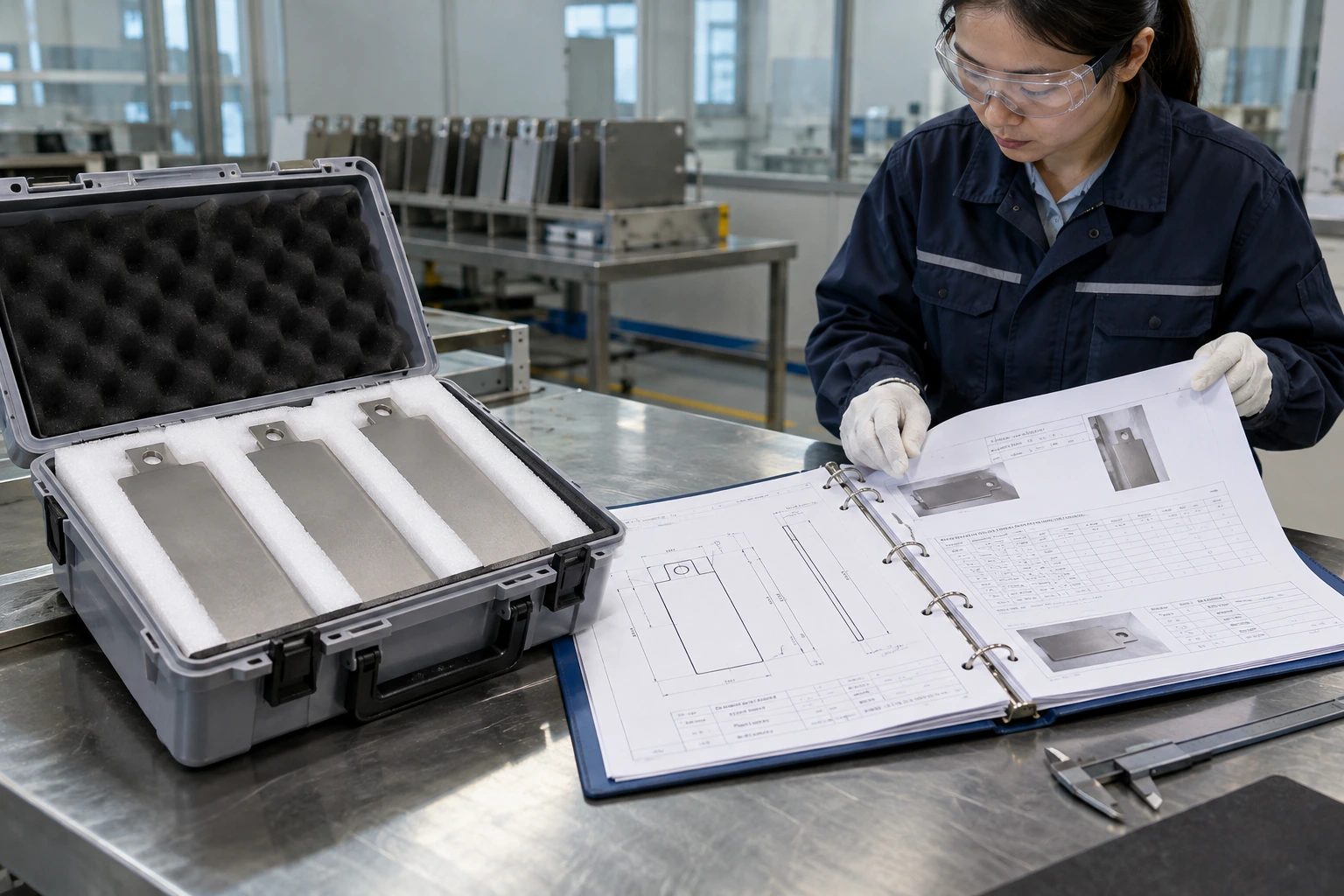
An approved Titanium electrode sample should define a documented part revision and its acceptance evidence. Physical resemblance alone does not establish that a later batch matches the approved design.
Which records belong beside the sample?
Freeze the conditions that made the sample pass. Retain drawings, coating description, operating duty, and test results together. Identify any prototype deviations before treating them as production requirements.
- Assign a part number and revision.
- Record measured fit and functional results.
- Resolve temporary prototype features.
| Check | Decision |
|---|---|
| Physical sample | Provides a reference object |
| Controlled specification | Defines repeatable requirements |
A reference part cannot explain an undocumented manufacturing assumption. Key Takeaway: Approve the sample and its records as one package.
2. Which Titanium electrode Drawing Details Need Control?

Control Titanium electrode drawing details that affect fit, current distribution, active area, and handling. Outside dimensions alone leave holes, tabs, welds, and coating boundaries open to interpretation.
What should a drawing review resolve?
Mark every interface the assembler depends on. Datums and tolerances should reflect actual mating parts. Include uncoated contact zones and orientation where a reversed assembly could cause problems.
- Identify critical dimensions and their measurement method.
- Show coating and masking boundaries.
- Define tab, hole, weld, and mounting positions.
| Check | Decision |
|---|---|
| Part geometry | Controls installation |
| Active boundary | Controls the working surface |
A minor border change can alter both fit and current-density calculations. Key Takeaway: Release a complete drawing before a repeat order.
3. How Do You Track Titanium electrode Revisions?

Track Titanium electrode revisions with a controlled identifier that appears on orders, drawings, inspection records, and packaging. A filename such as final-new does not provide reliable change history.
Who should approve a revision?
Make the change visible to every handoff. Engineering should define the technical change, quality should adjust acceptance checks, and purchasing should specify the effective revision. Retire conflicting instructions from active use.
- Record what changed and why.
- State the affected orders or effective batch.
- Confirm supplier acknowledgment before production.
| Check | Decision |
|---|---|
| Revision history | Explains the design change |
| Order reference | Identifies the version to manufacture |
Version ambiguity can produce a conforming part for the wrong drawing. Key Takeaway: Use one traceable revision across the entire order package.
4. How Do You Freeze a Titanium electrode Coating Specification?

Freeze a Titanium electrode coating specification through agreed identity, duty, active boundaries, measurement definitions, and acceptance evidence. A generic coating-family name may leave meaningful differences unresolved.
Which details can be agreed without disclosing a recipe?
Specify the required result and evidence. For platinized electrode specifications, define relevant loading or thickness conventions and operating assumptions. Proprietary formulation details need not become public to establish a controlled supply specification.
- Identify the approved coating designation.
- State substrate, preparation, and masking requirements where agreed.
- Define notification for meaningful process changes.
| Check | Decision |
|---|---|
| Coating designation | Identifies the agreed product |
| Acceptance evidence | Checks conformity and application fit |
A protected formulation can coexist with a clear purchasing specification. Key Takeaway: Agree on traceable coating identity and measurable acceptance.
5. What Titanium electrode Batch Records Should Follow Delivery?

Titanium electrode batch records should connect delivered parts with revision, production lot, inspections, and agreed material evidence. Request records that support your actual acceptance and field-tracing needs.
How much documentation is useful?
Choose records you will use. A long certificate pack can still omit a critical dimension or lot identifier. Agree required fields and retain them in a searchable order history.
- Record quantity, part number, and revision.
- Link inspection results to the delivered lot.
- Identify approved deviations and release authority.
| Check | Decision |
|---|---|
| Lot identification | Supports traceability |
| Inspection record | Supports receipt and release |
Documentation has value when it helps accept a part or investigate a problem. Key Takeaway: Request a concise, part-specific delivery record.
6. How Should You Handle a Titanium electrode Process Change?

Handle a Titanium electrode process change through agreed notification, technical review, and requalification where risk justifies it. A change may affect the part even when nominal dimensions remain unchanged.
Which changes deserve attention?
Ask what could alter fit or function. Changes in substrate source, coating process, tooling, weld procedure, or inspection method may require review. Define the decision process before a supplier needs it.
- Classify changes by potential consequence.
- Agree evidence required for approval.
- Track affected inventory and orders.
| Check | Decision |
|---|---|
| Low-impact documented change | May need limited review |
| Fit or function change | May require new validation |
The same part number should not conceal an unreviewed technical change. Key Takeaway: Use a written change process tied to application risk.
7. How Do You Protect Titanium electrode Surfaces in Transit?

Protect Titanium electrode surfaces with packaging that prevents rubbing, bending, contamination, and unsupported loads during transit. The correct method depends on geometry and coating sensitivity.
What should a packaging trial demonstrate?
Inspect how the part moves inside the package. Separators should protect active faces without introducing contamination. Support frames and tabs so shock loads do not distort critical geometry.
- Prevent active surfaces from contacting each other.
- Use suitable clean separation materials.
- Identify unpacking and lifting instructions.
| Check | Decision |
|---|---|
| Surface separation | Reduces rubbing damage |
| Structural support | Limits bending and movement |
A passed factory inspection does not prevent damage after packing. Key Takeaway: Approve packaging as part of the production design.
8. How Do You Compare Titanium electrode Repeat Quotations?

Compare Titanium electrode repeat quotations against the same revision, coating basis, inspection, packaging, and delivery scope. A lower price can reflect a changed requirement rather than a purchasing gain.
What should the quote repeat explicitly?
Check the technical scope before the price difference. Your quotation requirements should carry the controlled revision and required evidence. Clarify deviations before issuing the purchase order.
- Compare quantities and technical scope.
- Identify changes in testing or packaging.
- Record commercial assumptions separately from specifications.
| Check | Decision |
|---|---|
| Matched scope | Allows meaningful price comparison |
| Unstated deviation | Requires clarification |
A price comparison becomes useful after requirements are aligned. Key Takeaway: Use a scope checklist for repeat and alternate-source quotations.
9. How Do Field Results Improve Titanium electrode Supply?

Field results improve Titanium electrode supply when service observations can be traced to part revision, batch, and operating duty. Without that link, a complaint may not reveal a repeatable cause.
Which feedback should reach the supplier?
Send evidence that can be matched to production. Include installation position, chemistry, current, maintenance, and photographs. Separate isolated handling damage from a pattern across comparable units.
- Retain batch identity through installation.
- Record operating and maintenance conditions.
- Track corrective actions and subsequent results.
| Check | Decision |
|---|---|
| Traceable field observation | Supports investigation |
| Confirmed recurring pattern | Supports process or design correction |
Field evidence is more useful when comparable installations can be grouped. Key Takeaway: Close the loop between delivered batch and operating behavior.
10. What Makes a Titanium electrode Repeat Order Ready?

A Titanium electrode repeat order is ready when revision, coating, acceptance, packaging, quantity, and delivery scope are explicit. Unresolved technical changes should have a named disposition.
How can we help prepare the package?
Send the approved sample record with the order drawing. We can review custom electrode requirements and the checks needed for repeat supply; contact us today with your controlled package. Our position is to make repeat orders traceable to what your equipment actually approved.
- Attach the released drawing and coating designation.
- State required inspection and packaging records.
- Identify changes since the previous delivery.
| Check | Decision |
|---|---|
| Technical baseline | Defines what should repeat |
| Order scope | Defines what should be delivered |
This package reduces ambiguity between a successful prototype and later production. Key Takeaway: Approve the records that let a good sample become a repeatable order.
Frequently Asked Questions
Can I place a repeat order using only an old invoice? Only if it unambiguously identifies the current specification. A controlled drawing and revision provide a stronger technical reference.
What's the best way to preserve an approved sample? Store it with identification and protected surfaces. Keep its drawing, operating assumptions, and approval records accessible.
How do I know if a process change needs new testing? Review its effect on fit, function, and risk. Agree the requalification decision with your engineering and quality teams.
Can I accept different coating color in a repeat batch? Possibly, under agreed criteria. Color alone cannot establish conformity or failure.
Can I qualify another supplier with the same sample? Yes, with a controlled specification and independent validation. A sample by itself may not communicate every requirement.