
An electroplating anode cathode system should be selected around bath chemistry, target deposit or recovery reaction, contamination limits, current distribution, geometry, and maintenance. Electrode names alone do not define process behavior.
The wrong anode can shift bath chemistry, increase voltage, create uneven current, or introduce unwanted material. A good comparison starts with process duty, then checks surface family, cell layout, inspection, and pilot evidence.
1. What Job Does Each Electrode Perform?
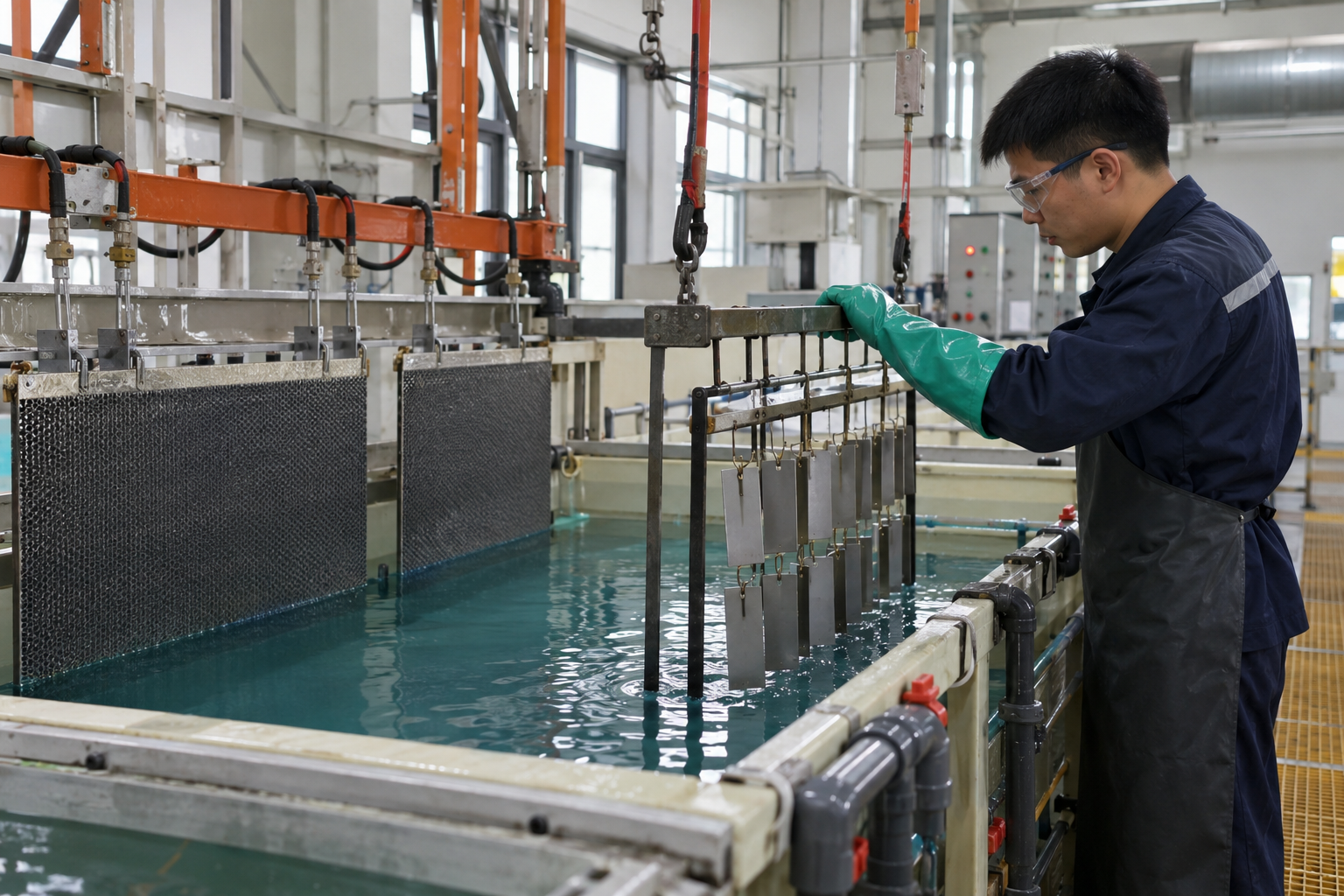
An electroplating anode cathode pair performs linked oxidation and reduction duties while current passes through the bath. Material selection must support both half-reactions and product-quality needs.
What should be defined at the anode?
State whether the anode is soluble or dimensionally stable and which reaction is intended. Begin with material balance. Include:
- Anodic reaction and expected gas or dissolved species
- Bath additions or metal replenishment method
- Contamination and byproduct limits
What should be defined at the cathode?
Describe the workpiece or recovery surface, required deposit, geometry, and current distribution target. Anode layout should support that cathodic result.
| Electrode | Primary duty | Buyer question |
|---|---|---|
| Anode | Oxidation and bath support | Soluble or insoluble? |
| Cathode | Deposition or recovery | What quality is required? |
| Pair | Complete current path | How is distribution controlled? |
Key Takeaway: Select anode and cathode as one process pair tied to bath chemistry and product quality.
2. Which Bath Data Control Anode Choice?

An electroplating anode cathode decision depends on metal ions, acid or alkali, additives, pH, temperature, conductivity, impurities, and process variation. A bath family name is not enough.
Which chemistry belongs in the RFQ?
Share a controlled formulation and realistic ranges. Additives can change the whole answer. Include:
- Main salts, acids, bases, and metal concentration
- Brighteners, carriers, wetting agents, and replenishment
- Chloride, fluoride, organics, metals, and other impurities
How should bath drift be represented?
Provide startup, normal, and service-limit values. Explain filtration, analysis, additions, and bleed strategy.
| Bath field | Normal input | Boundary input |
|---|---|---|
| Metal ion | Working range | Low and high limits |
| Additive | Control target | Replenishment cycle |
| Impurity | Current level | Maximum accepted level |
Key Takeaway: Use actual bath formulation and control ranges to evaluate anode compatibility and reaction duty.
3. When Does an Insoluble Titanium Anode Fit?
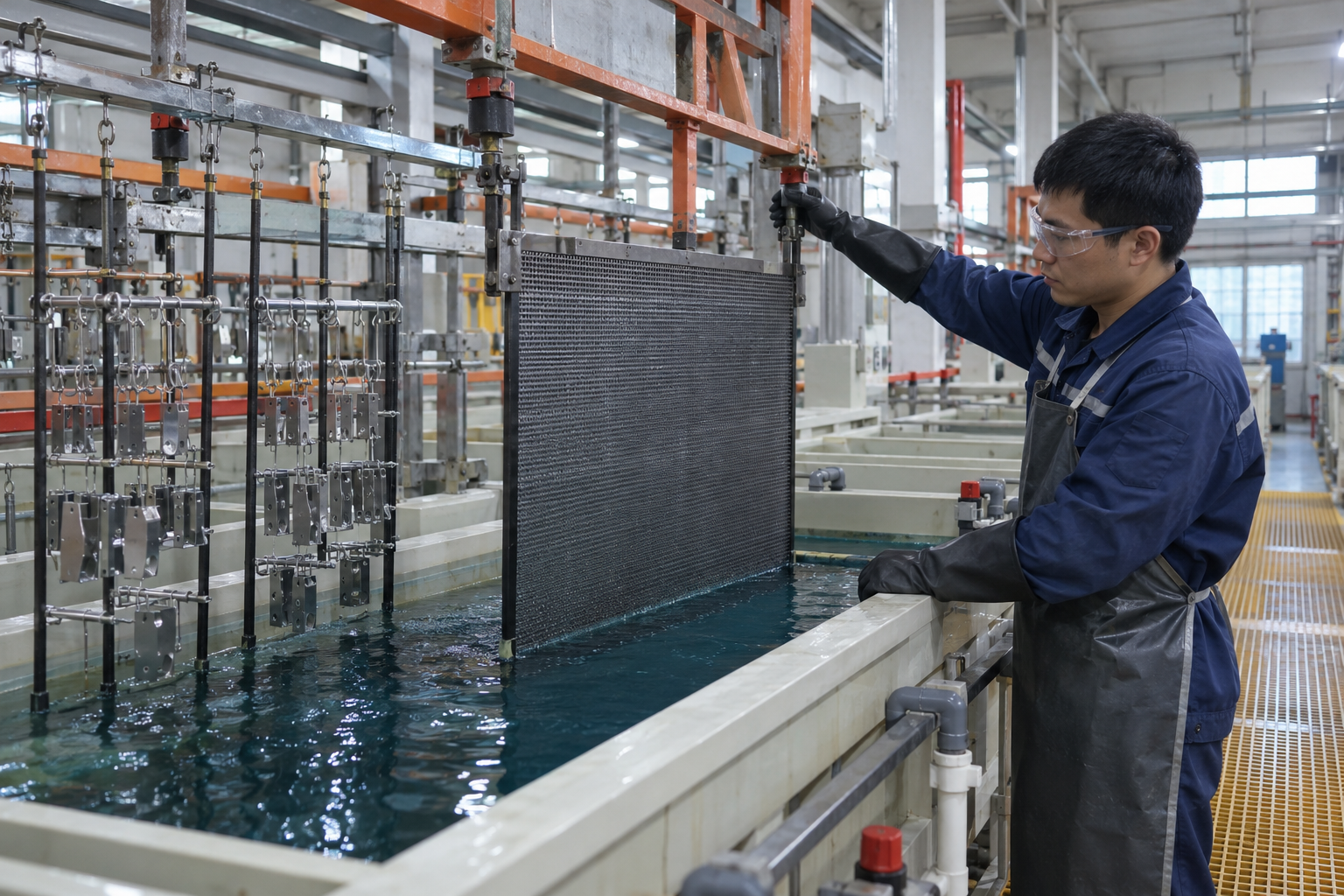
An electroplating anode cathode system may use a coated titanium anode when dimensional stability and a defined anodic reaction fit the bath. Metal replenishment may then need a separate method.
What should buyers compare with a soluble anode?
Compare complete process consequences. Anode choice changes bath management. Review:
- Metal balance and replenishment
- Anodic gas, acidity, and additive effects
- Contamination, sludge, maintenance, and geometry
Which coating families may be reviewed?
MMO and platinized titanium serve different baths and reaction duties. Selection needs chemistry, loading, temperature, and contamination limits.
| Option | Selection focus | Process implication |
|---|---|---|
| Soluble anode | Metal dissolution | Bath replenishment through anode |
| MMO titanium | Oxide reaction fit | Separate metal control |
| Platinized titanium | Platinum behavior and purity | Loading and carrier compatibility |
Key Takeaway: Compare soluble and insoluble anodes through reaction, metal balance, contamination, and operating control.
4. How Does Geometry Affect Deposit Uniformity?
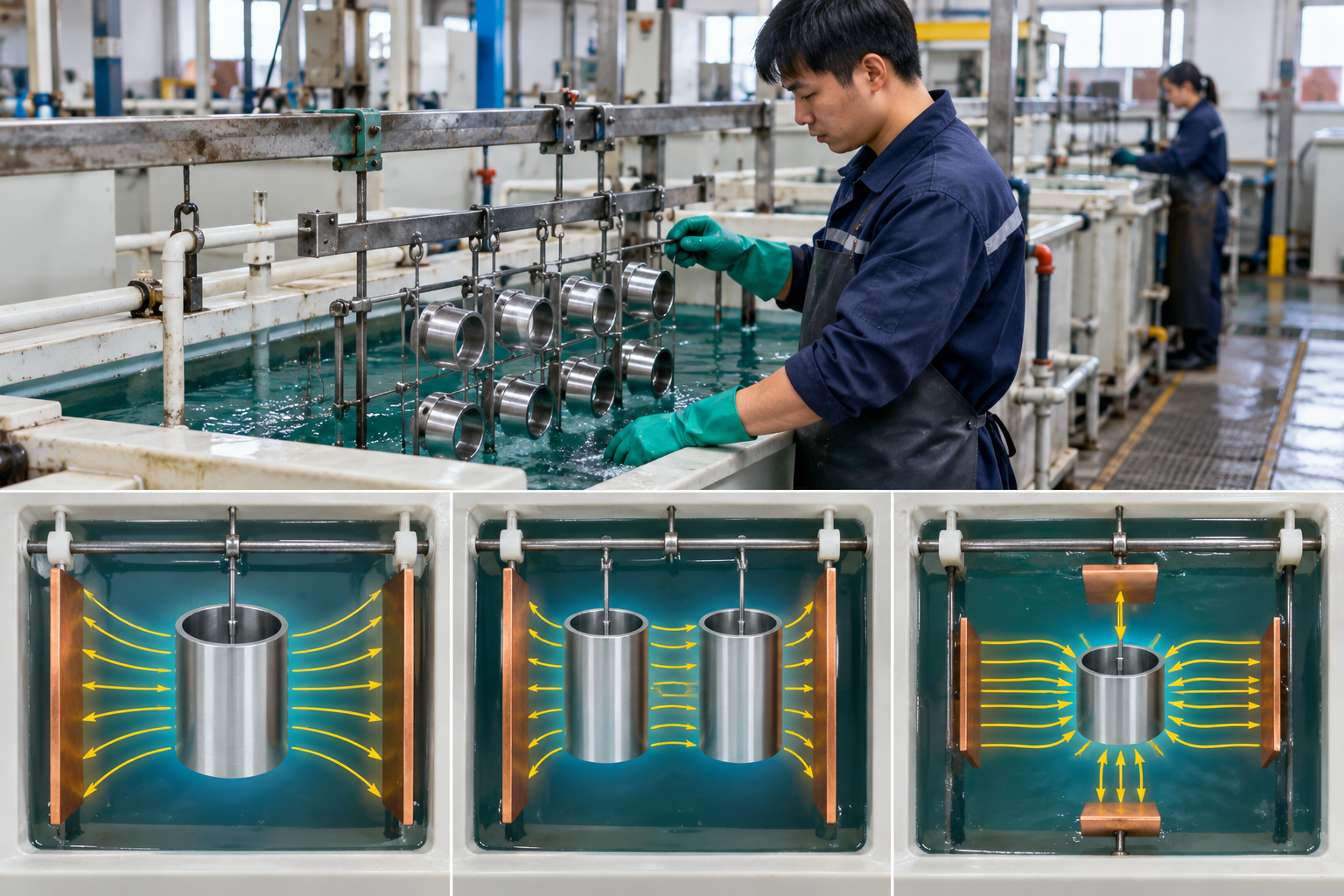
An electroplating anode cathode geometry shapes electric field, current density, edge effects, shielding, throwing power, and bath movement. Coating choice cannot fix a poorly arranged cell.
Which geometry inputs matter?
Model or test the actual workpiece and rack. Current follows the available path. Include:
- Workpiece shape, rack position, and cathode area
- Anode form, placement, spacing, and active boundaries
- Shields, robbers, agitation, and part movement
How should distribution be validated?
Use thickness mapping, current measurements, or representative test pieces under controlled bath conditions. Record rack and orientation.
| Distribution issue | Possible cause | Test |
|---|---|---|
| Heavy edges | Current concentration | Thickness map |
| Thin recesses | Weak field or transport | Representative part |
| Batch variation | Rack or bath change | Controlled comparison |
Key Takeaway: Validate anode layout against real workpiece geometry and deposit-quality criteria.
5. Which Electrical Data Must Be Shared?
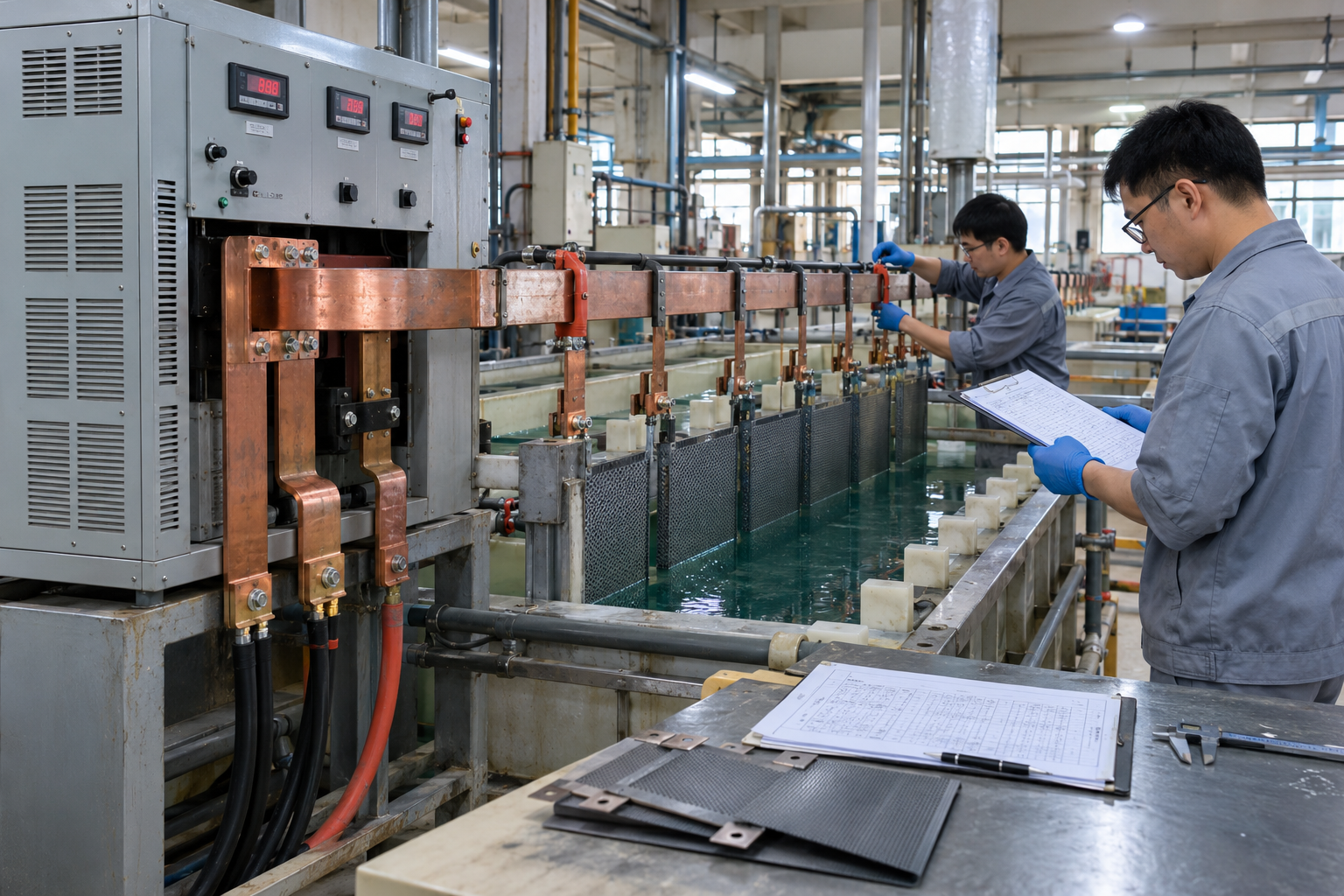
An electroplating anode cathode system needs current, voltage, active area, waveform, duty, and contact data. Total amperage cannot describe local loading.
Which values should be separated?
Distinguish normal from peak duty. Put area beside current. Provide:
- Anode and cathode active areas
- Normal and maximum current density
- DC, pulse, reverse, ramp, and cycle information
Why do contacts and busbars matter?
Resistance at racks, hooks, welds, and busbars creates voltage loss and heat. Inspect and maintain the complete current path.
| Electrical field | Risk | Evidence |
|---|---|---|
| Current density | Surface overload | Area calculation |
| Contact resistance | Heat and voltage loss | Inspection or measurement |
| Waveform | Different surface duty | Rectifier program |
Key Takeaway: Define active area, waveform, duty, and contacts so coating and conductor design match the process.
6. How Do Flow and Gas Affect the Cell?
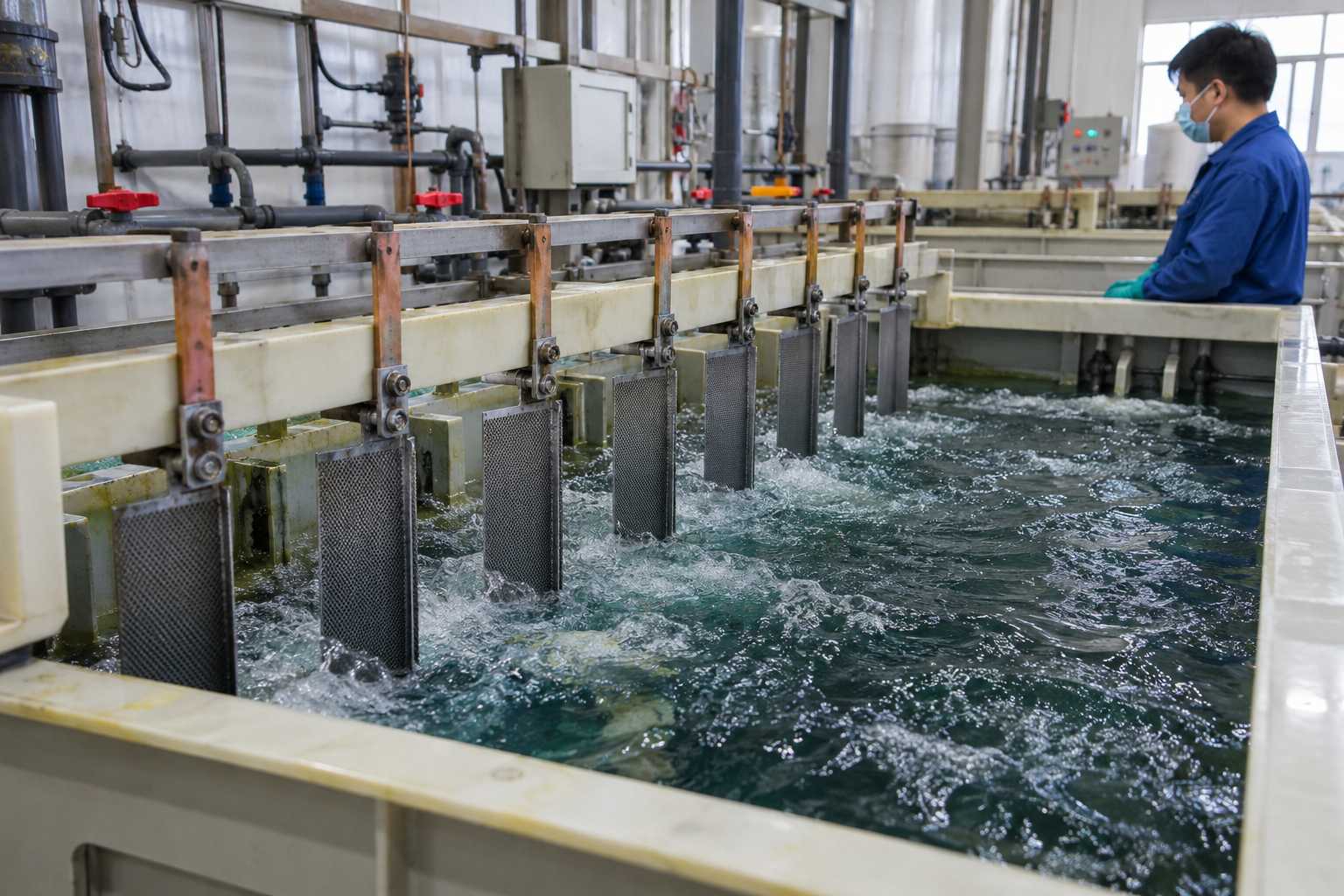
An electroplating anode cathode pair operates within agitation, filtration, heating, cooling, and gas evolution. Uneven transport changes concentration and deposit behavior.
Which hydraulic conditions should be recorded?
Describe flow near each electrode and workpiece. Tank circulation is not local flow. Include:
- Pump rate, eductors, air agitation, or mechanical movement
- Filtration, solids, sludge, and tank turnover
- Gas release, surface coverage, and ventilation
How should changes be tested?
Compare deposit or recovery results at controlled flow settings. Observe bubbles, deposits, temperature, and voltage.
| Transport condition | Possible effect | Control |
|---|---|---|
| Low local flow | Depletion or deposits | Agitation review |
| Gas coverage | Lost active area | Orientation and release |
| Solids | Surface defects | Filtration and cleaning |
Key Takeaway: Review local flow and gas behavior alongside current distribution and bath chemistry.
7. How Should Anodes Be Cleaned and Maintained?
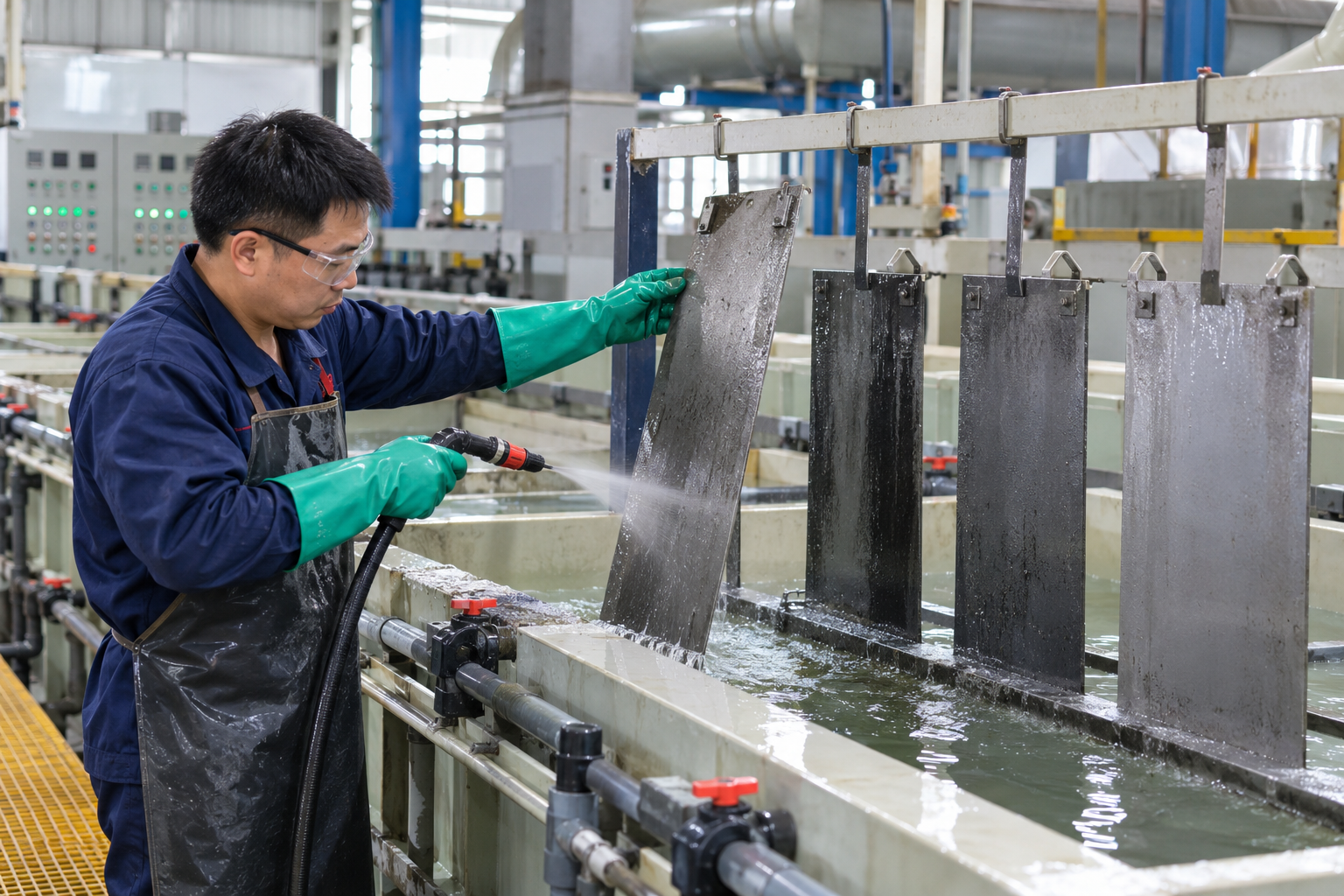
An electroplating anode cathode maintenance plan should protect active coatings, contacts, racks, and bath purity. Aggressive cleaning can trade deposits for surface damage.
What should a cleaning procedure define?
Approve method before field use. Cleaning needs limits and evidence. Specify:
- Chemical, concentration, temperature, and contact time
- Tools, handling, rinse, neutralization, and inspection
- Trigger, interval, record, and release condition
What should operators inspect?
Look for deposits, scratches, bent parts, contact heat, loose joints, and uneven surface change. Trend voltage and process results.
| Maintenance finding | Possible cause | Response |
|---|---|---|
| Scale | Bath or local chemistry | Diagnose and clean |
| Scratch | Handling or tool | Assess active-area damage |
| Hot contact | Resistance | Repair current path |
Key Takeaway: Use controlled cleaning and inspection to protect coating and bath while preserving diagnostic evidence.
8. How Should Quality Be Verified?

An electroplating anode cathode quality plan should cover identity, dimensions, active area, surface condition, connections, and agreed functional evidence. Acceptance follows project risk.
Which records belong with the anode?
Link each part to an approved baseline. Traceability makes process changes visible. Keep:
- Part number, drawing revision, and batch identity
- Dimensional, coating-boundary, and connection inspection
- Agreed surface or functional results
How can the site support supplier review?
The quality-control page can frame the discussion, while your purchase specification defines the exact records.
| Record | Confirms | Buyer decision |
|---|---|---|
| Drawing report | Fit and geometry | Mechanical release |
| Batch identity | Traceability | Documentation release |
| Pilot result | Process behavior | Technical release |
Key Takeaway: Approve the electrode, its records, and its process result as one controlled package.
9. What Should a Pilot Run Prove?
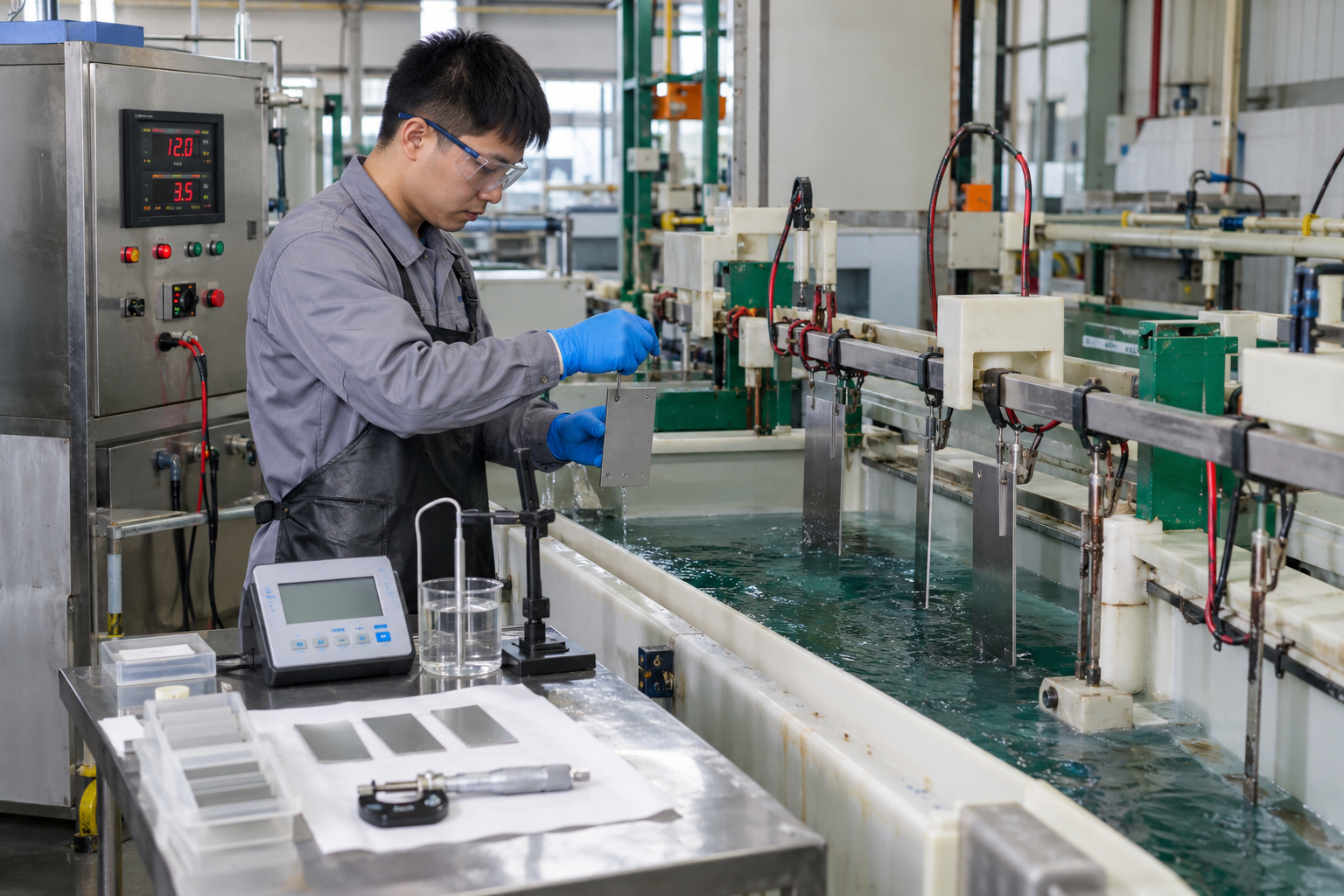
An electroplating anode cathode pilot should prove deposit or recovery quality, current distribution, bath behavior, voltage, heat, flow, and maintenance under defined conditions.
Which outputs should be measured?
Tie measurement to release criteria. A pilot is a decision experiment. Record:
- Deposit thickness, uniformity, composition, or recovery result
- Current, voltage, temperature, time, and bath analysis
- Surface condition, gas, maintenance, and byproducts
How do you scale after the pilot?
Freeze bath, rack, anode layout, waveform, drawing, and inspection baseline. Identify scale-dependent flow and field changes.
| Pilot output | Question | Scale action |
|---|---|---|
| Thickness map | Is distribution acceptable? | Freeze or revise layout |
| Bath analysis | Is chemistry stable? | Define replenishment |
| Voltage trend | Is resistance controlled? | Confirm power and contacts |
Key Takeaway: Scale only after the pilot meets product, bath, electrical, and maintenance criteria.
10. What Should the Anode RFQ Include?

An electroplating anode cathode RFQ should define bath, product, reaction, current, geometry, contamination limits, flow, maintenance, and validation. It should distinguish soluble and insoluble options.
Which files should you send?
Use controlled bath and drawing documents. Make every supplier quote one process. Include:
- Bath formulation, limits, replenishment, and product target
- Workpiece, rack, anode layout, current, waveform, and flow
- Quantity, cleaning, sample, inspection, and acceptance
How should supplier responses be compared?
Use the request-a-quote page and require assumptions, exclusions, material route, and pilot plan.
| Response field | Strong answer | Warning sign |
|---|---|---|
| Bath basis | Full chemistry considered | Generic industry claim |
| Distribution | Geometry and area addressed | Size-only quote |
| Validation | Defined pilot evidence | No release method |
Key Takeaway: Compare complete process proposals, not anode price alone. When your RFQ is ready, contact us today for technical review.
Frequently Asked Questions
Can I replace a soluble anode with coated titanium directly? Not without reviewing metal balance, bath chemistry, anodic reactions, current distribution, and replenishment.
What's the best anode for electroplating? The answer depends on bath, target reaction, contamination limits, loading, geometry, and maintenance.
How do I know if current distribution is uniform? Review thickness maps, workpiece geometry, rack, anode placement, gap, shields, current, flow, and bath control.
How do I know if rising voltage comes from the anode? Check scale, contacts, bath conductivity, spacing, gas coverage, and active-surface condition before assigning cause.
How do I know if a pilot proves enough? It should meet defined product, bath, electrical, flow, maintenance, and repeatability criteria.