
Choose an MMO or platinum-coated Titanium electrode from the intended reaction, electrolyte, operating window and validation evidence. A higher coating price does not prove better performance in your bath. Similar-looking quotations can also use different loading or area conventions. Compare complete specifications and test both candidates under matched conditions when suitability remains uncertain.
1. How Do You Compare MMO and Platinum Titanium electrode Types?
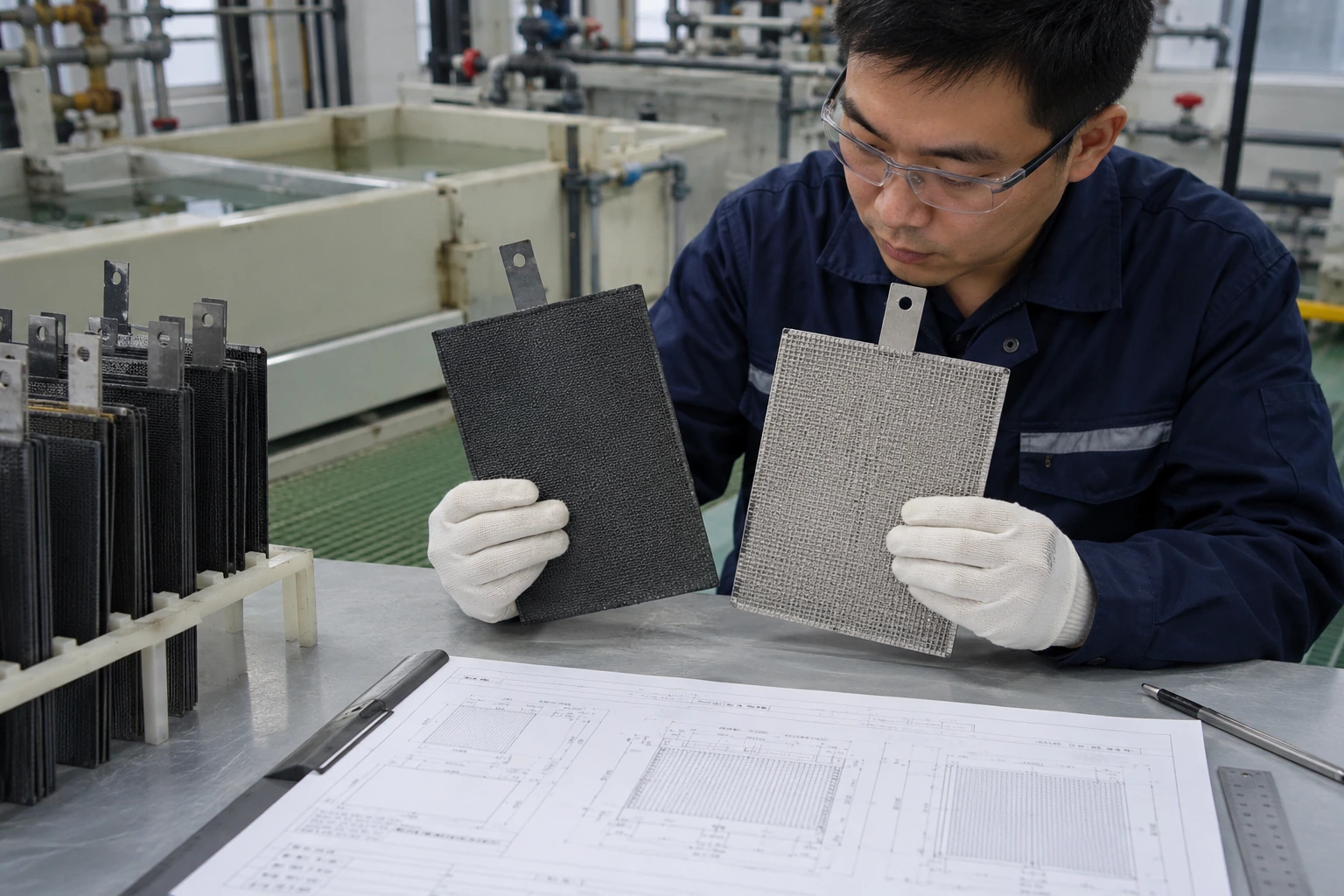
Compare MMO and platinum-coated Titanium electrode types by their suitability for your reaction and operating conditions. Neither family is a universal winner.
What should the comparison define?
Start with the process requirement. State the desired output, chemistry, current and temperature. Then compare candidate surfaces against the same acceptance plan.
- Identify the target anodic reaction.
- Record required output and quality.
| Check | Decision |
|---|---|
| Material family | Defines candidate surface chemistry |
| Application evidence | Establishes suitability |
A coating name is a starting point rather than a complete selection. Key Takeaway: Compare both candidates against one duty.
2. What Differs at the Titanium electrode Working Surface?

An MMO Titanium electrode uses a mixed-metal-oxide working surface, while a platinized electrode uses a specified platinum layer. Their surface chemistry and manufacturing descriptions differ.
Which specification terms need clarification?
Ask what each quoted quantity represents. Oxide loading, precious-metal loading and layer thickness are different measurements. Confirm area and method before comparing values.
- Separate composition from coating quantity.
- Record the measurement convention.
| Check | Decision |
|---|---|
| MMO surface | Uses a defined oxide system |
| Platinum surface | Uses a defined active metal layer |
Unmatched measurement definitions can distort a cost or quality comparison. Key Takeaway: Normalize the specification basis.
3. Which Reaction Should Your Titanium electrode Support?

A Titanium electrode should support the intended anodic reaction with acceptable behavior under the actual electrolyte. Competing reactions can affect useful output.
What should the supplier explain?
Name the reaction before selecting the surface. Chlorine-generation and oxygen-evolution duties can need different considerations. Avoid transferring a result from an unrelated process.
- State desired and unwanted products.
- Include current and chemistry ranges.
| Check | Decision |
|---|---|
| Target reaction | Defines the process objective |
| Competing reactions | Require application assessment |
Reaction selection connects coating choice with the product you need. Key Takeaway: Use a reaction-specific comparison.
4. How Does Chemistry Change Titanium electrode Coating Choice?

Chemistry can change the appropriate Titanium electrode coating through available reactions and material compatibility. pH alone cannot describe that exposure.
What should accompany a coating inquiry?
Send the complete liquid analysis. A custom engineering review needs relevant ions, additives and impurities. Include cleaning and upset conditions rather than only nominal operation.
- List composition and concentration ranges.
- Record temperature and duty cycle.
| Check | Decision |
|---|---|
| Normal chemistry | Defines routine operation |
| Other exposure | Can introduce separate limits |
A rating from another bath may not describe your process. Key Takeaway: Compare candidates within the same chemical window.
5. Does Titanium electrode Geometry Change the Comparison?

Titanium electrode geometry can change a coating comparison through area, spacing, contacts and transport. A mesh and plate trial may test more than coating chemistry.
How should you control geometry?
Use matched shapes where the test permits. If geometry must differ, identify its effects separately. Keep the active-area convention consistent.
- Record coated and masked boundaries.
- Match installed spacing and connection condition.
| Check | Decision |
|---|---|
| Matched geometry | Narrows the comparison |
| Changed geometry | Adds another design variable |
A better result may come from cell integration rather than surface chemistry. Key Takeaway: Keep geometric differences visible.
6. Can Coating Price Predict Titanium electrode Operating Cost?

Coating price cannot independently predict Titanium electrode operating cost. Useful output, energy, maintenance and replacement behavior require supporting evidence.
Which inputs make a cost comparison credible?
Use measured performance where available. Keep uncertain lifespan assumptions separate. A premium purchase price and a low purchase price both need technical context.
- Match quotation scope and quantities.
- Compare energy per useful output.
| Check | Decision |
|---|---|
| Purchase cost | Describes acquisition |
| Operating evidence | Supports ownership-cost estimates |
Cost claims become stronger when their assumptions are visible. Key Takeaway: Compare qualified candidates with transparent inputs.
7. How Should You Specify a Platinum Titanium electrode?

Specify a platinum-coated Titanium electrode through substrate, active-layer basis, geometry and operating duty. The word platinum does not define every relevant property.
What should the quality package include?
Connect the layer specification with its measurement method. State active boundaries and sampling locations. Review compatibility for the complete part, including contacts and seals.
- Identify material and coating designation.
- Define inspection and functional criteria.
| Check | Decision |
|---|---|
| Layer evidence | Supports coating conformity |
| Cell evidence | Supports application fit |
Analytical conformity and operating suitability answer different questions. Key Takeaway: Request both where the project requires them.
8. Can You Swap Titanium electrode Coatings Without Testing?
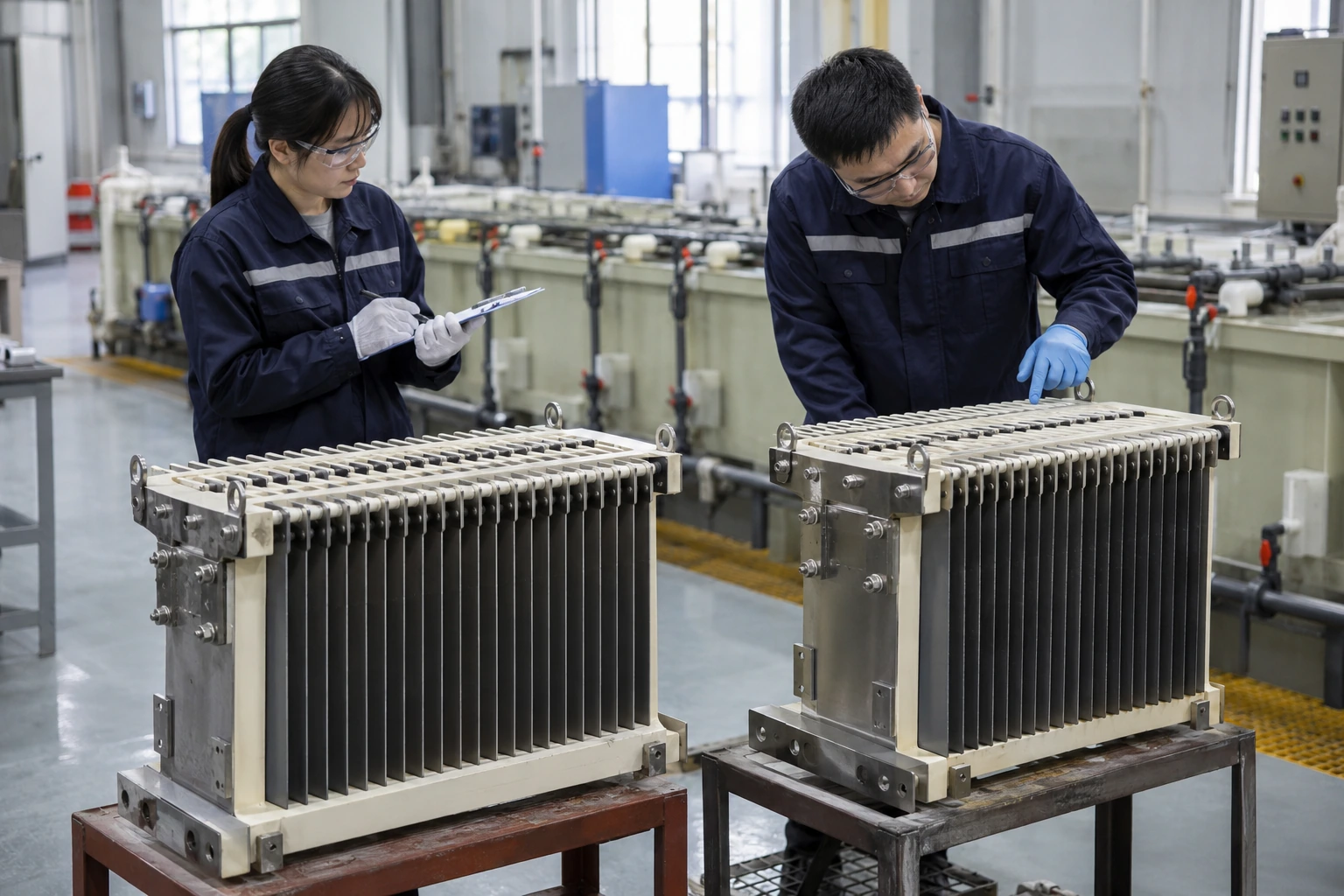
Changing a Titanium electrode coating can change reaction behavior and compatibility even when dimensions stay unchanged. A substitution needs technical review and appropriate validation.
What should the change trial measure?
Use the original process criteria. For water-treatment applications, compare useful treatment response and unwanted products alongside electrical readings. Record all changed conditions.
- Retain the approved baseline.
- Inspect surfaces and connections after testing.
| Check | Decision |
|---|---|
| Controlled substitution | Allows meaningful comparison |
| Unreviewed replacement | Leaves application risks unresolved |
A fitting replacement can still represent a different electrochemical component. Key Takeaway: Qualify the coating change before series use.
9. Which Tests Compare Titanium electrode Coating Candidates?

Compare Titanium electrode candidates with tests that address identity, dimensions, output and condition under matched duty. A visual inspection cannot settle the whole choice.
How should the report present results?
State the conditions beside each result. Include uncertainty and observed limitations. Keep short-duration evidence separate from durability forecasts.
- Use consistent analysis and sampling.
- Record actual test duration and waveform.
| Check | Decision |
|---|---|
| Matched functional test | Compares application behavior |
| Condition assessment | Checks visible or measured changes |
A test result without its conditions cannot support a fair ranking. Key Takeaway: Approve the candidate that meets the defined requirements.
10. What Titanium electrode Comparison Data Should You Send?

Send Titanium electrode chemistry, reaction targets, geometry, electrical duty and acceptance criteria for a coating comparison. Identify whether you are replacing an approved part or developing a new cell.
How can we help narrow the choice?
Send both candidate specifications when available. We can review electrode options for your stated application; contact us today with the comparison package. Our position is that coating choice should follow measured process requirements.
- List unresolved technical differences.
- Define the evidence needed for selection.
| Check | Decision |
|---|---|
| Common duty basis | Makes comparison possible |
| Validation plan | Supports the final decision |
The package prevents a material label from becoming a substitute for evidence. Key Takeaway: Select the coating through a bounded application review.
Frequently Asked Questions
Can I assume platinum is better than MMO? No. Suitability depends on reaction duty, chemistry and the complete specification.
What's the best coating for my electrolyte? Use an application-specific review and evidence. A generic family name cannot establish compatibility.
How do I know if coating loading and thickness are comparable? Clarify composition, density, geometry and measurement basis. The quantities are not automatically interchangeable.
Can I swap coatings without changing the cell? Only after review and validation. Mechanical fit does not prove equivalent reaction behavior.
Can I compare candidates using voltage alone? No. Match operating conditions and measure useful output, quality and relevant condition changes.