
Read a Titanium electrode accelerated-life test as evidence under its stated stress conditions, not as a direct promise of service years. A long test result can look decisive while using a different electrolyte or failure endpoint from another supplier. Comparing those hours without context may reward the easier test. Check conditions, endpoints and transfer assumptions before using durability data in procurement.
1. What does an accelerated Titanium electrode test establish?

An accelerated Titanium electrode test establishes behavior under selected elevated or modified stresses. Its value depends on whether those conditions answer the intended comparison question.
What was the test designed to compare?
Name the evidence boundary. A screening test can rank samples within one protocol without predicting field life. Keep that limited purpose explicit in the purchasing discussion.
- State the screening objective.
- Identify stressed operating variables.
| Check | Decision |
|---|---|
| Protocol-specific ranking | May support sample screening |
| Service-life prediction | Needs a justified transfer relationship |
Separate screening from field forecasting. Key Takeaway: Test duration has meaning only within a defined protocol.
2. Why do Titanium electrode test conditions matter?
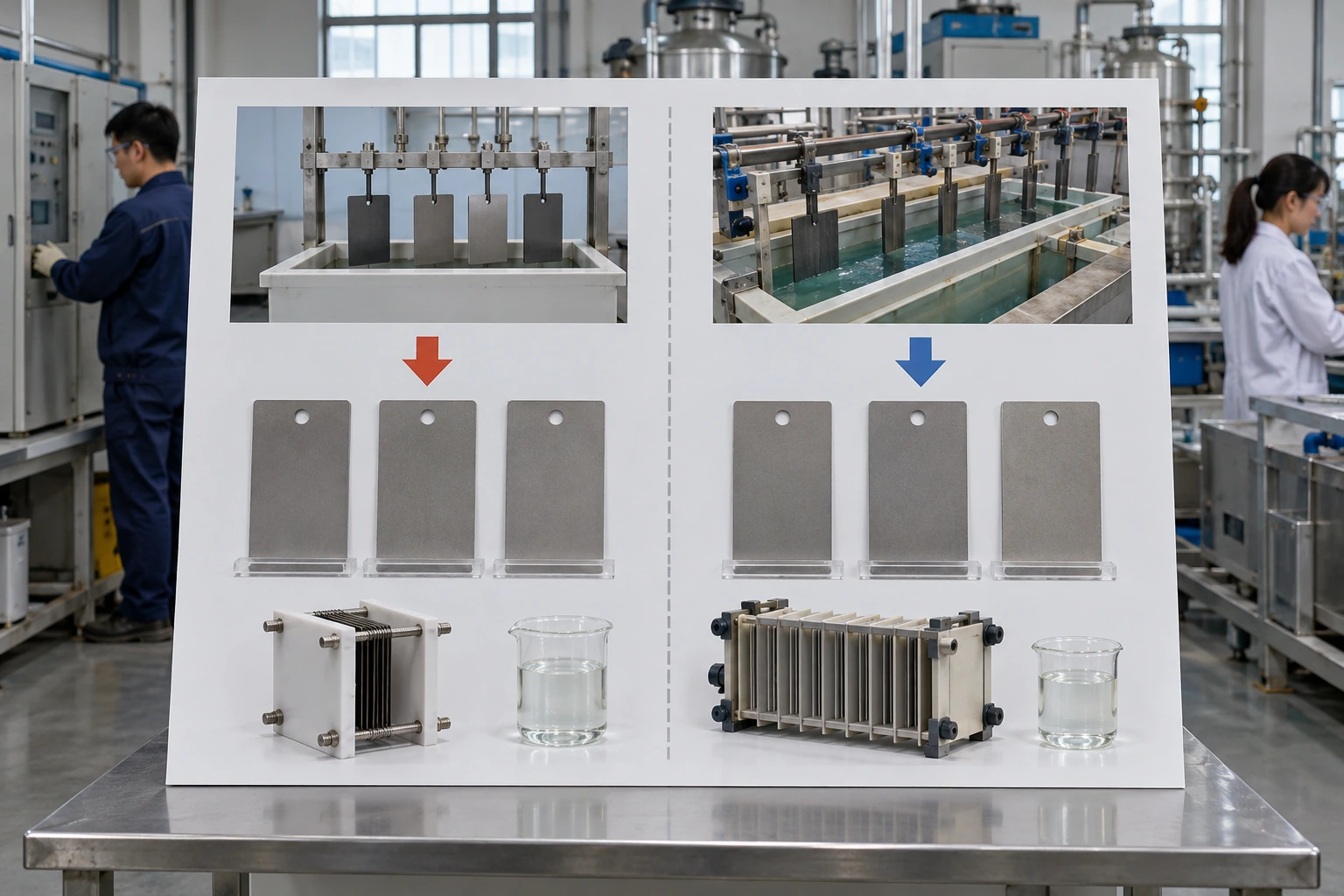
Titanium electrode test conditions matter because chemistry, temperature, current density and geometry can change degradation behavior. A harsher condition does not automatically preserve the service failure mechanism.
Does acceleration change what fails?
Compare stress with service. List the differences and ask how they affect interpretation. Avoid assuming that every mechanism accelerates by the same factor.
- Record electrolyte and temperature.
- Identify departures from intended duty.
| Check | Decision |
|---|---|
| Stress condition documented | Supports interpretation |
| Transfer assumption unexplained | Limits service-life claims |
Review mechanism relevance before extrapolation. Key Takeaway: An accelerated test must remain connected to the application question.
3. Which endpoint defines Titanium electrode test failure?

Titanium electrode test failure is defined by the agreed endpoint, such as a specified electrical change or another validated criterion. Results using different endpoints are not directly comparable.
What exactly ended the test?
Request the stopping rule. Include how the threshold was measured and whether the test stopped for equipment faults. An interrupted run is different from a sample reaching its failure criterion.
- State endpoint and measurement method.
- Record interruptions and exclusions.
| Check | Decision |
|---|---|
| Defined material endpoint | Supports protocol comparison |
| Administrative interruption | Needs a separate status |
Check why each reported test ended. Key Takeaway: A lifetime figure requires an explicit endpoint and event history.
4. Can Titanium electrode test hours become service years?

Titanium electrode test hours cannot become service years through an unsupported multiplication factor. A transfer model needs evidence that its assumptions hold across the relevant operating range.
What supports the conversion?
Ask for validation data. Include the intended field duty in a custom engineering review. Where correlation is unavailable, use the test as bounded comparative evidence instead of a lifetime guarantee.
- Review model assumptions.
- State unvalidated service conditions.
| Check | Decision |
|---|---|
| Assumed multiplier | Unsupported extrapolation |
| Validated relationship | May support a bounded prediction |
Keep uncertainty visible in procurement decisions. Key Takeaway: Do not turn accelerated hours into calendar life without a justified relationship.
5. How does current density affect Titanium electrode life tests?
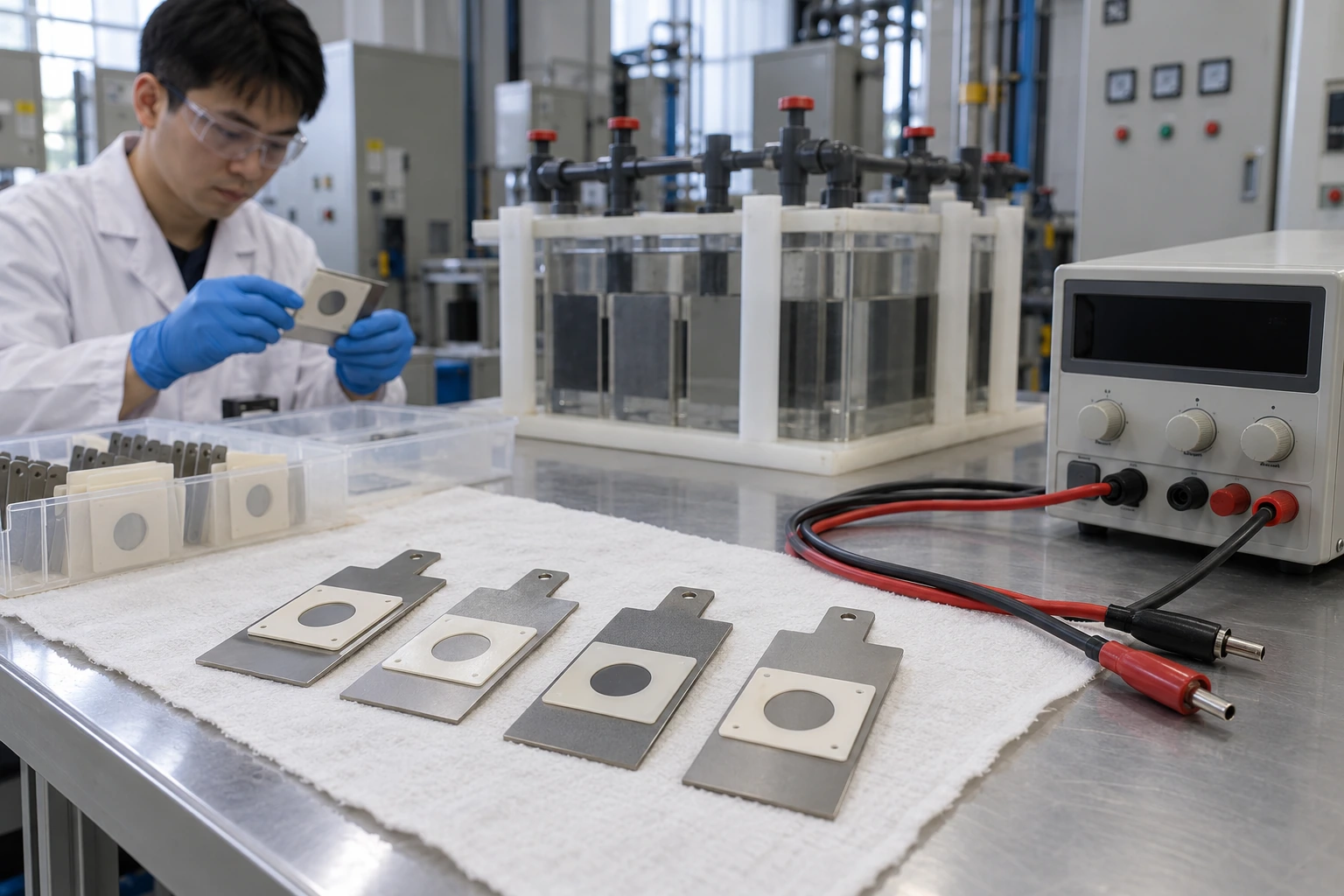
Current density affects Titanium electrode life tests because it changes the electrical loading on the declared active area. Area conventions and actual immersed geometry must be stated.
Are two current-density figures equivalent?
Check the denominator. Compare projected, coated and immersed-area definitions before judging stress severity. Record whether current remained at its commanded value throughout the test.
- Retain measured current trends.
- Document masking and immersion.
| Check | Decision |
|---|---|
| Nominal current density | Depends on declared area |
| Actual controlled duty | Provides a stronger exposure record |
Align area and current definitions. Key Takeaway: A test-stress comparison needs actual duty and a consistent area basis.
6. Does electrolyte choice change Titanium electrode failure modes?

Electrolyte choice can change Titanium electrode failure modes through reaction chemistry, material exposure and deposits. A result from one solution cannot automatically qualify another process.
Was the solution representative?
Review the chemical difference. Specify composition, impurities and replenishment practice. Keep a simplified laboratory electrolyte separate from production-feed validation in the report.
- Record preparation and replenishment.
- Retain relevant analytical checks.
| Check | Decision |
|---|---|
| Simplified test liquid | Useful for controlled screening |
| Production-feed validation | Addresses application-specific exposure |
Use each test for the claim it can support. Key Takeaway: Electrolyte relevance matters as much as elapsed test time.
7. How many Titanium electrode samples should be tested?

The number of Titanium electrode samples should reflect the decision risk and expected variation, using a justified sampling plan. One specimen cannot describe every production batch.
How much variation remains unseen?
Ask for individual results. A single average can hide early failures or inconsistent specimens. Keep sample selection and batch identity available for review.
- Report individual endpoints.
- Document sample-selection rules.
| Check | Decision |
|---|---|
| One selected specimen | Limited variability evidence |
| Defined sample plan | Supports a broader comparison |
Evaluate spread rather than only the longest run. Key Takeaway: Durability evidence should show sample variation, not just a favorable example.
8. What inspection should follow a Titanium electrode life test?

Post-test Titanium electrode inspection should examine whether observed condition supports the proposed failure mechanism. Electrical endpoints alone may leave several explanations unresolved.
What changed physically?
Preserve the tested sample. For water-treatment applications, compare coating, substrate and deposit evidence with operating records. Any cleaning before analysis should be documented because it can remove clues.
- Keep before-and-after images.
- Record analytical preparation.
| Check | Decision |
|---|---|
| Electrical endpoint | Defines the test event |
| Condition analysis | Helps interpret its mechanism |
Connect the endpoint with physical evidence. Key Takeaway: Post-test inspection can prevent the wrong mechanism from guiding a redesign.
9. How do you compare Titanium electrode durability claims?

Titanium electrode durability claims should be compared only after protocol, endpoint and sample basis are aligned. Unsupported differences should remain unresolved rather than converted into a neat ranking.
What belongs on a comparison sheet?
Use the same reporting fields. Include individual results, actual duty and relevant exclusions. Ask for clarification when a supplier reports only its best specimen.
- Align endpoint and chemistry.
- Review repeatability and sample history.
| Check | Decision |
|---|---|
| Matched protocol | Supports a bounded comparison |
| Different protocols | Requires technical reconciliation |
Compare evidence before comparing headline hours. Key Takeaway: A fair durability review starts with equivalent test definitions.
10. What Titanium electrode life-test report should you request?

A useful Titanium electrode life-test report includes protocol, raw trends, endpoints, sample identity and limits on extrapolation. These details turn a headline duration into reviewable evidence.
Request the complete durability package
Send your service conditions. When you contact us today, we can review electrode duty and sample requirements against the intended application. We favor qualified durability statements over unexplained lifetime promises.
- Separate screening and service claims.
- Identify remaining validation work.
| Check | Decision |
|---|---|
| Test report complete | Supports technical screening |
| Service correlation missing | Limits lifetime prediction |
Agree on what the evidence can justify. Key Takeaway: Use accelerated testing to reduce uncertainty without hiding its limits.
Frequently Asked Questions
Can I convert accelerated hours into years? Only with a validated relationship covering the relevant conditions and failure mechanism.
What's the best accelerated test current? Use a justified protocol; higher current alone does not guarantee better service relevance.
How do I know if two reports are comparable? Check chemistry, area basis, measured duty, endpoints and sample selection.
Can I accept the longest specimen as typical life? No. Review individual results and the sampling basis.
Can I use one electrolyte to qualify every application? No. Different chemistry can change material exposure and degradation mechanisms.