
In BPMED, a titanium electrode closes its electrical circuit while water dissociation occurs at a bipolar membrane junction. Buyers who merge those roles can misread where acid and base ions originate. This guide separates membrane function, terminal reactions, and process loops. Begin a supplier discussion with a Titanium electrode drawing and the intended stack arrangement.
1. How Does a Titanium electrode Close a BPMED Circuit?
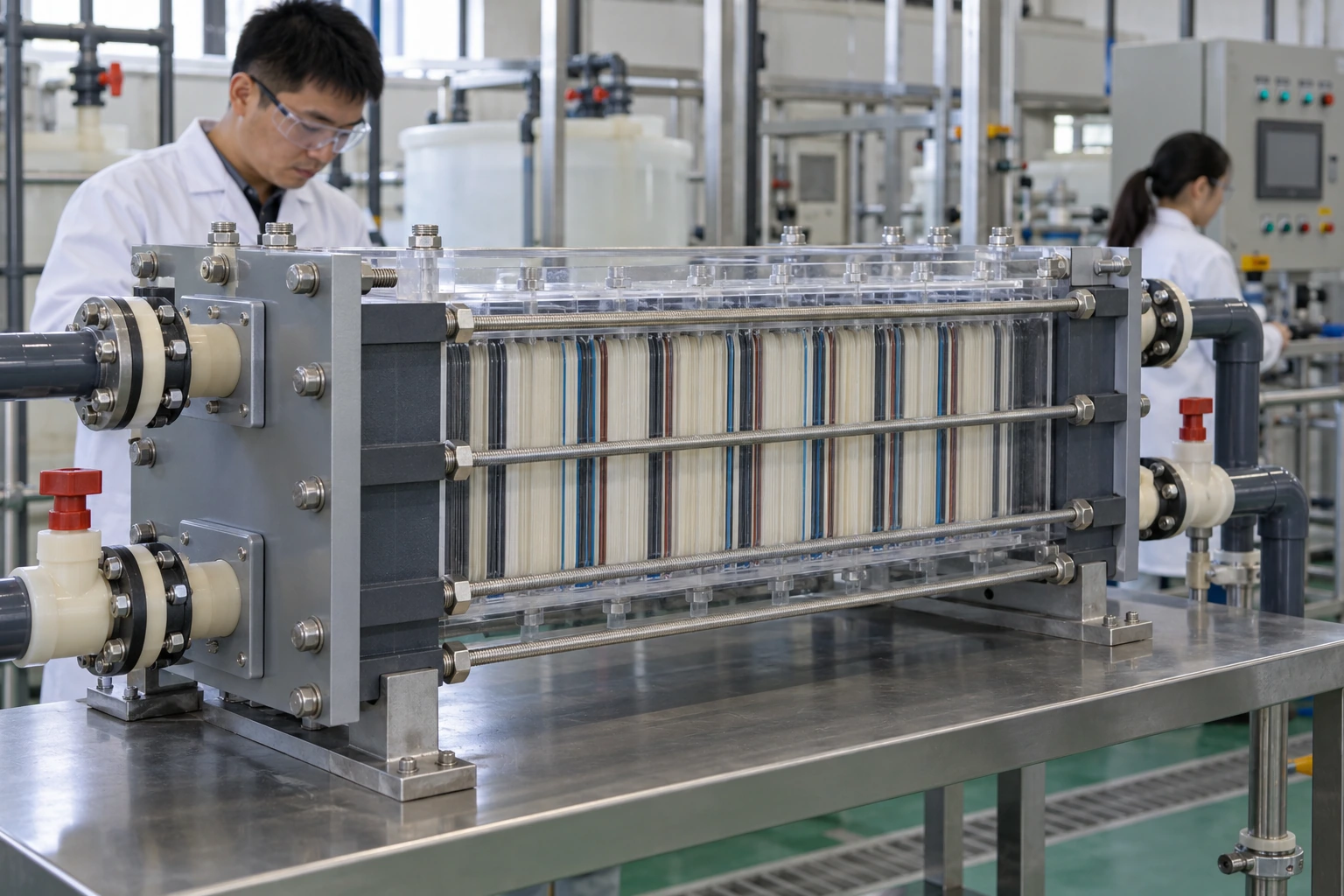
A Titanium electrode closes the terminal electrical path in BPMED, while bipolar membranes create H+ and OH- at their internal junctions.
Mark the current terminals
Start at the stack ends. A direct-current potential drives ion transport across the repeating membrane arrangement. Terminal electrodes exchange charge with their electrolyte, while each bipolar membrane performs water dissociation within the membrane junction.
- Show terminal electrode compartments beyond repeating membrane units.
- Draw each acid, base, salt, and rinse loop as a separate hydraulic path.
| Check | Decision |
|---|---|
| Terminal electrodes | Close the circuit through electrolyte reactions |
| Bipolar membrane | Generates H+ and OH- at its junction under suitable bias |
Circuit closure and acid/base generation happen at different physical interfaces. Key Takeaway: Use separate labels for electrode compartments and bipolar membrane junctions.
2. Where Does Water Split Near a Titanium electrode?
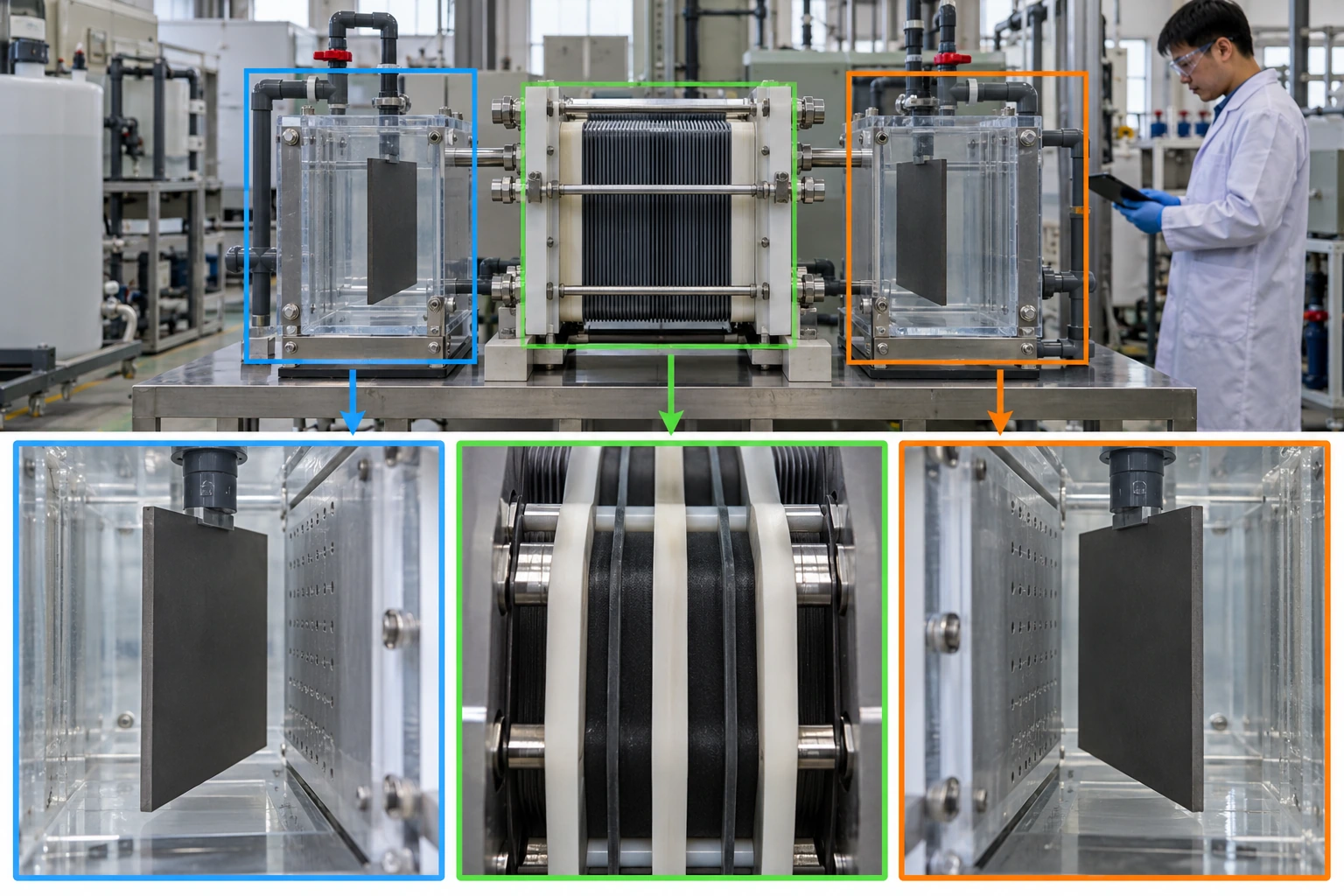
A Titanium electrode sits apart from the bipolar membrane junction, where water dissociation supplies H+ and OH- to process channels. Separate terminal water electrolysis and gas evolution may occur depending on rinse chemistry.
Locate the water-dissociation junction
Follow the membrane layers. A bipolar membrane combines cation- and anion-exchange layers, with a junction between them. Junction dissociation sends H+ and OH- into adjacent process channels; terminal water electrolysis and gas evolution may depend on rinse chemistry.
- Identify which face of each bipolar membrane meets the acid-side and base-side compartments.
- Keep junction chemistry separate from reactions in terminal electrode rinse channels.
| Check | Decision |
|---|---|
| Bipolar junction | Water dissociation produces H+ and OH- |
| Terminal end | Electrode reactions carry current into the stack |
A schematic that locates the junction prevents a common confusion about gas-forming electrolysis. Key Takeaway: Ask for a membrane orientation drawing before reviewing electrode material.
3. What Reactions Occur at a Titanium electrode?

A Titanium electrode hosts terminal oxidation or reduction reactions in its own compartment; exact products depend on electrode and electrolyte system.
Review the terminal reaction environment
The end loop has its own chemistry. Current enters and leaves through electrode-electrolyte interfaces at opposite stack ends. Rinse composition, exposed coating, current direction, and gas management define terminal design, separate from bipolar-junction chemistry.
- List electrode rinse composition, circulation path, and the conditions expected during operation.
- State which terminal end is anode and cathode for each approved operating mode.
| Check | Decision |
|---|---|
| Electrode compartment | Terminal reaction and rinse exposure |
| BPM junction | Water dissociation and ion delivery to adjacent channels |
Changing electrode choice does not relocate water dissociation from a bipolar junction. Key Takeaway: Keep reaction zones distinct in specifications and commissioning records.
4. How Does a Bipolar Membrane Differ from a Titanium electrode?

A Titanium electrode forms a conductive terminal component, while a bipolar membrane forms a layered ion-exchange separator with a water-dissociation junction.
Compare function before materials
Name each part by its job. A custom stack-interface review can identify terminal surface and separate it from membrane junction. Treating both as interchangeable components can lead to wrong material, connection, or inspection requirements.
- List membrane type, orientation, and adjacent channel on the stack drawing.
- Specify electrode geometry and coating separately from membrane construction.
| Check | Decision |
|---|---|
| Bipolar membrane | Layered separator and internal dissociation interface |
| Terminal electrode | Conductive surface at the stack boundary |
These components occupy separate locations and carry different acceptance questions. Key Takeaway: Separate their bill-of-material entries and review criteria.
5. Which Rinse Conditions Reach a Titanium electrode?
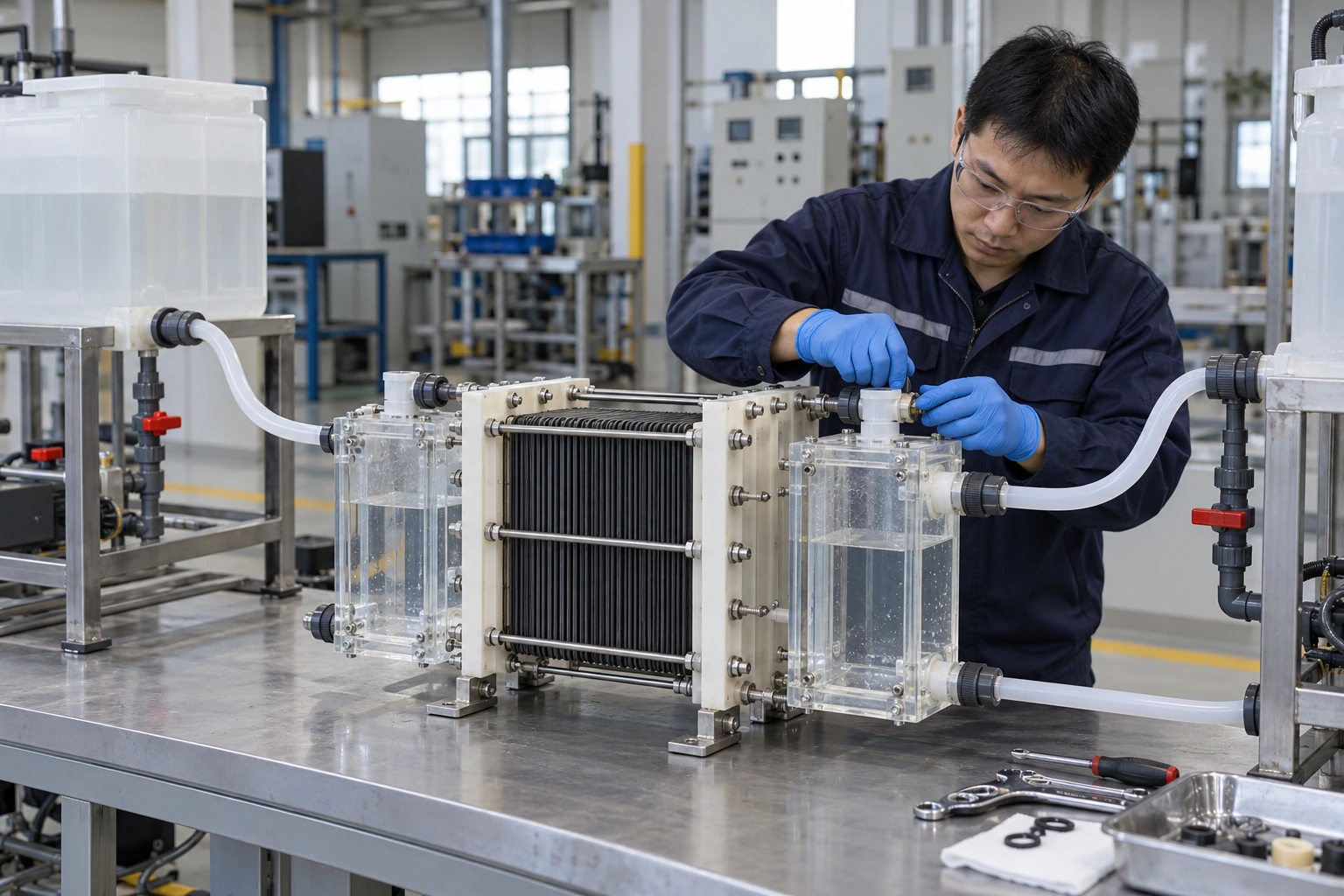
A Titanium electrode sees a terminal rinse loop, whose composition and circulation must fit its exposed surface and selected process design.
Keep rinse flow separate
Trace the fourth loop. A BPMED pilot can circulate salt, acid, base, and electrode-rinse solutions independently. The rinse loop supports terminal electrode reactions and should be evaluated for compatibility and crossover risk without assuming a universal recipe.
- Mark rinse inlet, outlet, sample points, and any recirculation tank on the process sketch.
- Compare rinse chemistry with electrode coating, seals, and adjacent membrane exposure.
| Check | Decision |
|---|---|
| Process loops | Salt, acid, and base circuits |
| Terminal loop | Electrode rinse circuit and end-compartment interfaces |
A distinct rinse circuit makes sampling and troubleshooting more interpretable. Key Takeaway: Confirm how each loop connects before discussing electrode service life.
6. How Do Current and Stack Design Affect a Titanium electrode?

A Titanium electrode is affected by stack current and terminal reaction conditions, while membrane count, solution resistance, and flow affect total behavior.
Read current with stack layout
Count every resistance path. Cell-pair arrangement, membrane properties, channel conductivity, and electrode overpotential all contribute to the voltage demand. The current setting alone cannot predict product concentration or establish a safe electrode duty.
- Record stack current and voltage alongside flow, temperature, and solution conductivity.
- Tie reported performance to membrane configuration and the actual feed chemistry.
| Check | Decision |
|---|---|
| Electrical inputs | Current, voltage, and terminal surface condition |
| Process inputs | Membrane arrangement, flows, and solution composition |
A measured response belongs to the complete test configuration, not one component. Key Takeaway: Keep the stack drawing attached to each performance record.
7. What Product Paths Surround a Titanium electrode?

A Titanium electrode sits beside separate acid, base, salt, and rinse paths; their product roles depend on the membrane arrangement and feed.
Map every product path
Follow H+ and OH- from their source. Bipolar membranes dissociate water, while adjacent monopolar membranes and salt-channel ions shape how those species enter acid and base loops. Back diffusion, co-ion passage, and water transfer can change measured concentrations.
- Label each tank, pump, stack channel, and return line by process role.
- Report product composition with feed chemistry, operating conditions, and sampling location.
| Check | Decision |
|---|---|
| Acid/base outputs | Depend on membrane arrangement and ion transport |
| Rinse return | Remains a separate terminal-electrode stream |
An acid or base stream is not automatically high-purity product. Key Takeaway: Define product acceptance from process data rather than stack type alone.
8. Where Could a Titanium electrode Serve Water Treatment?
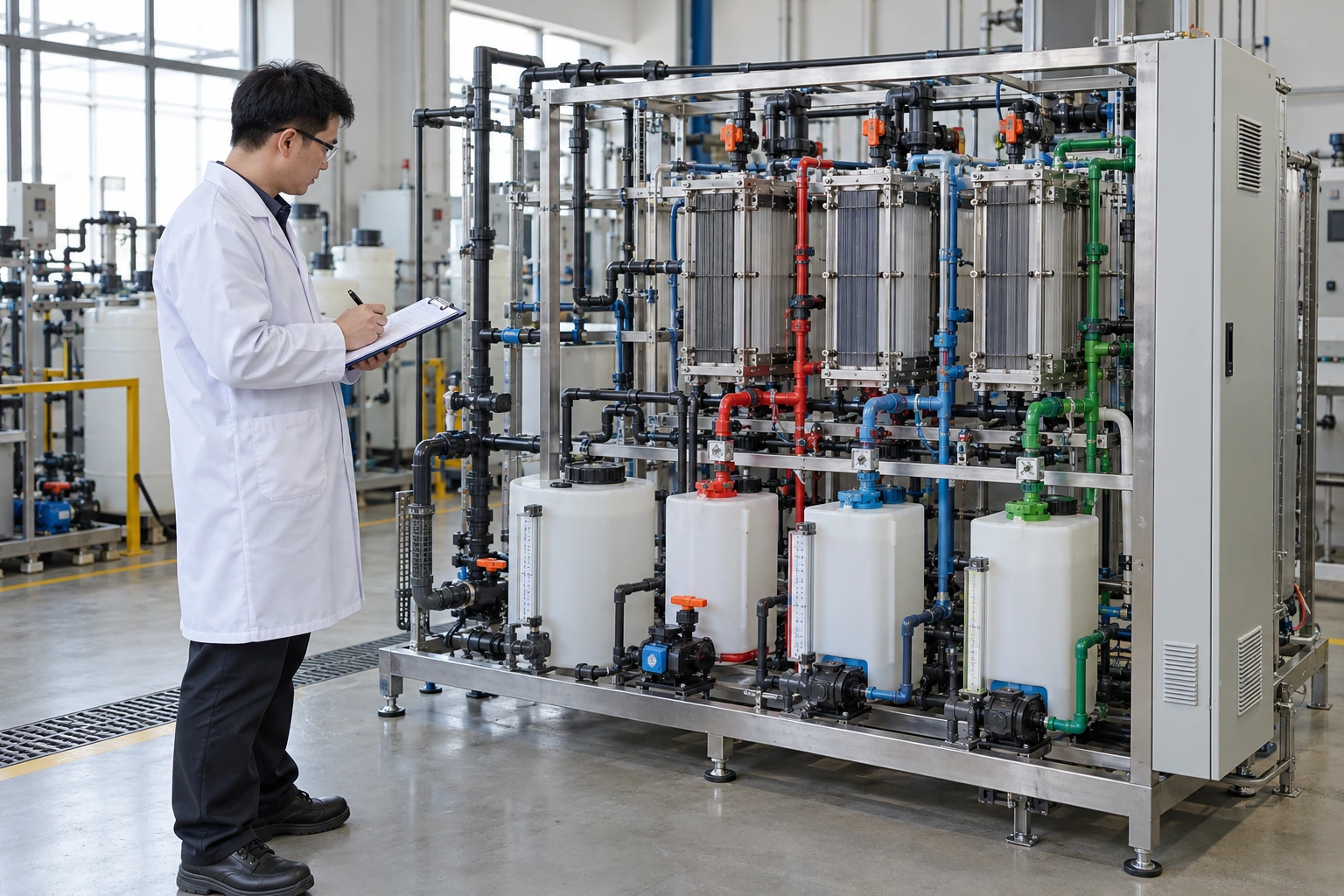
A Titanium electrode may be one interface in a water-treatment process that uses BPMED for salt conversion, but product goals and feed chemistry govern fit.
Screen process goals
Start with the salt balance. Research systems have examined acid/base production from saline feeds, yet output quality depends on membrane selectivity, concentration, and operating conditions. See water-treatment applications; this context does not imply a complete BPMED package or certified product water.
- Describe the feed ions, target products, residual salt path, and downstream use.
- Check where acid/base products and electrode rinse return within the broader process.
| Check | Decision |
|---|---|
| Process question | What conversion or recovery objective is required? |
| Electrode question | What terminal chemistry and surface exposure apply? |
Application fit depends on the complete process balance and intended use. Key Takeaway: Share the feed and product specifications before discussing electrode options.
9. What Should Buyers Share About a Titanium electrode?

A Titanium electrode inquiry should include stack configuration, end-compartment geometry, rinse duty, electrical connections, and application chemistry.
Send inputs that define the interface
A labeled drawing prevents crossed roles. Include membrane order, bipolar orientation, channel identities, port positions, and electrode connections. Add target product chemistry and note any unconfirmed current, temperature, or rinse conditions so review stays within known facts.
- Attach a stack end view and a process-flow sketch with four distinct loops where applicable.
- List required drawing evidence, inspection points, and unresolved engineering decisions.
| Check | Decision |
|---|---|
| Stack data | Membrane order, ports, end frames, and dimensions |
| Duty data | Feed chemistry, current mode, and rinse conditions |
An inquiry becomes actionable when component boundaries and unknowns are visible. Key Takeaway: Ask the stack designer to confirm interfaces that remain outside electrode scope.
10. How Should a Titanium electrode Be Reviewed for BPMED?

A Titanium electrode review should test drawing fit and rinse exposure without implying a complete bipolar-membrane system supply.
Set a bounded review scope
Keep the deliverable specific. A technical discussion can check terminal geometry, connection orientation, and exposed-surface conditions against the supplied stack data. For a project-specific conversation, contact us today with drawings, chemistry, and the required electrode boundary.
- Send the stack drawing, process-loop sketch, and intended operating states.
- Separate questions about membrane selection, acid/base quality, and full-system certification from electrode scope.
| Check | Decision |
|---|---|
| Electrode scope | Geometry, surface, connection, and rinse exposure |
| System scope | Membrane performance, products, and operating approval |
Clear scope lets a supplier respond without implying control over the whole process. Key Takeaway: Request review against named interfaces and confirmed project data.
Frequently Asked Questions
Can I use a titanium electrode in bipolar membrane electrodialysis? Possibly, subject to stack design, exposed surface, rinse chemistry, polarity duty, and supplier review. The substrate alone does not establish compatibility.
What's the best electrode for BPMED? There is no universal choice. Terminal chemistry, coating, electrical duty, electrolyte, and assembly interfaces set the requirements.
How do I know if a bipolar membrane electrode is correctly placed? Read a stack drawing: water dissociation occurs at the bipolar membrane junction, while terminal electrodes sit in end compartments.
Can I get high-purity acid or base from BPMED? Purity depends on feed composition, membrane selectivity, leakage, water transport, and operating conditions; stack type alone cannot promise it.
How do I know if the titanium electrode splits water in BPMED? Process-channel H+ and OH- come from bipolar-junction water dissociation. Separate water electrolysis and gas evolution may occur at terminal electrodes, depending on rinse chemistry.