
A Titanium electrode coating specification should distinguish mass loading, thickness and composition because those quantities answer different questions. Two quotations may use similar numbers while one counts precious metal and another counts total oxide. Treating them as equivalent can distort both cost and acceptance. Define the material basis, area convention and measurement method before comparing values.
1. What does Titanium electrode coating loading measure?

Titanium electrode coating loading usually expresses a stated coating mass or constituent mass per declared area. The specification must say which material is counted.
Mass of what, over which area?
Read both parts of the unit. A value can refer to total deposited material or selected elements. Keep that basis attached to every result rather than reporting an unexplained mass-per-area figure.
- Identify counted constituents.
- State the area convention.
| Check | Decision |
|---|---|
| Mass basis missing | Comparison remains ambiguous |
| Mass and area defined | Supports a usable specification |
Clarify the unit before discussing acceptance. Key Takeaway: Loading is meaningful only when its numerator and denominator are explicit.
2. How does Titanium electrode loading differ from thickness?
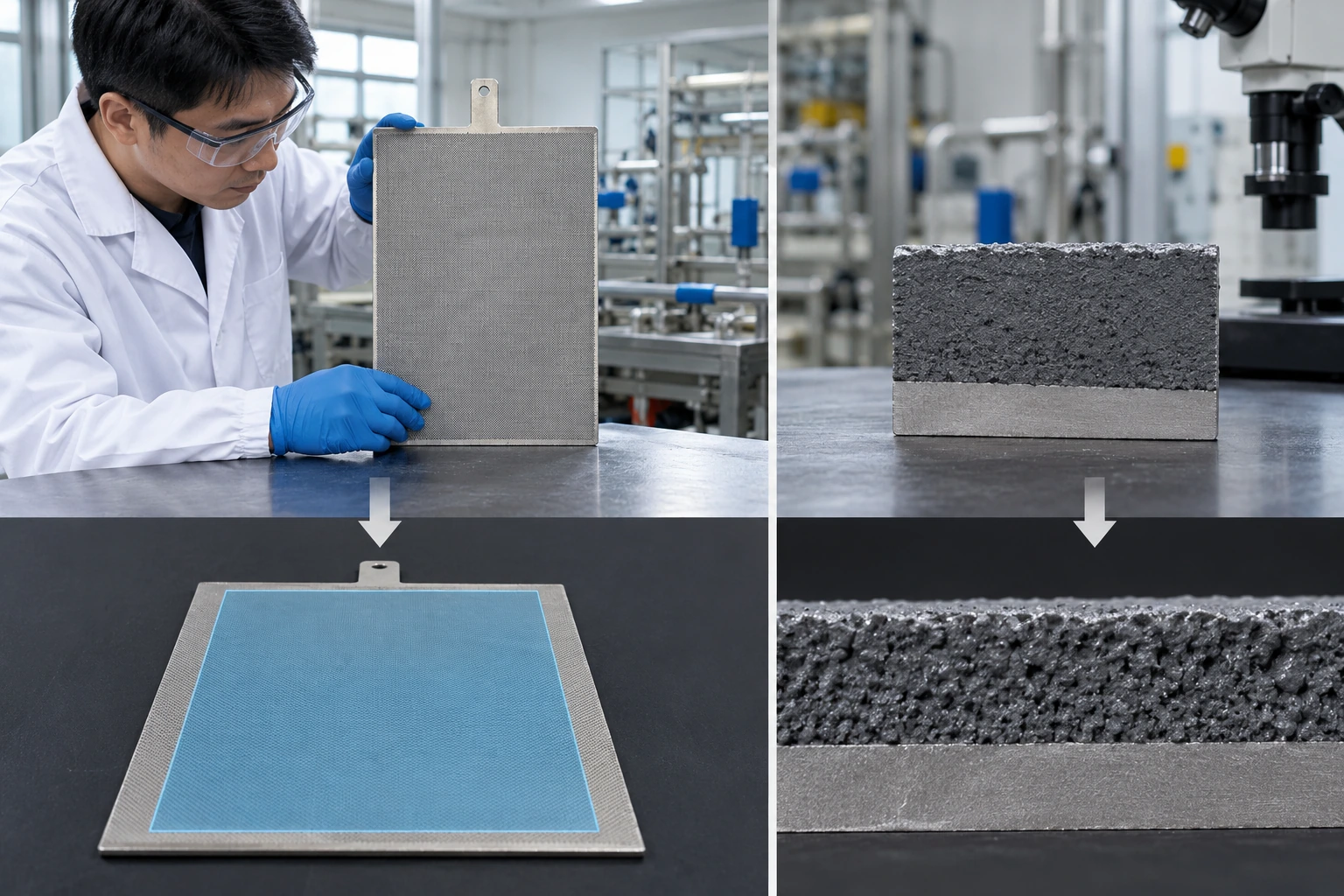
Titanium electrode loading measures mass per area, while thickness measures distance through the coating. Density, porosity and composition affect any relationship between them.
Can one quantity be converted into the other?
Check the required assumptions. Do not turn a loading value into thickness using an unexplained bulk-density assumption. A rough or porous coating may not behave like a uniform dense film.
- State conversion assumptions.
- Distinguish measured from calculated values.
| Check | Decision |
|---|---|
| Mass loading | Material quantity per area |
| Thickness | Local or averaged geometric depth |
Use the quantity suited to the acceptance question. Key Takeaway: Loading and thickness are related only through a justified material model.
3. Which elements count in Titanium electrode loading?

The elements included in Titanium electrode loading must be specified because precious-metal content, total metal content and total oxide mass differ. A composition percentage also needs its own basis.
What does the supplier's number include?
Request a material definition. Identify whether percentages refer to metals, oxides or another stated basis. Avoid comparing an elemental ratio with a total-coating mass specification.
- Record elemental and oxide conventions.
- Keep composition and loading separate.
| Check | Decision |
|---|---|
| Composition ratio | Relative constituent amounts |
| Total loading | Quantity on a declared area |
Resolve terminology before comparing prices. Key Takeaway: A precise coating specification identifies both composition and deposited quantity.
4. Why does Titanium electrode area convention matter?

Titanium electrode area conventions affect reported loading, especially for mesh, multiple faces and masked regions. Different area bases can change a nominal figure without changing the physical part.
Which surfaces are included?
Trace area to the drawing. Include coated faces and excluded regions in a custom engineering review. State whether mesh values use projected area or a defined developed-area method.
- Identify coated and uncoated regions.
- Record the area calculation.
| Check | Decision |
|---|---|
| Projected area | A declared planar basis |
| Developed area | A different geometric basis |
Use the same convention across reports. Key Takeaway: Compare coating loading only after aligning the area definition.
5. Can average loading hide Titanium electrode variation?

Average Titanium electrode loading can hide local variation because a whole-part result does not describe every edge, face or mesh strand. Sampling should reflect relevant functional regions.
Where might variation affect duty?
Ask for a sampling map. Define locations and acceptance rules appropriate to the geometry. A favorable average does not establish uniform coverage across every active surface.
- Include relevant edges and faces.
- State local and average criteria separately.
| Check | Decision |
|---|---|
| Whole-part average | Summarizes total quantity |
| Location-specific checks | Investigate distribution |
Match sampling with the functional risk. Key Takeaway: Uniformity claims need evidence beyond a single average.
6. How is Titanium electrode coating thickness measured?

Titanium electrode coating thickness can be measured through suitable methods such as qualified cross-section examination, depending on the coating and required resolution. Preparation and sampling influence the result.
What does the measured section represent?
Review the method's scope. Ask how the specimen was prepared and where measurements were taken. Local thickness observations should not silently become a whole-part uniformity claim.
- Record method and measurement locations.
- Retain representative images.
| Check | Decision |
|---|---|
| Local cross section | Describes examined locations |
| Whole-part statement | Requires a suitable sampling basis |
Keep the finding proportional to sampling coverage. Key Takeaway: A precise local measurement still needs context.
7. What can XRF establish about a Titanium electrode?

XRF can support Titanium electrode composition or coating-quantity assessment when calibration and the analytical model suit the material and geometry. Instrument capability alone does not establish method validity.
Was the method calibrated for this surface?
Ask about standards and geometry. Curvature, roughness and coating structure can affect interpretation. Keep uncertainty and calibration evidence with reported values.
- Identify applicable calibration standards.
- Record sample geometry and method limitations.
| Check | Decision |
|---|---|
| Instrument reading | Needs analytical context |
| Validated method | Supports a defined measurement claim |
Review method suitability before setting tolerances. Key Takeaway: XRF results depend on more than owning an instrument.
8. Does more Titanium electrode coating guarantee longer life?

More Titanium electrode coating does not automatically guarantee longer life because formulation, adhesion, process quality and service conditions also matter. A loading increase requires application evidence.
What does the extra material accomplish?
Request a matched comparison. In water-treatment applications, compare useful performance and durability under consistent conditions. Do not accept a lifetime multiplier derived from loading alone.
- Keep coating formulation traceable.
- Use comparable operating duty.
| Check | Decision |
|---|---|
| Higher stated loading | One material characteristic |
| Qualified durability improvement | Requires supporting tests |
Separate material quantity from demonstrated service behavior. Key Takeaway: Loading is a specification variable, not a universal lifetime predictor.
9. How should Titanium electrode loading acceptance be written?

Titanium electrode loading acceptance should define basis, method, sampling, uncertainty and the decision rule. Otherwise, supplier and buyer may both obtain valid but incompatible results.
How will disagreements be resolved?
Agree on the method beforehand. Specify whether acceptance uses local values, an average or another justified criterion. Retain samples and records according to the agreed quality process.
- Define sample locations and tolerances.
- State handling of measurement uncertainty.
| Check | Decision |
|---|---|
| Number without method | Open to interpretation |
| Complete acceptance definition | Supports repeatable decisions |
Align measurement procedures before delivery. Key Takeaway: A coating tolerance needs a reproducible way to judge it.
10. What Titanium electrode coating data should you request?

A Titanium electrode coating-data request should include composition, loading basis, geometry and the intended acceptance question. This makes quotations and test reports easier to compare without unsupported conversions.
Ask for defined coating quantities
Send the application and area basis. When you contact us today, we can review drawing-based coating requirements and relevant inspection scope. We favor clear material definitions over ambiguous specification numbers.
- Identify the required measured quantities.
- Keep durability requirements separate.
| Check | Decision |
|---|---|
| Defined coating data | Supports material review |
| Unqualified quantity claim | Needs clarification |
Resolve measurement meaning before placing the order. Key Takeaway: Specify what must be measured and how it will be accepted.
Frequently Asked Questions
Can I compare loading and thickness directly? Only through a justified conversion model that addresses composition, density and structure.
What's the best loading for an MMO electrode? Use an application-specific qualified specification rather than a universal value.
How do I know if a loading figure counts total coating? Ask whether it refers to selected elements, total metal or total coating material.
Can I infer uniformity from an average loading? No. Local distribution requires an appropriate sampling plan.
Can I guarantee longer life by adding coating? Not from quantity alone. Manufacturing quality and service conditions also need evidence.