
Constant current suits many Titanium electrode processes when charge delivery needs control, provided voltage, area and safety limits remain satisfied. You set a voltage during commissioning, then find production changes as feed temperature shifts. Raising that setting can hide the cause and push another operating condition outside its approved range. Choose a control mode around your process objective and verify what it actually holds constant.
1. What does Titanium electrode current control do?

Titanium electrode current control adjusts supply voltage within available limits to maintain a commanded current. It controls charge delivery over time, not chemical yield by itself.
What does the controller promise?
Define the controlled quantity. Record current setpoint and measured current separately. A controller can meet its electrical target while flow, chemistry or selectivity changes product output.
- Track current and operating time.
- Measure useful product independently.
| Check | Decision |
|---|---|
| Current regulation | Controls electrical charge rate |
| Product measurement | Confirms useful process output |
Keep electrical control and production acceptance separate. Key Takeaway: Stable amperage does not guarantee stable product quality.
2. How does Titanium electrode voltage control differ?
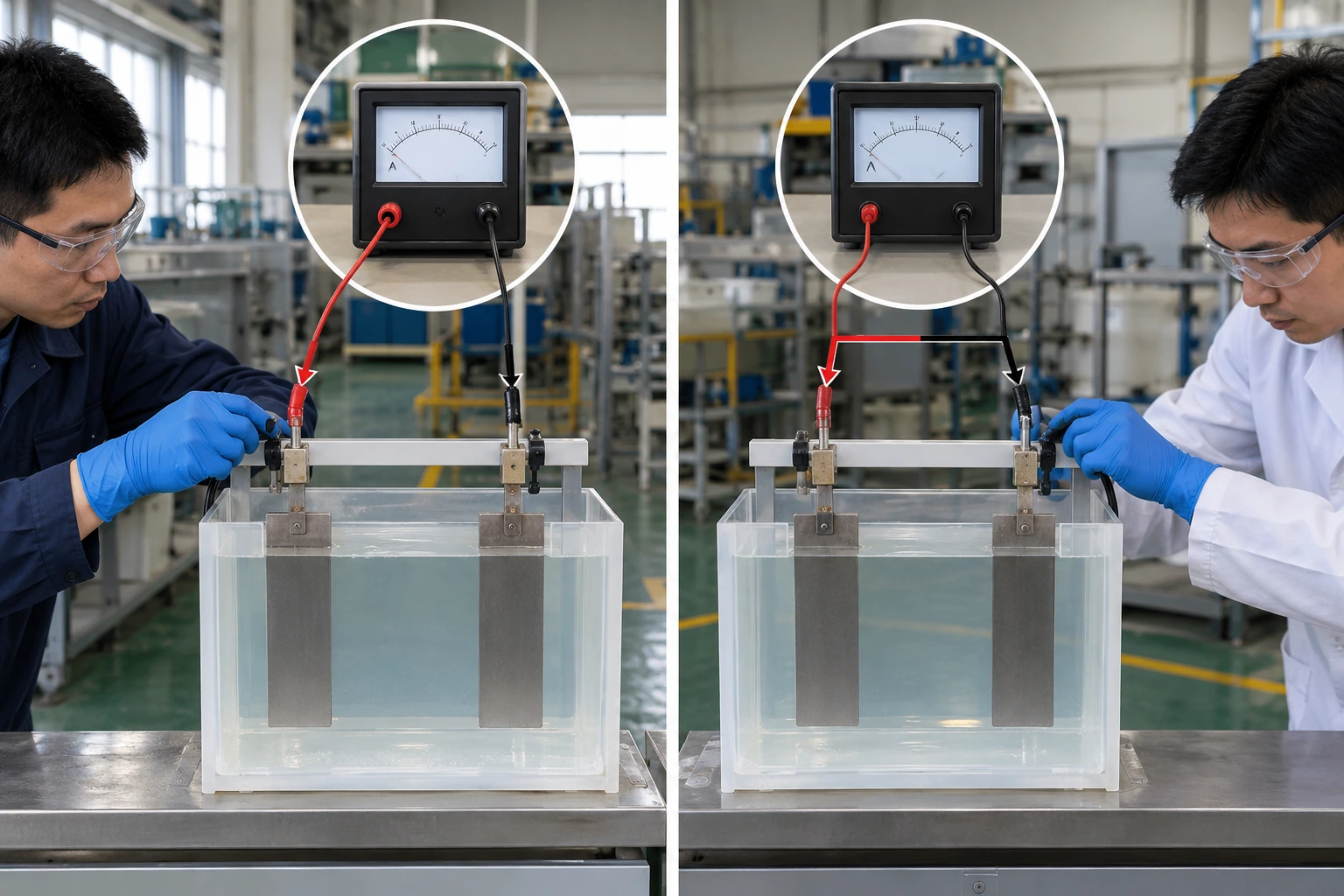
Titanium electrode voltage control holds a selected terminal voltage while current responds to cell conditions. Conductivity, temperature and electrode state can therefore change current during a run.
When can fixed voltage mislead you?
Watch the current response. A voltage setting that worked yesterday may produce another current today. Specify a current ceiling and review operation against the electrode's approved area and duty.
- Record sensing-point location.
- Trend current beside voltage.
| Check | Decision |
|---|---|
| Constant voltage | Current follows changing load |
| Constant current | Voltage follows changing load |
Select control based on what your process must regulate. Key Takeaway: A fixed voltage setting is not a fixed reaction rate.
3. Why does Titanium electrode resistance change?

Titanium electrode cell resistance and reaction requirements change with electrolyte, temperature, gas coverage and surface condition. Your controller responds to these changes but cannot identify their cause.
What does a changing control output reveal?
Treat controller effort as evidence. Rising voltage under current control deserves investigation against process conditions. Falling current under voltage control may describe a related change through another operating mode.
- Compare temperature and conductivity records.
- Preserve flow and maintenance events.
| Check | Decision |
|---|---|
| Voltage rises at fixed current | Investigate additional losses |
| Current falls at fixed voltage | Investigate changed cell behavior |
Interpret readings within the selected control mode. Key Takeaway: Mode-aware trends prevent incorrect comparisons across operating periods.
4. Can Titanium electrode current exceed its area limit?

Titanium electrode current can exceed an approved area-based limit if your setpoint ignores immersed active area or parallel current distribution. A rectifier's capacity is not an electrode rating.
Which area supports your setpoint?
Check the drawing basis. Include exposed faces, masking and immersion level in a custom engineering review. Do not count hidden, dry or electrically inactive surfaces as equivalent reaction area.
- State the area convention explicitly.
- Review current sharing between parallel branches.
| Check | Decision |
|---|---|
| Nameplate current | Available supply capacity |
| Approved current density | Application-specific electrode condition |
Use the smaller verified operating envelope. Key Takeaway: Set current from qualified duty and active area, not supply size.
5. What happens at Titanium electrode voltage compliance?

At voltage compliance, a Titanium electrode supply cannot maintain its commanded current because the required voltage exceeds its available setting or capacity. Actual current then differs from the setpoint.
Has regulation reached its limit?
Read the operating status. Review current, voltage and mode indicators together. Increasing compliance without checking insulation, chemistry and equipment limits can create a different fault.
- Log compliance events and duration.
- Investigate why required voltage increased.
| Check | Decision |
|---|---|
| Within compliance | Current regulation may be maintained |
| At compliance | Actual current can fall below command |
Confirm actual delivery before calculating production from setpoints. Key Takeaway: A commanded current is not proof that the cell received it.
6. Does current control fix Titanium electrode output?

Current control cannot fix Titanium electrode output changes caused by competing reactions, feed variation or sampling errors. Charge and useful production must be compared using matched measurement boundaries.
What else controls your yield?
Measure the product stream. Track concentration with flow for continuous production, or quantity over a defined batch period. Keep chemical measurement units consistent across comparisons.
- Record inlet and outlet conditions.
- Separate concentration from production rate.
| Check | Decision |
|---|---|
| Electrical charge stable | Input basis is controlled |
| Yield changed | Investigate chemistry and measurement |
Use output evidence to test your control strategy. Key Takeaway: Electrical consistency supports a trial but does not replace chemical analysis.
7. How should Titanium electrode startup be controlled?
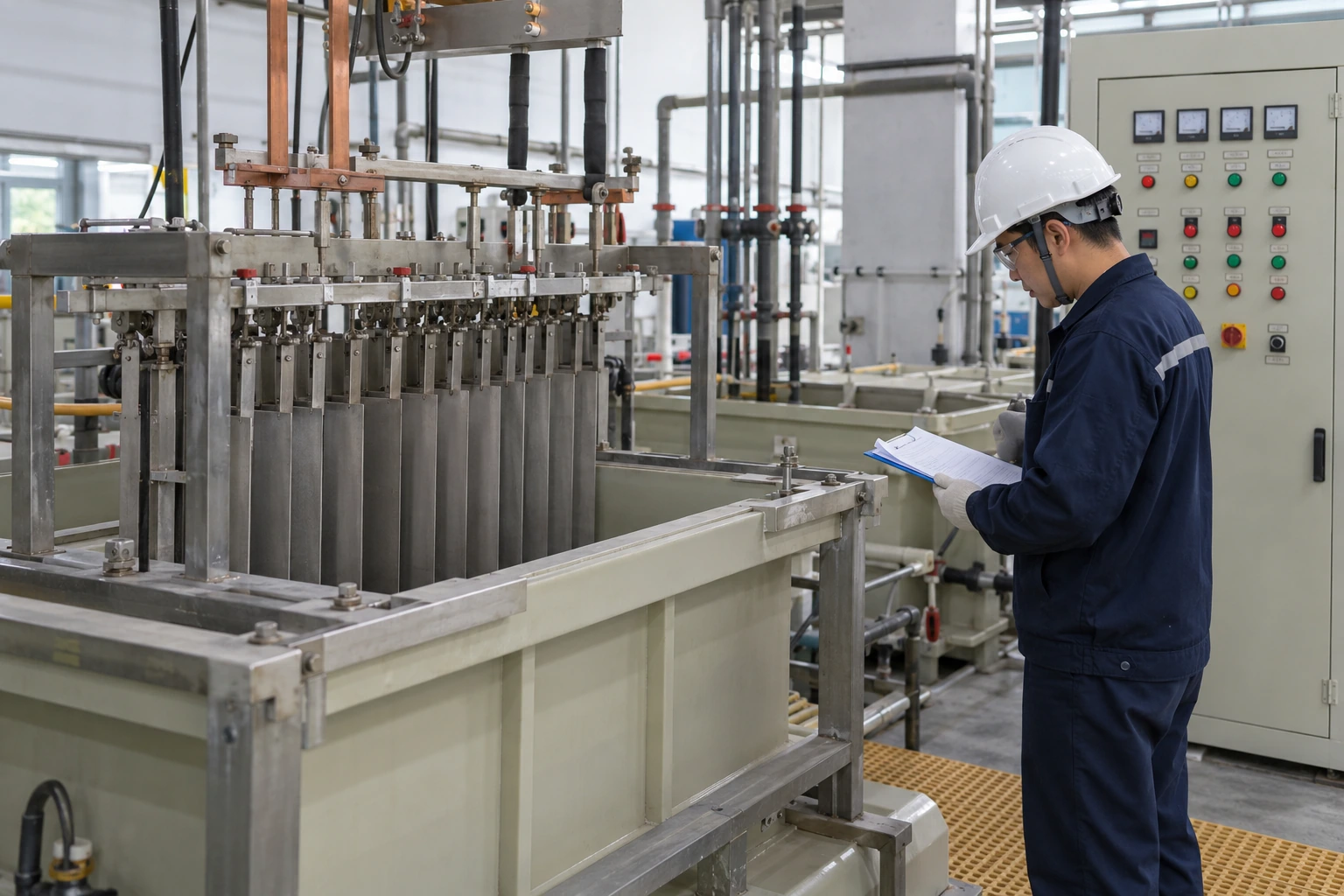
Titanium electrode startup should introduce power only after approved liquid, circulation and gas-management checks are satisfied. Current ramps and stabilization periods must come from equipment-specific commissioning requirements.
What should happen before power is enabled?
Verify permissives before commands. A stored setpoint should not override a missing process condition. Qualified commissioning personnel should document power-enable and restart behavior.
- Confirm approved sensor and interlock status.
- Record baseline conditions before ramping.
| Check | Decision |
|---|---|
| Permissives incomplete | Do not energize |
| Conditions verified | Follow the approved startup procedure |
Keep sequence control separate from current regulation. Key Takeaway: A stable current loop cannot make an unsafe startup acceptable.
8. Which Titanium electrode alarms support control?

Titanium electrode control needs application-specific protection for conditions that current regulation cannot manage, including flow, temperature and gas handling. Alarm and trip functions require their own engineering review.
Which process faults can the controller miss?
List independent failure modes. For water-treatment applications, consider loss of liquid service even when electrical readings look plausible. Assign each required protective action to verified hardware and logic.
- Distinguish alarms from automatic trips.
- Document reset and restart conditions.
| Check | Decision |
|---|---|
| Electrical regulation | Maintains selected output |
| Process protection | Responds to defined hazardous conditions |
Do not assign every protective function to one current loop. Key Takeaway: Control and protection need separate acceptance checks.
9. How can you test Titanium electrode control stability?

Titanium electrode stability should be tested across the approved operating range using measured current, voltage and process output. A short room-temperature demonstration cannot qualify all intended conditions.
What makes a useful acceptance run?
Choose representative operating points. Include conditions expected during actual service without crossing approved limits. Record deviations and settling behavior so procurement can judge the complete requirement.
- Agree on measurement uncertainty and duration.
- Retain raw trends rather than averages alone.
| Check | Decision |
|---|---|
| Single nominal point | Limited evidence |
| Approved range comparison | Broader operating evidence |
Keep acceptance claims within the tested range. Key Takeaway: Specify the operating envelope before accepting stable-control claims.
10. What Titanium electrode settings need supplier review?

A Titanium electrode settings review should cover control mode, active area, voltage compliance, normal chemistry and protective functions. This turns an unexplained production swing into a defined engineering question.
Ask for a coordinated operating envelope
Share settings with their context. You can contact us today with your cell drawing and electrical duty for an electrode suitability review. Our approach ties electrode recommendations to measured process conditions.
- Identify settings and actual readings.
- Include normal, startup and fault states.
| Check | Decision |
|---|---|
| Electrode review | Checks material and duty fit |
| System approval | Remains with responsible equipment engineers |
Document who approves each operating limit. Key Takeaway: Choose a control strategy that your complete cell system can support.
Frequently Asked Questions
Can I switch from voltage control to current control? Possibly, after system review. Current limits, compliance, startup behavior and existing protective functions must remain suitable.
What's the best mode for constant production? Current control can help regulate charge input. Actual production still depends on chemistry, flow and useful current efficiency.
How do I know if the supply has reached compliance? Check measured output and operating status. Current below command while voltage reaches its allowed limit is a warning sign.
Can I raise current when concentration drops? Not without diagnosing the change. Dilution, sampling or competing reactions may explain lower concentration without requiring more current.
Can I copy settings from an identical-looking electrode? No, appearance is insufficient. Confirm active area, coating, electrolyte and the complete approved duty.