
Pair a Titanium electrode anode with a cathode qualified for your reduction reaction, electrolyte and product requirements. You may specify the anode carefully while treating the other plate as interchangeable metal. That shortcut can leave cathodic deposits, contamination or excessive voltage unexplained. Review both reaction surfaces as a pair before accepting a cell-performance claim.
1. Why does a Titanium electrode need cathode matching?

A Titanium electrode anode needs cathode matching because the other electrode completes the electrochemical circuit and performs a reduction reaction. Its condition affects whole-cell behavior and possible products.
What reaction occurs at the companion electrode?
Name both reactions. Define the desired cathodic process and plausible competing reactions before choosing a material. An electrode described as durable in one duty may be unsuitable in another.
- State anode and cathode roles separately.
- Include expected electrolyte and product conditions.
| Check | Decision |
|---|---|
| Anode specification only | Leaves half the reaction pair undefined |
| Paired specification | Supports complete cell review |
Use both surfaces in your process brief. Key Takeaway: Cell performance cannot be assigned to the anode alone.
2. Is the counter Titanium electrode role always cathodic?
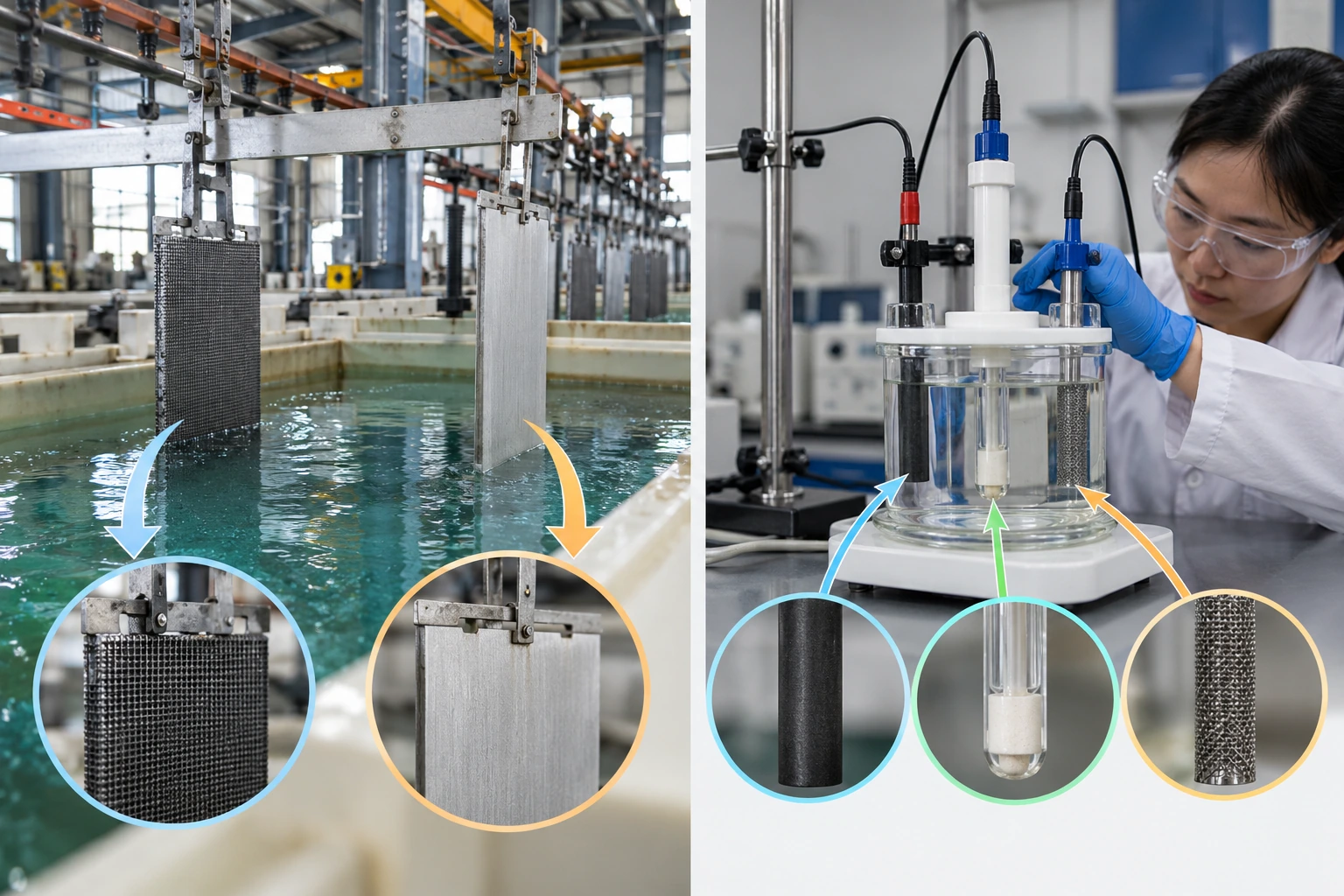
The counter-electrode role in a Titanium electrode experiment is not always cathodic; it depends on the working electrode's instantaneous reaction. In an industrial anodic process, its companion normally performs cathodic reduction.
Are laboratory and industrial names being mixed?
Define function before terminology. A three-electrode experiment also includes a reference electrode with another purpose. Avoid transferring a laboratory counter-electrode description directly into a production cathode specification.
- Identify working, counter and reference roles where applicable.
- State polarity and any reversal explicitly.
| Check | Decision |
|---|---|
| Industrial companion cathode | Reduction role during anodic duty |
| Laboratory counter electrode | Balances working-electrode current |
Keep naming consistent with the actual circuit. Key Takeaway: Electrode role follows operation, not a permanent label on a sample.
3. How does cathode area affect Titanium electrode cells?

Cathode area changes the loading and potential behavior of a Titanium electrode cell's companion surface. The appropriate area ratio depends on reactions, geometry and intended operating conditions.
Can you choose area from an arbitrary ratio?
Use the process basis. Ask for the cathode-area convention and supporting qualification data. A ratio copied from a laboratory experiment may not fit a production cell.
- Record immersed cathode area.
- Review current distribution and spacing.
| Check | Decision |
|---|---|
| Area ratio alone | Does not establish suitability |
| Area with duty and evidence | Supports a technical comparison |
Keep geometry and reaction requirements together. Key Takeaway: Specify cathode area through a qualified operating basis.
4. Can a cathode contaminate Titanium electrode output?

A cathode can contribute contamination to Titanium electrode process output through corrosion, deposits, handling or material release under unsuitable conditions. Whether a detected element came from that surface requires controlled sampling.
Which materials touch the product?
Map every wetted source. Include cathode, seals, piping and feed in a custom application review. Use blanks and comparative samples before assigning an impurity to one electrode.
- Record cathode composition and surface treatment.
- Define product-specific analytical requirements.
| Check | Decision |
|---|---|
| Product impurity detected | Source remains to be investigated |
| Controlled source comparison | Can narrow the origin |
Avoid attributing contamination from one result alone. Key Takeaway: A complete wetted-material inventory improves contamination diagnosis.
5. Does cathode coating change Titanium electrode voltage?

Cathode surface treatment can change Titanium electrode cell voltage by altering the reduction reaction interface. Any claimed improvement needs comparison under equivalent chemistry, geometry and electrical duty.
What would prove a useful cathode change?
Compare the whole operating pair. Record voltage and product quality while holding other conditions stable. Lower voltage is insufficient if a new surface introduces unacceptable product contamination.
- Use matched active-area definitions.
- Include material-condition inspection after testing.
| Check | Decision |
|---|---|
| Voltage benefit only | Incomplete acceptance evidence |
| Voltage and product criteria | More useful comparison |
Judge improvements against the complete process requirement. Key Takeaway: A better electrical reading must still meet material and product limits.
6. How do deposits affect Titanium electrode operation?
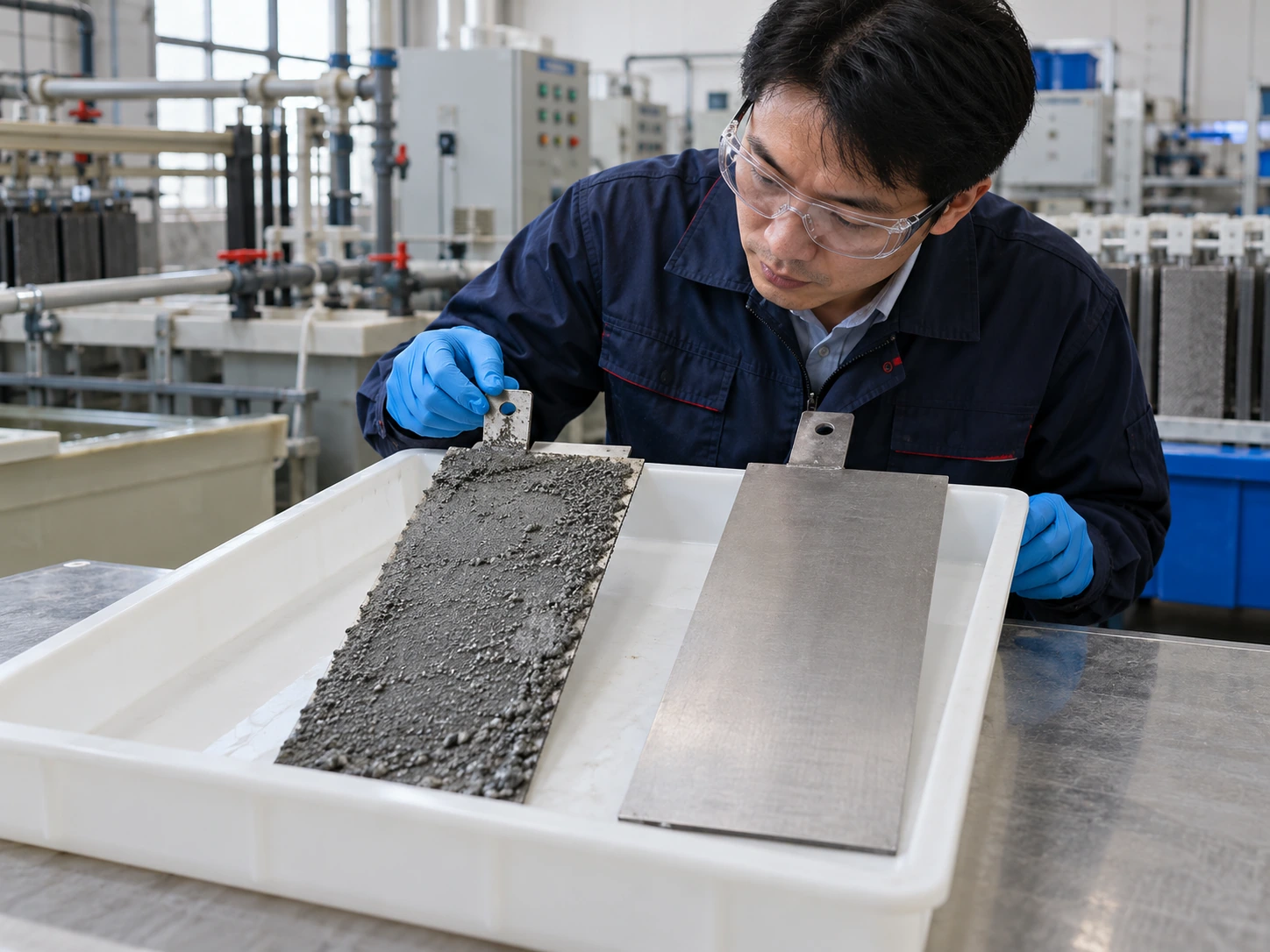
Cathodic deposits can affect Titanium electrode operation by changing surface behavior or narrowing flow paths. Deposit composition and location should guide maintenance review rather than appearance alone.
What is building on the cathode?
Preserve an as-found record. Photograph both electrodes and retain a deposit sample where justified. Cleaning compatibility must include the cathode treatment and adjacent components.
- Record feed quality and cleaning history.
- Compare deposit location with flow geometry.
| Check | Decision |
|---|---|
| Deposit present | Needs identification and context |
| Source understood | Supports prevention and maintenance choices |
Use deposit evidence to investigate recurrence. Key Takeaway: Anode replacement will not remove the cause of repeated cathode buildup.
7. What happens during Titanium electrode polarity reversal?
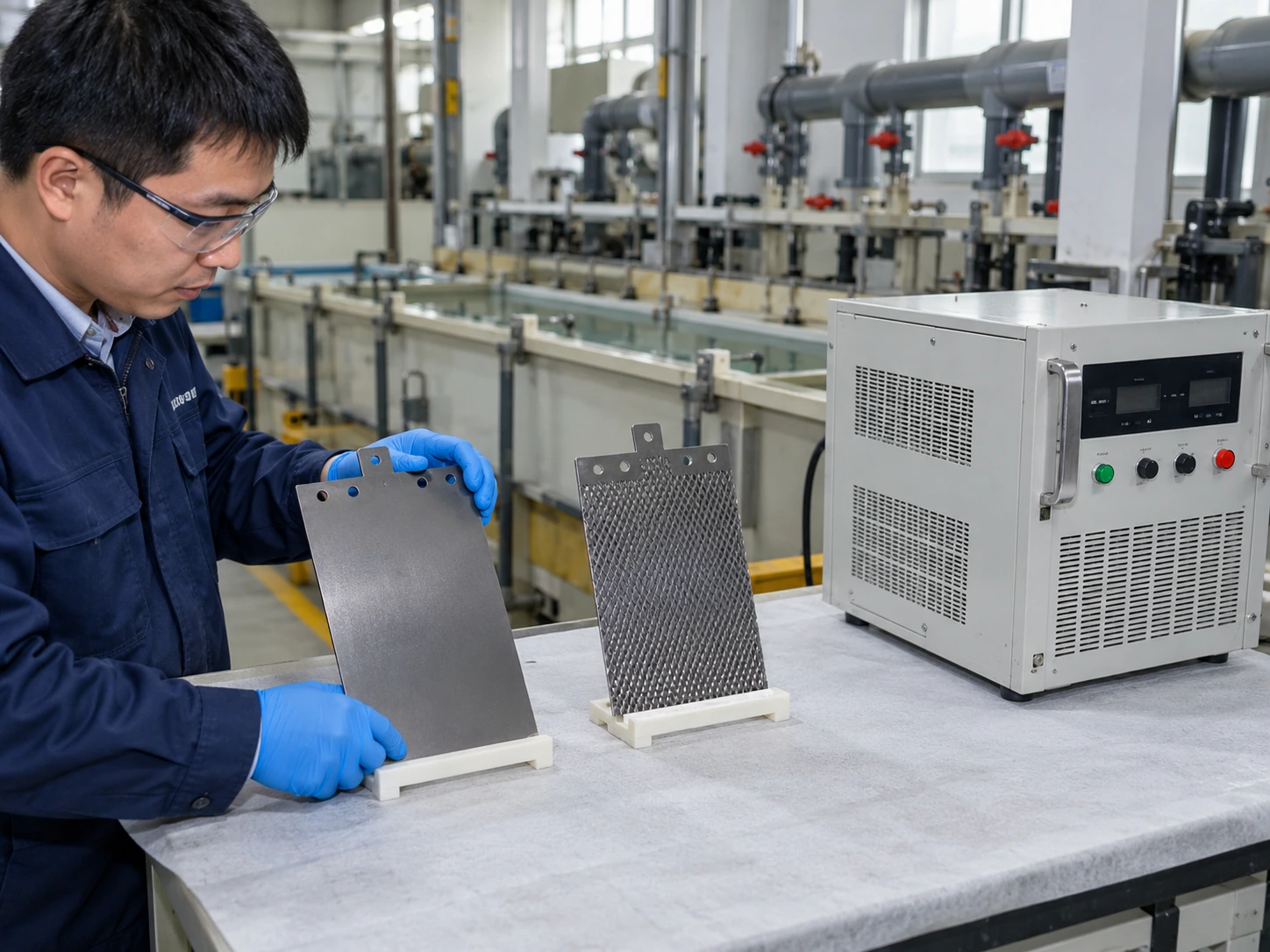
During Titanium electrode polarity reversal, each electrode may face a reaction role outside its normal duty. Both surface systems need explicit qualification for the waveform and electrolyte.
Can both electrodes tolerate the changed role?
Review the pair under reversal. Do not assume that a compatible anode coating makes the companion cathode suitable as a temporary anode. Include peak conditions, duration and repetition in the review.
- Provide measured reversal waveform.
- Identify every treated surface and connection.
| Check | Decision |
|---|---|
| Normal-polarity approval | Does not cover all reverse duty |
| Pair-specific reversal approval | Supports the intended program |
Treat reversal as a separate operating condition. Key Takeaway: Qualify both sides before enabling a reverse-current program.
8. When should Titanium electrode compartments be separated?
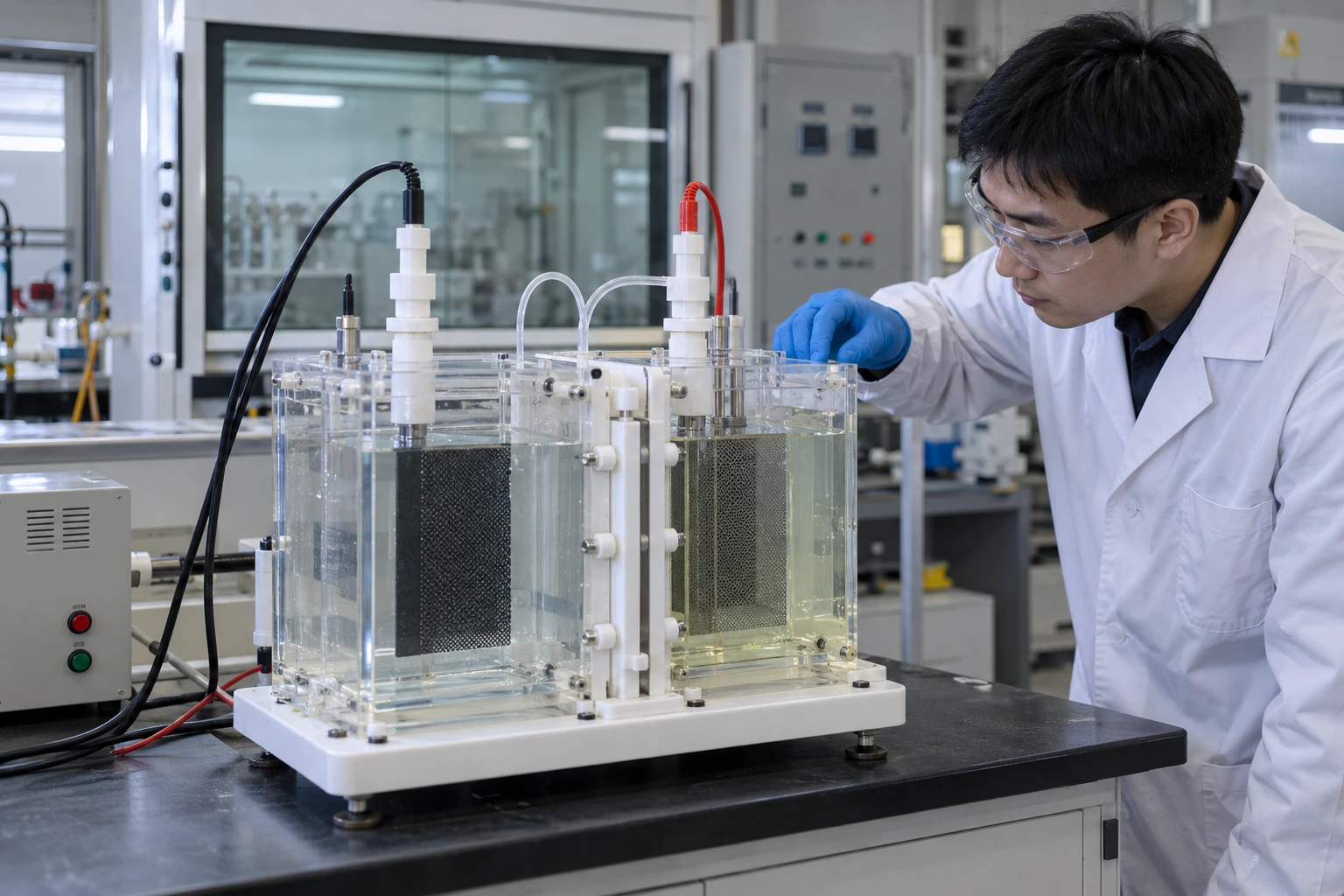
Separate compartments may be needed when Titanium electrode anode and cathode products must not mix freely. A separator introduces its own transport, sealing and electrical requirements.
Would separation solve the product problem?
Define the required barrier function. Compare drawing-based electrode options with your product-purity and crossover requirements. A divided arrangement should be justified by a measurable process objective.
- Identify unwanted cross-reactions or contamination.
- Specify acceptable transport between compartments.
| Check | Decision |
|---|---|
| Shared chamber acceptable | May avoid separator complexity |
| Separation required | Needs qualified cell interfaces |
Select architecture around the product requirement. Key Takeaway: Use a separator for a defined problem, not as a universal upgrade.
9. How do you qualify a Titanium electrode pair?

A Titanium electrode pair should be qualified through matched operating tests that measure electrical behavior, useful output and material condition. Keep feed, geometry and sample history controlled.
What does acceptance cover?
Write the paired test scope. Define criteria for both electrodes and for the resulting product. Record what remains untested instead of stretching a short trial into a lifetime claim.
- Retain pre-test and post-test photographs.
- State duty, duration and stop criteria.
| Check | Decision |
|---|---|
| One-surface inspection | Limited component evidence |
| Paired process trial | Evaluates the intended combination |
Keep acceptance proportional to actual evidence. Key Takeaway: A qualified pair needs defined conditions and measurable endpoints.
10. What Titanium electrode pairing data should you provide?

A Titanium electrode pairing request should include both electrode drawings, reaction roles, electrolyte and product limits. These inputs connect material choices with the process you need to run.
Ask for a paired review
Send both sides of the cell. You can contact us today with the operating brief for a review of electrode materials and drawing-based scope. We support component recommendations that account for the companion reaction.
- Include cathode material and surface treatment.
- State reversal and compartment arrangements.
| Check | Decision |
|---|---|
| Complete pair information | Supports compatibility review |
| Anode-only description | Leaves system assumptions unresolved |
Resolve the missing reaction details before ordering. Key Takeaway: Specify an electrochemical pair, not a well-described anode beside an unknown plate.
Frequently Asked Questions
Can I use any stainless steel plate as the cathode? No. Material grade, electrolyte, polarity, deposits and product-purity requirements need review.
What's the best cathode-to-anode area ratio? There is no universal ratio. Use reaction-specific design and validation data for your geometry and duty.
How do I know if the cathode raises cell voltage? Use controlled diagnostics. Whole-cell readings and separate electrode measurements answer different questions.
Can I reverse polarity with an approved anode? Only after reviewing both electrodes. Each surface must tolerate the changed reaction role under the actual waveform.
Can I blame a metal impurity on the cathode? Only with supporting source evidence. Feed, piping, seals and the other electrode may also contribute.