
Calculate Titanium electrode current density by dividing current through a working surface by its agreed active-area basis. Your new cell may have the same rectifier setting as an older model yet show hotter tabs and faster wear. A changed plate count, masked border, or current path can explain that difference. This guide gives you a calculation method and the checks needed before treating the result as an operating limit.
1. How Do You Calculate Titanium electrode Current Density?
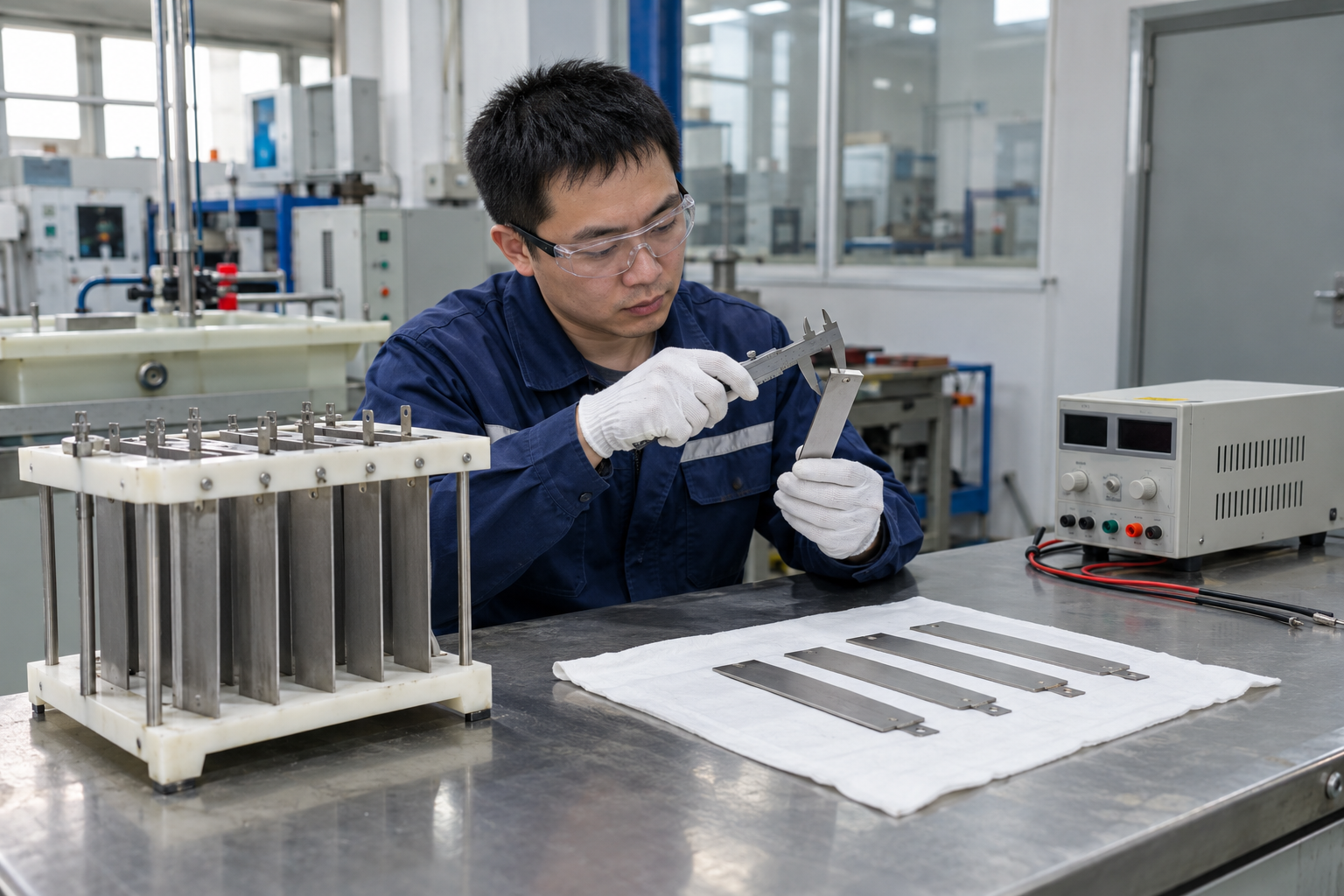
You calculate Titanium electrode current density as j = I / A, using current I and an explicitly defined working area A. A result without its area convention cannot support a reliable comparison.
Which units belong on your calculation?
Put the units beside every number. Amperes divided by square centimeters give A/cm². Do not combine a millimeter drawing with a square-decimeter rating until you convert both dimensions.
- Record measured current rather than rectifier nameplate capacity.
- State whether area means one face, both faces, or projected mesh.
- Keep units attached when transferring results into a quotation.
| Check | Decision |
|---|---|
| 1 dm² | 100 cm² |
| 1 A/dm² | 0.01 A/cm² |
A unit error can change a reported loading by a factor of one hundred. Key Takeaway: Ask both engineering teams to sign off the denominator before discussing a current rating.
2. Which Titanium electrode Area Should You Count?
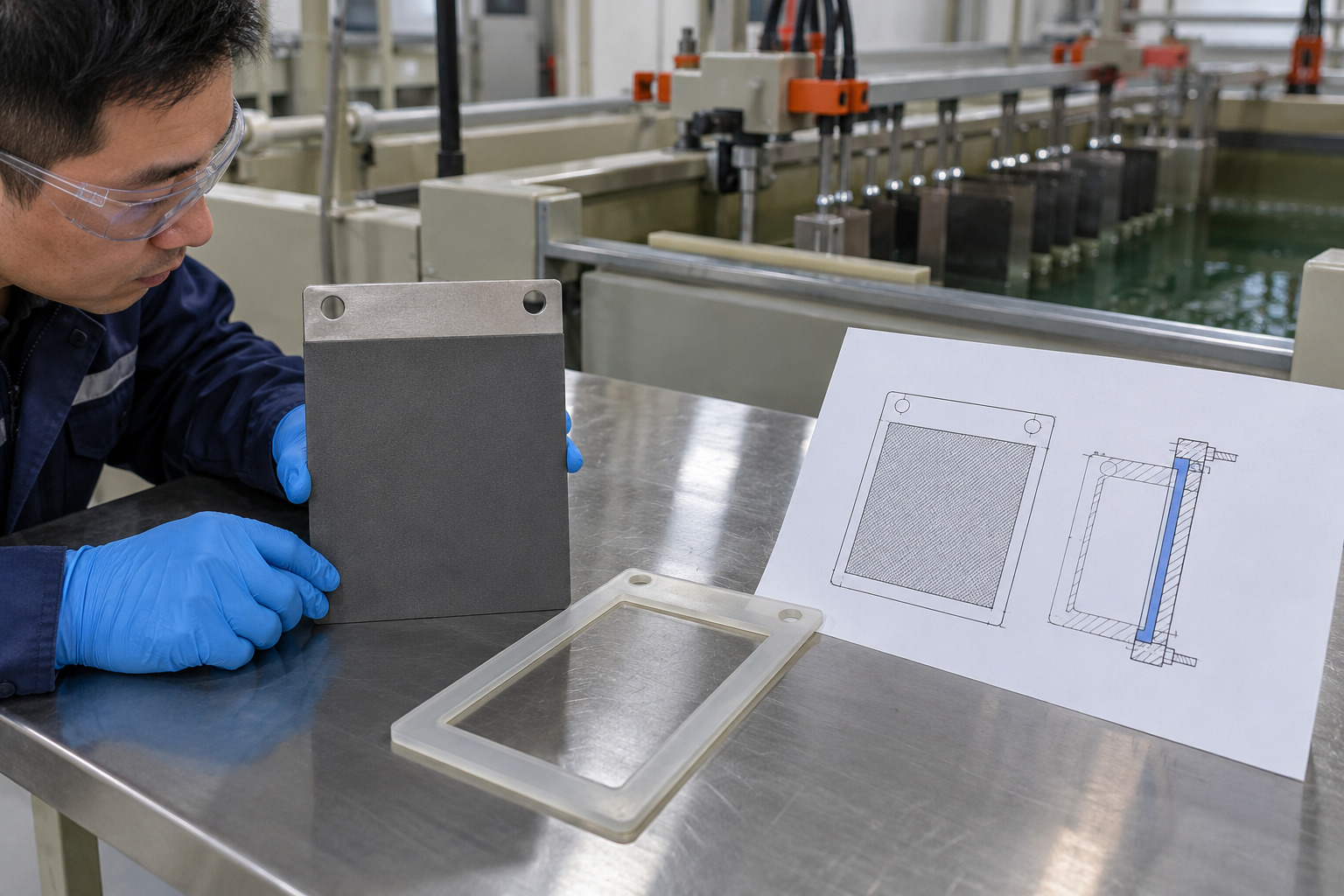
Count only Titanium electrode area included in the agreed calculation convention and exposed to the intended reaction. Tabs, dry borders, and insulated regions usually need separate treatment.
How do you mark the active boundary?
Draw the wet boundary before measuring. A coating may extend behind a gasket where electrolyte cannot reach it. Photograph or annotate that boundary so purchasing can reproduce your calculation.
- Mark the liquid level and gasket footprint.
- Separate mechanical dimensions from exposed dimensions.
- Identify partial immersion and deliberately masked faces.
| Check | Decision |
|---|---|
| Coated but dry tab | Exclude from wetted working-area calculation |
| Exposed working face | Include under the stated convention |
An accurate outer dimension can still produce an inaccurate active-area estimate. Key Takeaway: Keep a marked drawing with every current-density record.
3. Does a Titanium electrode Use One Face or Two?
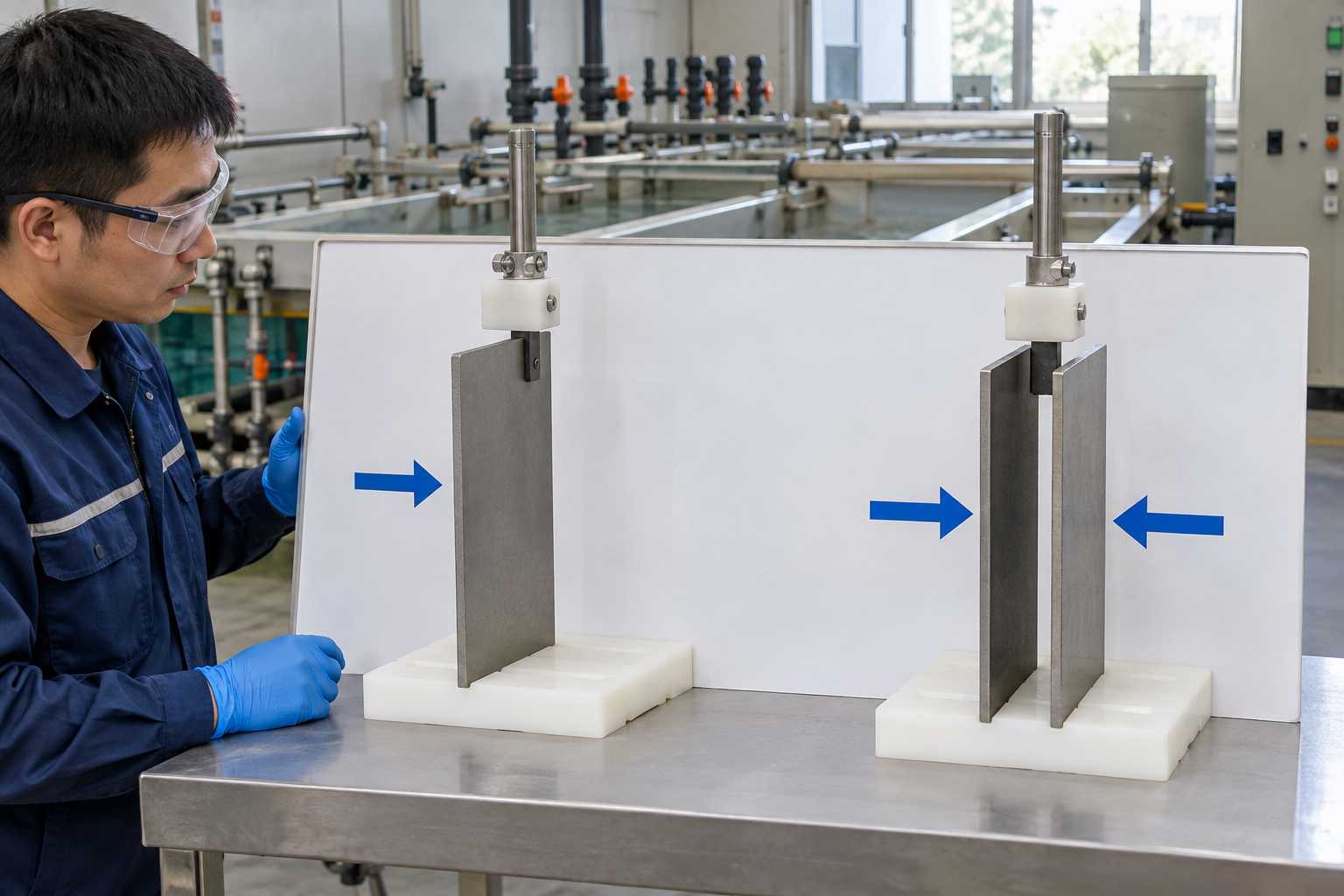
A Titanium electrode uses a two-face area basis only when both faces are included in the design convention and participate in the intended current path. Counting two faces does not prove equal local loading.
What does a simple example show?
Check what each face actually faces. In a hypothetical cell, a 100 cm² active face carrying 10 A averages 0.10 A/cm². Two participating faces totaling 200 cm² average 0.05 A/cm² at the same total current.
- Confirm a counter-electrode faces each working side.
- Identify an outer plate whose rear face has a different field.
- Label the example as arithmetic, not a recommended rating.
| Check | Decision |
|---|---|
| 10 A / 100 cm² | 0.10 A/cm² |
| 10 A / 200 cm² | 0.05 A/cm² |
The calculation changes because area changes, while local current may remain uneven. Key Takeaway: Specify face participation before doubling an area value.
4. How Does Titanium electrode Mesh Change Area Calculations?
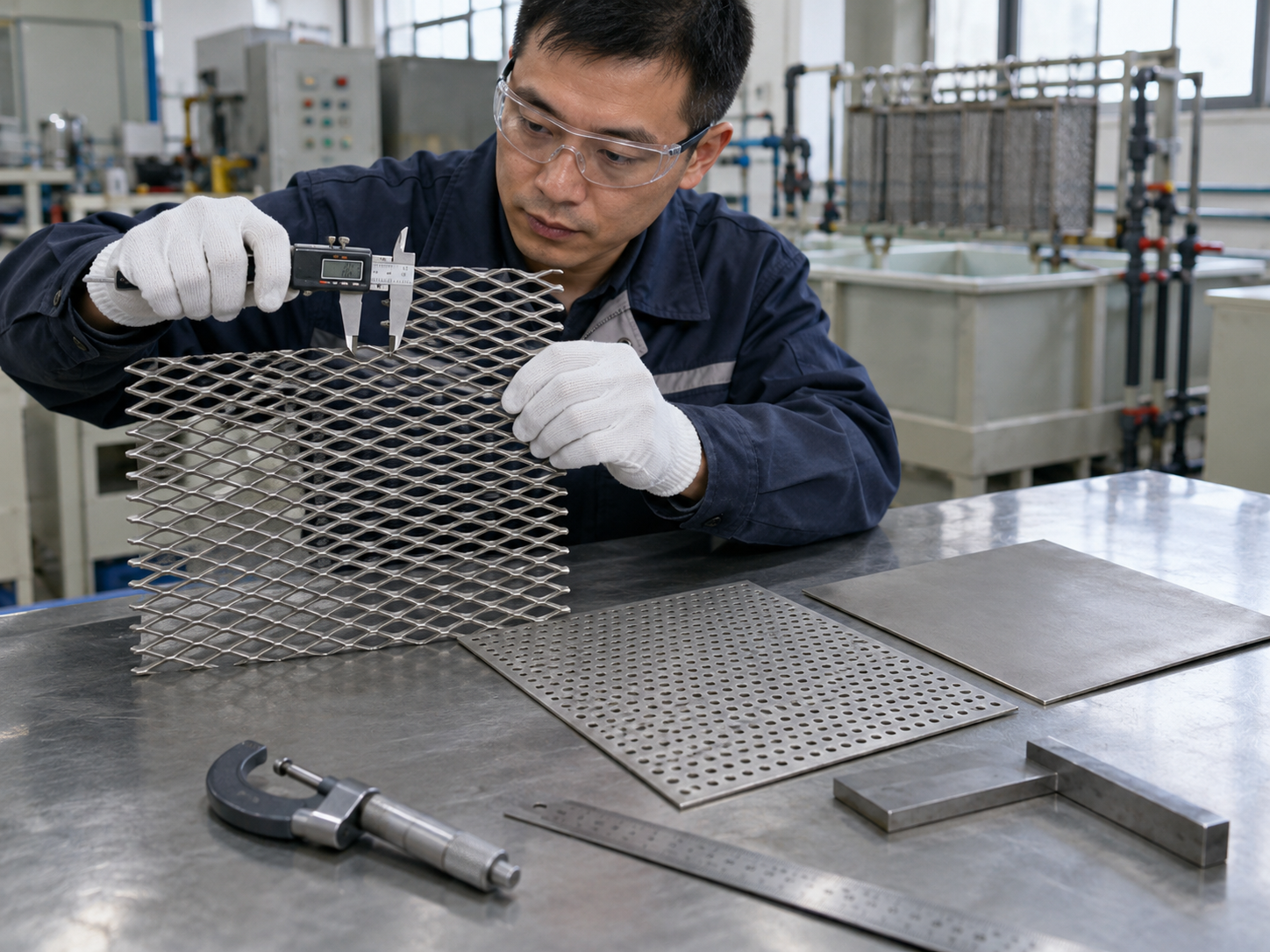
A Titanium electrode mesh requires a declared basis because projected area, metal surface area, and electrochemically active area describe different quantities. An open-area percentage alone does not identify all three.
What should your mesh drawing include?
Use a convention your supplier can reproduce. Your drawing review should include strand width, thickness, aperture dimensions, and mesh orientation. Record whether the quoted rating uses projected panel area or a calculated metal area.
- Retain a photograph with a scale reference.
- Identify expanded, woven, or perforated construction.
- Avoid borrowing an area multiplier from a different mesh.
| Check | Decision |
|---|---|
| Projected area | Panel footprint under a defined convention |
| Metal surface area | Geometry-dependent exposed strand surfaces |
Two meshes with identical outside dimensions can have different metal area and flow resistance. Key Takeaway: Request the calculation basis alongside every mesh current-density claim.
5. How Does a Titanium electrode Stack Divide Current?
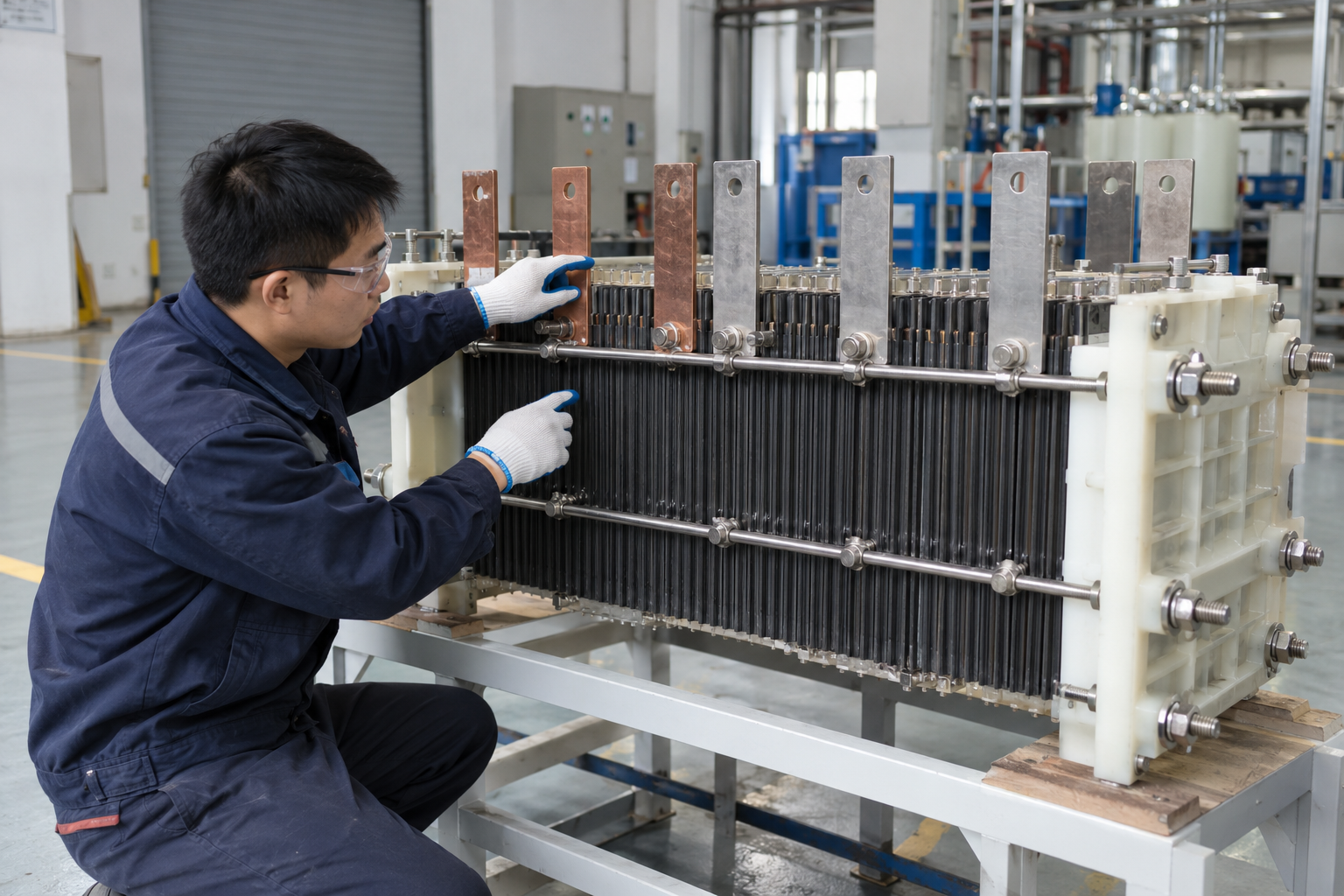
A Titanium electrode stack divides current according to its electrical connections and cell arrangement. Series and parallel assemblies cannot be calculated from plate count alone.
Which electrical sketch should accompany the drawing?
Trace current through one complete path. Series cells carry the same circuit current, whereas parallel branches divide it according to their behavior. A bipolar stack also needs an engineer to identify each active face and path.
- Draw busbars and polarity connections.
- Distinguish cells from individual plates.
- Measure branch current where unequal sharing is plausible.
| Check | Decision |
|---|---|
| Series cells | Use circuit current for each series cell |
| Parallel branches | Use current carried by the relevant branch |
Dividing supply current by every visible plate can underestimate actual surface loading. Key Takeaway: Review the circuit diagram before averaging across a stack.
6. Why Can a Titanium electrode Have Local Hot Spots?

A Titanium electrode can have local hot spots when current crowds near edges, narrow connections, or uneven gaps. Average current density cannot reveal that distribution.
Which geometric details deserve attention?
Look beyond the average value. A bent plate changes spacing even when total area stays constant. Gas coverage and deposits can also shift current into remaining wetted regions.
- Check flatness and installed gap.
- Inspect narrow tabs and sharp active boundaries.
- Compare temperature and surface wear across positions.
| Check | Decision |
|---|---|
| Uniform average | Describes the whole stated area |
| Local peak | Depends on geometry and transport |
A satisfactory average cannot clear a visibly overheated connection or damaged edge. Key Takeaway: Pair area calculations with physical inspection and application testing.
7. How Does Titanium electrode Duty Cycle Affect Loading?

A Titanium electrode duty cycle affects cumulative charge and transient stress, so both peak and average current belong in your specification. Intermittent operation does not erase a high peak.
What should a pulsed operating record contain?
Keep the waveform with the average. In a hypothetical rectangular pulse, 20 A at 50% duty averages 10 A. Its 20 A peak still needs separate coating and connection qualification.
- Record pulse duration, rest duration, and polarity.
- Separate startup excursions from steady operation.
- Track cumulative ampere-hours where useful.
| Check | Decision |
|---|---|
| Peak current | Checks instantaneous loading |
| Time average | Supports charge and energy accounting |
Identical average currents can conceal very different waveforms. Key Takeaway: Submit waveform limits when requesting electrodes for pulsed or intermittent duty.
8. Can Titanium electrode Voltage Reveal Current Density?
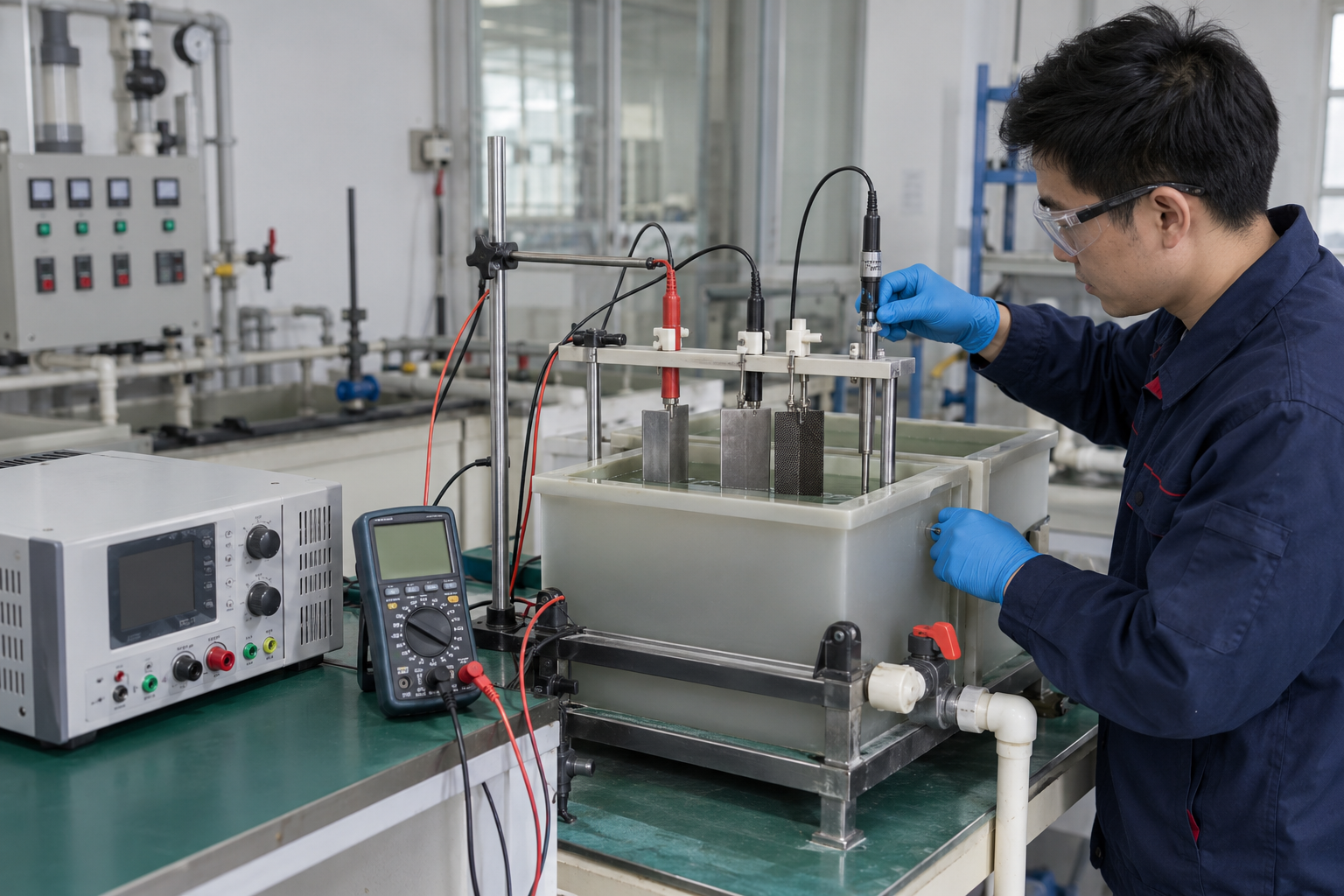
A Titanium electrode voltage reading cannot reveal current density without current and area information. Cell voltage also contains reaction, solution, contact, and separator contributions.
How should you investigate a voltage increase?
Compare like operating points. For electroplating and electrowinning applications, record bath composition and temperature alongside electrical values. A colder bath or larger gap can raise voltage even when the coating has not changed.
- Match current, chemistry, flow, and temperature.
- Inspect contact voltage drops separately.
- Review deposits and electrode spacing before assigning a cause.
| Check | Decision |
|---|---|
| Current plus area | Defines average current density |
| Voltage trend | Helps diagnose changing cell resistance |
A voltage alarm identifies a changed system, not automatically a failed anode. Key Takeaway: Use several measurements before ordering replacement electrodes.
9. How Do You Validate a Titanium electrode Current Limit?

Validate a Titanium electrode current limit using the supplier's duty-specific basis and a test representative of your cell. A calculation supplies loading, not proof of durability.
What should a release test compare?
Choose the acceptance rule before energizing. Agree output, temperature, voltage stability, and inspection criteria with engineering. Test at intended conditions and document any deliberate deviations.
- Use the same area convention as the quotation.
- Include normal and expected high-load operation.
- Retain baseline photographs and instrument records.
| Check | Decision |
|---|---|
| Calculated loading | Checks consistency of design inputs |
| Application test | Checks behavior under specified duty |
An unrecorded test cannot establish which combination actually passed. Key Takeaway: Approve a bounded operating window instead of an isolated current number.
10. What Titanium electrode Data Should You Send for Review?

Send Titanium electrode dimensions, exposed-area markings, electrical layout, current profile, chemistry, and temperature for a meaningful review. Those inputs connect your arithmetic with a manufacturable component.
How do you turn the calculation into an inquiry?
Send the marked drawing with the operating sheet. We can review electrode geometry and coating options against your stated duty; contact us today with that package. Our position is straightforward: an electrode rating should come with conditions you can check.
- Attach area calculations and units.
- Identify unresolved branch currents or masked regions.
- State output targets and sample-test criteria.
| Check | Decision |
|---|---|
| Drawing | Shows what carries and distributes current |
| Operating record | Shows how the assembly will be used |
This package resolves area ambiguity before it becomes a purchasing dispute. Key Takeaway: Keep calculations, drawings, and trial results under one revision.
Frequently Asked Questions
Can I use total plate size as active area? Only if your agreed convention supports it. Dry tabs, gaskets, and masked borders may reduce the participating area.
What's the best current density for my cell? There is no universal value. Coating, chemistry, temperature, waveform, and geometry determine an appropriate operating range.
How do I know if both electrode faces count? Check the electrical and mechanical layout. Both faces must participate under the area convention used for the rating.
Can I divide rectifier current by every plate? Not automatically. Series cells and parallel branches distribute current differently, so start with a circuit diagram.
Can I raise current after adding more electrode area? Only after review. Flow, contacts, gas handling, power supply, and coating limits must support the revised operating point.