
Choose a Titanium electrode mesh or plate according to your cell's flow path, current distribution, spacing, and mechanical support. A mesh that fits perfectly can still trap deposits or flex into a narrow gap. A solid plate can simplify inspection yet obstruct a flow-through design. Compare both forms using the same operating duty and a drawing that shows how electrolyte and current actually move.
1. When Does Titanium electrode Mesh Make Sense?
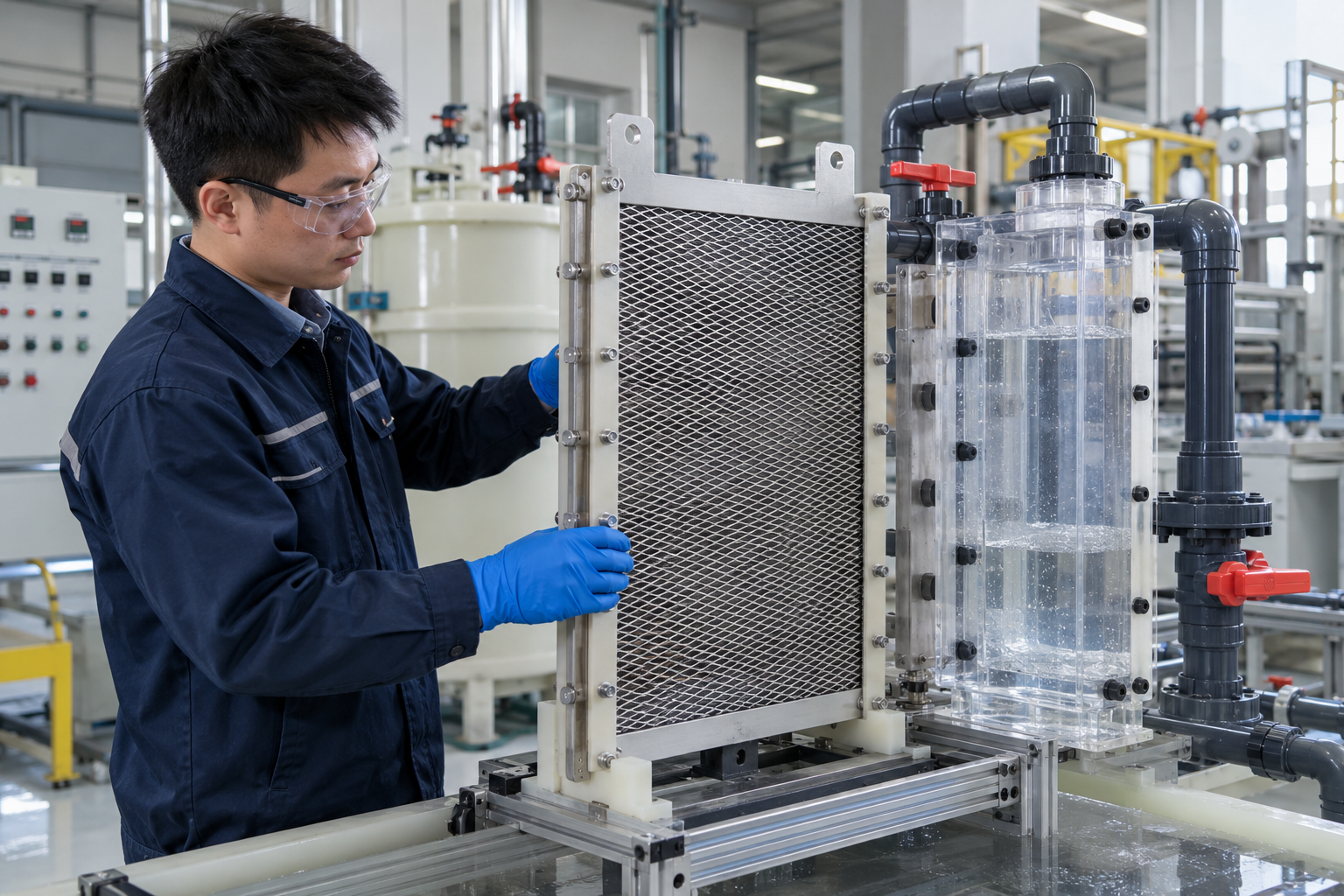
A Titanium electrode mesh makes sense when openings help electrolyte passage, gas release, or access around complex parts. Its benefit depends on orientation and support inside your actual assembly.
What must the openings accomplish?
Give every opening a job. Mesh should solve a transport or geometry requirement. Buying it solely because it looks like a larger surface can produce an unsupported current-density assumption.
- Show intended flow direction through or alongside the mesh.
- Check whether deposits can bridge apertures.
- Identify supports that prevent distortion during installation.
| Check | Decision |
|---|---|
| Open flow path | Confirm aperture and orientation |
| Unsupported wide span | Review stiffness and reinforcement |
Open geometry changes both fluid movement and mechanical behavior. Key Takeaway: Choose mesh for a documented cell requirement.
2. When Does a Titanium electrode Plate Make Sense?
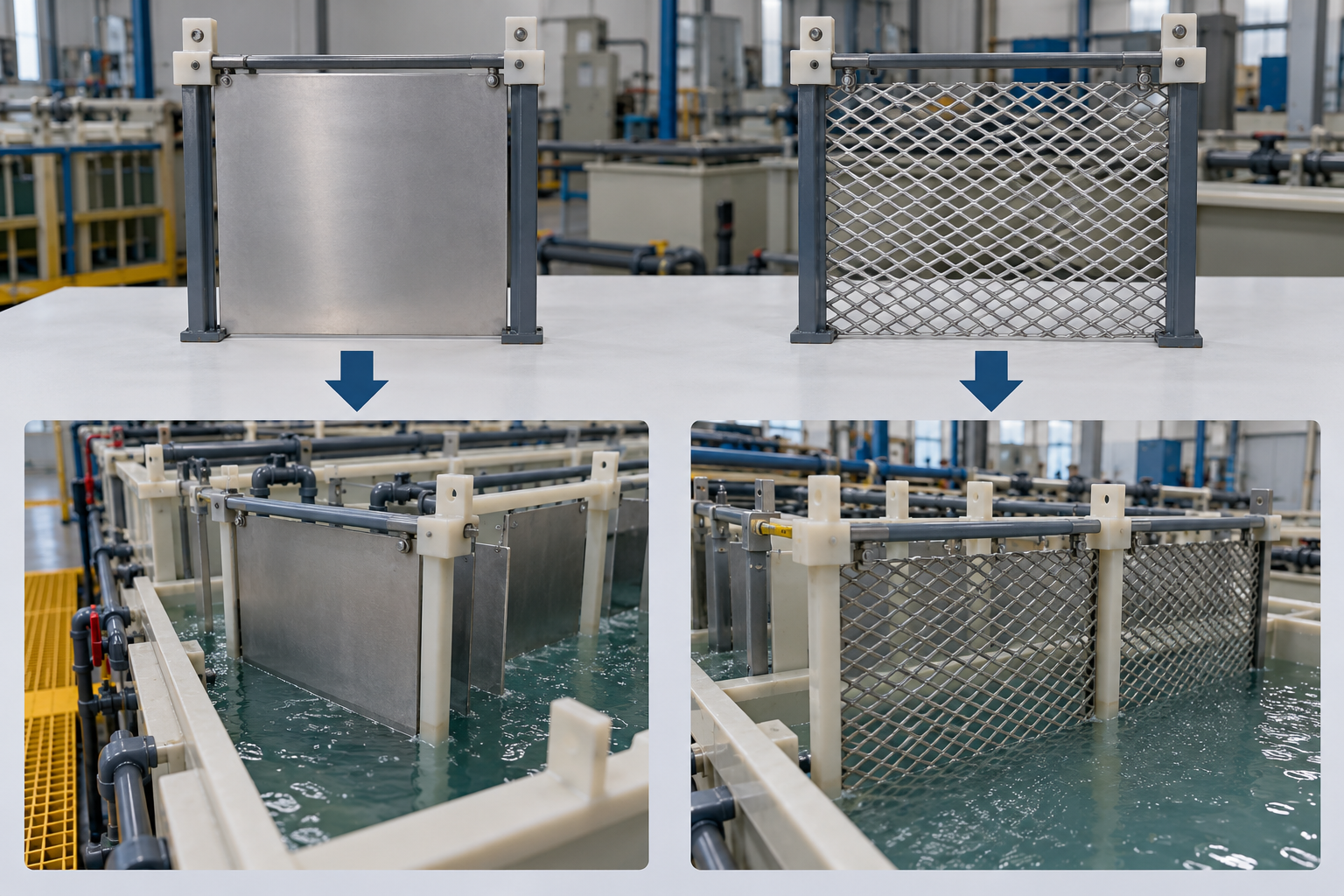
A Titanium electrode plate makes sense when a flat working face, controlled gap, or straightforward surface inspection supports your process. A plate still needs a route for liquid and gas movement.
How do the two forms compare visually?
Compare the installed shapes. A flat panel and expanded mesh can share outside dimensions while presenting different flow passages. Inspect the frame, not just the loose sample.
- Compare clearance around the panel.
- Check how bubbles escape at the upper edge.
- Verify that gasket compression does not warp the plate.
| Check | Decision |
|---|---|
| Solid plate | Continuous face and defined edge |
| Expanded mesh | Open apertures with directional strands |
The best loose sample may be the wrong installed component. Key Takeaway: Evaluate both forms in an assembly drawing.
3. How Do You Compare Titanium electrode Working Areas?

Compare Titanium electrode working areas using the same declared convention for each design. Mesh projected area, strand area, and electrochemical surface area are not interchangeable.
Which denominator belongs in the comparison?
Agree on area before comparing current. Ask each supplier whether a quoted density uses panel footprint or calculated metal surface. Retain that definition in trial reports and purchase specifications.
- Record mesh aperture, strand width, and thickness.
- Identify coated faces and masked borders.
- Avoid applying a generic mesh-area multiplier.
| Check | Decision |
|---|---|
| Plate face area | Calculated from exposed dimensions |
| Mesh area | Requires its stated geometric convention |
Different denominators can make identical currents appear to favor one design. Key Takeaway: Normalize the area basis before comparing performance claims.
4. How Does Titanium electrode Geometry Affect Flow?

A Titanium electrode geometry affects flow resistance, local mixing, and stagnant regions. Mesh openings can help transport, but a narrow or fouled aperture can become a restriction.
What should the pilot rig reveal?
Follow the liquid through the entire cassette. Your water-treatment application review should include inlet distribution and outlet conditions. A photograph of bubbles alone cannot quantify how evenly liquid reaches the working faces.
- Record flow and pressure loss at operating temperature.
- Inspect inlet and outlet distribution.
- Repeat the check after realistic deposit formation.
| Check | Decision |
|---|---|
| Clean assembly | Establishes baseline flow |
| Used assembly | Reveals fouling sensitivity |
A clean-water trial may overstate performance in solids-bearing service. Key Takeaway: Test the geometry with representative liquid conditions.
5. Can Titanium electrode Shape Change Current Distribution?
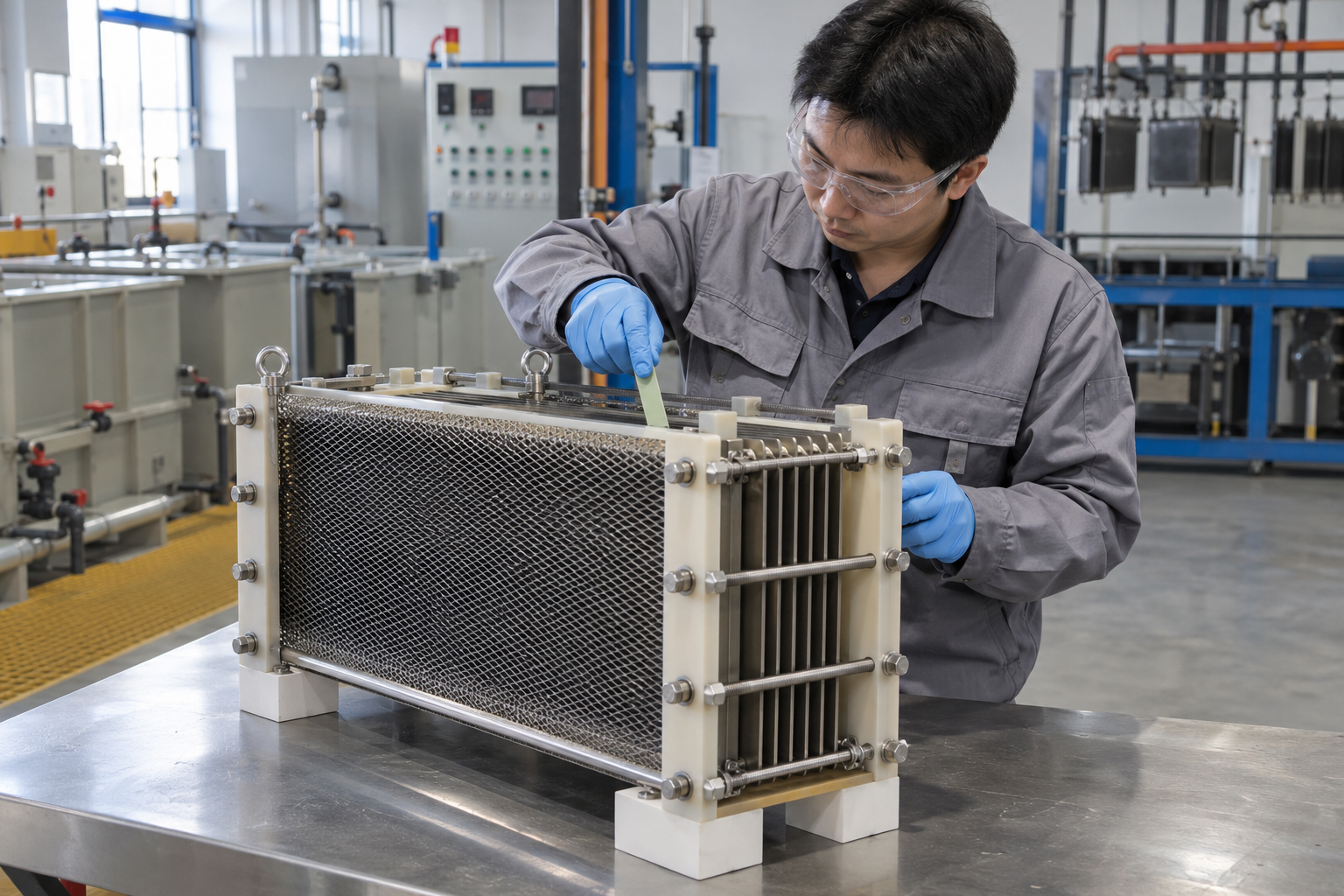
A Titanium electrode shape can change current distribution through edges, strand geometry, spacing, and proximity to opposing surfaces. Coating chemistry does not remove those geometric effects.
Where should you look for uneven loading?
Inspect the nearest gaps and narrowest paths. Distorted mesh can approach a cathode locally while average spacing remains acceptable. Similar effects occur around plate edges and projecting tabs.
- Measure installed gap at multiple positions.
- Check strand orientation and sharp projections.
- Compare wear or deposits across the working surface.
| Check | Decision |
|---|---|
| Consistent spacing | Supports repeatable geometry |
| Local protrusion | May concentrate current |
Outside dimensions alone cannot establish electrical equivalence. Key Takeaway: Include gap measurements in sample approval.
6. How Should You Support a Titanium electrode Mesh?

Support a Titanium electrode mesh so it retains shape during transport, assembly, flow, and thermal cycling. The required frame depends on span, strand dimensions, and mounting loads.
Which loads belong in the drawing review?
Check handling as well as operation. A mesh may be stiff enough in water yet bend when lifted from one tab. Specify approved lifting points and support locations before coating.
- Define frame and weld positions.
- Keep lifting forces away from fragile coated areas.
- Check clearance after clamping and thermal movement.
| Check | Decision |
|---|---|
| Frame support | Controls span and position |
| Handling fixture | Reduces assembly damage |
Mechanical stability protects the gap that electrical testing assumes. Key Takeaway: Approve a supported assembly rather than an unsupported coupon.
7. Which Titanium electrode Coating Fits Each Shape?

A Titanium electrode coating must fit chemistry and reaction duty whether its substrate is mesh or plate. Both forms can carry application-specific active surfaces when manufacturing and inspection support them.
Does platinum automatically favor one form?
Separate coating duty from substrate shape. A platinum-coated mesh and plate can serve different installation needs. Ask how inner strands, welds, and edges are coated and inspected.
- Name the electrolyte and intended reaction.
- Mark active surfaces around frames and welds.
- Confirm inspection access to complex features.
| Check | Decision |
|---|---|
| Coating family | Selected against reaction and chemistry |
| Substrate form | Selected against geometry and transport |
A shape comparison cannot replace a coating-compatibility review. Key Takeaway: Approve coating and geometry as related specifications.
8. How Do You Inspect a Titanium electrode Mesh?

Inspect a Titanium electrode mesh for geometry, strand damage, coated boundaries, frame alignment, and batch identity. Its open construction makes sampling position more sensitive than a broad flat face.
What should an inspection report identify?
Record where each measurement was taken. Your quality-control records should distinguish flat coupons from finished mesh. A measurement made across an opening may not represent coating on a strand.
- Specify measurement spots and fixture orientation.
- Check burrs, broken strands, and distorted apertures.
- Retain photographs of coated and contact zones.
| Check | Decision |
|---|---|
| Dimensional check | Confirms form and installation |
| Surface measurement | Needs a geometry-aware method |
A precise instrument does not compensate for an unsuitable sample position. Key Takeaway: Define the inspection method before receiving the pilot batch.
9. How Does Titanium electrode Form Affect Maintenance?

A Titanium electrode form affects deposit access, rinsing, removal, and handling during maintenance. A design that saves space may demand more care when deposits bridge narrow passages.
What should you test before production?
Try the removal procedure on a sample assembly. Confirm that technicians can withdraw the cassette without rubbing active surfaces. Ask for a coating-compatible cleaning method rather than improvising around inaccessible areas.
- Check tool and hand clearance.
- Locate supports used during cleaning.
- Inspect for trapped liquid after rinsing.
| Check | Decision |
|---|---|
| Removable cassette | Can simplify access |
| Tight fixed frame | May restrict inspection and cleaning |
Maintenance access changes service effort even when initial electrical performance matches. Key Takeaway: Include a dry maintenance rehearsal in design approval.
10. How Do You Specify a Titanium electrode Geometry Trial?

Specify a Titanium electrode geometry trial with matched chemistry, current basis, temperature, output targets, and maintenance criteria. That makes mesh and plate comparisons useful for your purchasing decision.
What should the final comparison include?
Compare the complete installed duty. We can review mesh, plate, and fabricated electrode drawings against your operating conditions; contact us today with both candidate layouts. Our position is to make geometry earn its place through measured cell behavior.
- Measure output and electrical consumption.
- Inspect spacing, flow, deposits, and handling.
- Approve the drawing and test conditions together.
| Check | Decision |
|---|---|
| Electrical result | Compare at matched process output |
| Mechanical result | Check fit and service access |
A winner on voltage alone may lose on assembly or maintenance effort. Key Takeaway: Select the form that meets the complete acceptance plan.
Frequently Asked Questions
Can I replace a plate with mesh without changing my cell? Not safely by dimensions alone. Flow, area convention, stiffness, and current distribution need review.
What's the best mesh opening size? It depends on duty. Solids, gas release, pressure loss, mechanical support, and inspection access all affect the choice.
How do I know if mesh has more active area? Ask for the area definition and calculation. Outside dimensions and open-area percentage do not establish electrochemical surface area.
Can I apply the same coating to mesh and plate? Potentially, with process qualification. Complex geometry changes coating access and measurement positions.
Can I choose the cheaper shape after a short trial? Only if the trial covers your acceptance criteria. Include maintenance access and dimensional stability alongside electrical output.