
A Titanium electrode system manages remaining oxidant by pairing generation and contact with a separate downstream process. That step applies when reuse or discharge requires residual reduction. Define treatment boundaries, sample locations, flow range, and control owners before selecting an interface; no single skid or recipe fits every water train.
1. What Residual Follows Titanium electrode Chlorination?

A Titanium electrode chlorination step can leave oxidant in water after its intended contact period, depending on water demand and process conditions.
Separate generation, contact, and residual removal
An electrode cell supplies an oxidant-producing step, while downstream contact and water chemistry shape remaining residual. Trace water beyond its contact stage. If reuse or discharge requires lower oxidant, that objective belongs to a defined downstream process boundary.
- Mark cell outlet, contact volume, residual sample point, and final reuse or discharge point.
- Identify which process owner defines the required endpoint and evidence.
| Check | Decision |
|---|---|
| Electrochlorination | Creates oxidant input |
| Downstream treatment | Manages remaining residual |
Residual management can remain necessary even after a generation cell operates as intended. Key Takeaway: Define the endpoint before selecting a downstream treatment approach.
2. Where Does Dechlorination Fit after a Titanium electrode?
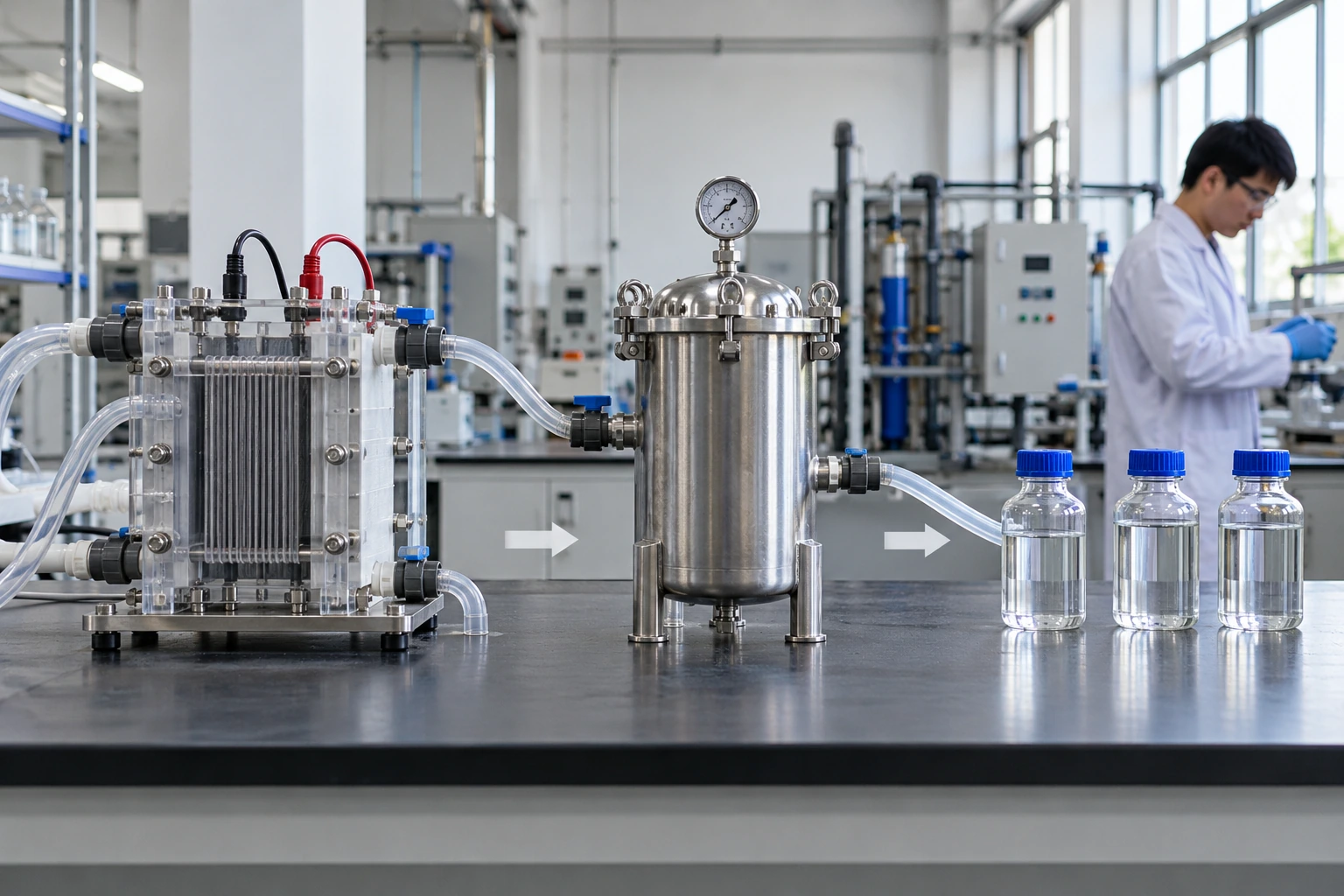
A Titanium electrode treatment train places any dechlorination step after the oxidant duty and before its required reuse or discharge boundary.
Place the handoff on the process flow
A typical review follows generation, contact, residual measurement, downstream treatment, and final sampling as separate stages. Show every package handoff on the flow drawing. A qualitative process board can clarify sequence without implying that each project needs identical equipment or chemistry.
- Draw normal flow and identify any stream that can bypass a treatment stage.
- Name the supplier or facility owner for each process package and control signal.
| Check | Decision |
|---|---|
| Upstream side | Generation and contact |
| Downstream side | Residual management and endpoint |
A clear flow boundary helps prevent gaps between two independently supplied packages. Key Takeaway: Review treatment sequence before defining equipment scope.
3. Why Measure Residual at a Titanium electrode Train Boundary?

A Titanium electrode train needs residual samples at locations that separate cell performance from downstream treatment performance.
Locate samples on both sides of each treatment boundary
A sample after contact describes upstream oxidant demand; a later sample describes conditions after downstream treatment. Put a port at each question. Include the final reuse or discharge point when that boundary determines acceptance.
- Mark samples before and after downstream treatment on the same flow drawing.
- Use a final-point sample when evaluating the process endpoint or permit condition.
| Check | Decision |
|---|---|
| Treatment inlet | Residual entering the step |
| Treatment outlet | Residual after the step |
One final result cannot show which unit created a change across the train. Key Takeaway: Agree on sample locations before a performance review or handover.
4. How Does Demand Change after Titanium electrode Treatment?

A Titanium electrode downstream treatment load changes with incoming residual, flow, water demand, and upstream contact history.
Review the changing load at the interface
A stream reaching a downstream step can vary with cell production, flow, contact, and other chemical demand. Connect upstream operating data to residual load. For a custom cell review, share operating range, contact-volume drawing, flow cases, and inlet residual data.
- Record expected minimum, typical, and peak flow cases without assuming a fixed residual profile.
- Provide representative upstream chemistry and residual data across operating modes.
| Check | Decision |
|---|---|
| Upstream evidence | Contact and residual history |
| Interface evidence | Flow and water chemistry |
A downstream unit cannot be reviewed from a nameplate flow alone. Key Takeaway: Define inlet conditions with the process team before choosing capacity.
5. Which Interfaces Must a Titanium electrode Package Share?

A Titanium electrode package must share its flow, sample, signal, and responsibility interfaces with any downstream residual-treatment package.
Write down who owns each handoff
One package may generate oxidant while another manages residual before discharge. Name an owner for each interface. Agree on signal names, normal-flow range, sampling access, alarm responsibilities, and evidence supplied at commissioning or handover.
- List process data and signals exchanged between each equipment supplier.
- Identify who owns sample methods, control response, and final acceptance.
| Check | Decision |
|---|---|
| Package A | Generation and contact data |
| Package B | Residual treatment and endpoint |
Two capable equipment packages can still leave a gap if no party owns their interface. Key Takeaway: Assign each process and measurement responsibility before purchase.
6. How Can Bypass Affect a Titanium electrode Residual?

A Titanium electrode bypass can change residual treatment if part of the flow misses a downstream step or returns under different conditions.
Trace normal and bypass routes
A bypass may serve maintenance or flow management, but its effect depends on where it connects and how flow returns. Trace normal and bypass paths. Mark valve positions, mixing points, and sample locations so reviewers can tell which water reached treatment.
- Draw normal flow, bypass flow, return point, and final sample location.
- Document who authorizes bypass use and what evidence confirms the intended route.
| Check | Decision |
|---|---|
| Normal route | Passes through treatment |
| Bypass route | May change treatment exposure |
A downstream sample can hide a bypass condition if route and timing are unknown. Key Takeaway: Include bypass states in the process and sampling review.
7. Which Analyzer Signals Matter after a Titanium electrode?

A Titanium electrode residual interface needs signals and samples that show incoming load, flow, downstream treatment state, and final result.
Pair process status with final-point evidence
An analyzer can report one measured condition, while flow and treatment status explain the process around it. Pair signals with process history. Select methods and locations with a process owner; a single sensor value cannot establish complete treatment performance or discharge approval.
- List analyzer, flow, treatment-status, and sample data shared at the package boundary.
- Define who reviews missing, disagreeing, or out-of-range results.
| Check | Decision |
|---|---|
| Process signal | Flow and treatment status |
| Endpoint evidence | Residual method and result |
A result without flow or treatment context can be difficult to interpret. Key Takeaway: Link final-point samples with the operating state that produced them.
8. What Chemistry Belongs in a Titanium electrode Project Review?

A Titanium electrode dechlorination review needs water chemistry, incoming oxidant, downstream method, reuse or discharge endpoint, and permit ownership.
Make the chemistry and endpoint explicit
A suitable reducing treatment consumes oxidant and converts it into non-oxidizing products; water chemistry and the required endpoint govern selection. Review full stream conditions with process owners. For a water-treatment duty, provide chemistry, inlet residual, flow range, and permit endpoint; an electrode supplier cannot set a universal dechlorination recipe.
- Identify relevant water constituents and treatment steps before selecting a downstream method.
- Have the facility environmental owner confirm applicable discharge and monitoring requirements.
| Check | Decision |
|---|---|
| Chemistry brief | Water and oxidant data |
| Endpoint brief | Reuse or permit boundary |
A method that fits one site's chemistry may not fit another stream or discharge permit. Key Takeaway: Confirm endpoint and chemistry with responsible process owners.
9. What Records Show Stable Titanium electrode Residual Control?

A Titanium electrode residual-control record should connect incoming residual, flow, downstream treatment status, sample method, and final result.
Preserve the complete operating interval
Natural decay or a separate treatment step may affect residual, but process owners must establish whether a chosen route meets their endpoint. Keep the sequence intact in operating records. Record each sample beside flow, treatment status, bypass state, and time so handover evidence reflects the complete interval.
- Keep time-linked inlet, outlet, and final-boundary measurements.
- Record maintenance, bypass, flow changes, and treatment interruptions near each result.
| Check | Decision |
|---|---|
| Process record | Flow and unit state |
| Result record | Method and sample location |
A final sample without unit history cannot explain a residual excursion or improvement. Key Takeaway: Agree on the handover record with operations and environmental reviewers.
10. What Should Buyers Specify for Titanium electrode Dechlorination?

A Titanium electrode dechlorination interface request needs the residual objective, flow range, chemistry, sample map, package limits, and acceptance owner.
Specify the boundary instead of assuming a standard skid
Share process drawings, upstream data, downstream method, signals, and final discharge or reuse conditions. Make scope visible on process drawings. To discuss an electrode interface, contact us today with a defined process boundary; ARY Titanium's listed product scope does not imply a supplied dechlorination skid.
- Attach process flow, chemistry data, measurement locations, and package responsibility notes.
- Identify the system integrator or treatment owner responsible for downstream performance.
| Check | Decision |
|---|---|
| Buyer input | Duty and interface data |
| Review outcome | Component fit or open scope |
A titanium electrode inquiry does not establish the design or performance of a separate residual-treatment unit. Key Takeaway: Confirm process ownership before finalizing the equipment handoff.
Frequently Asked Questions
Can I assume every electrochlorination system needs the same dechlorination skid? No; need and method depend on process chemistry, reuse or discharge endpoint, flow, and site requirements.
What's the best place for a downstream residual sample? A useful plan sets locations around treatment boundaries and the final endpoint, then links sample timing to flow and operating state.
How do I know if a stream bypassed residual treatment? Trace its piping route and operating state, then compare time-linked samples before and after the suspected bypass boundary.
Can I rely on natural decay to manage residual? Natural decay may fit only when process data and applicable endpoints support it; confirm with a facility owner.
How do I know if the project assigned dechlorination performance? Project documents should name the process designer, equipment supplier, sampling owner, permit reviewer, and party accepting final results.