
A Titanium electrode can support electrooxidation, while electrocoagulation relies on a dissolving metal anode for coagulant ions. Choosing between those jobs starts with the contaminant form and required endpoint, then follows with a cell and separation plan matched to representative water.
1. How does a Titanium electrode fit wastewater treatment?

A Titanium electrode usually belongs in oxidation or generation duty, while electrocoagulation often consumes iron or aluminum anodes. Pollutant names alone cannot identify which route fits a treatment train.
Start with the removal mechanism
EC releases metal ions that form coagulant species; EO transfers electrons or creates solution-phase oxidants. Start with the process endpoint. Decide whether a target leaves with floc or changes chemically.
- Separate suspended, colloidal, and dissolved target fractions in representative samples.
- Name the required endpoint, such as phase separation, compound conversion, or a measured residual.
| Check | Decision |
|---|---|
| EC evidence | Metal release and solids separation |
| EO evidence | Target change and oxidant response |
Similar removal percentages can conceal different mechanisms and different residual streams. Key Takeaway: Write the treatment endpoint before selecting an electrode material.
2. How does coagulation differ from Titanium electrode oxidation?
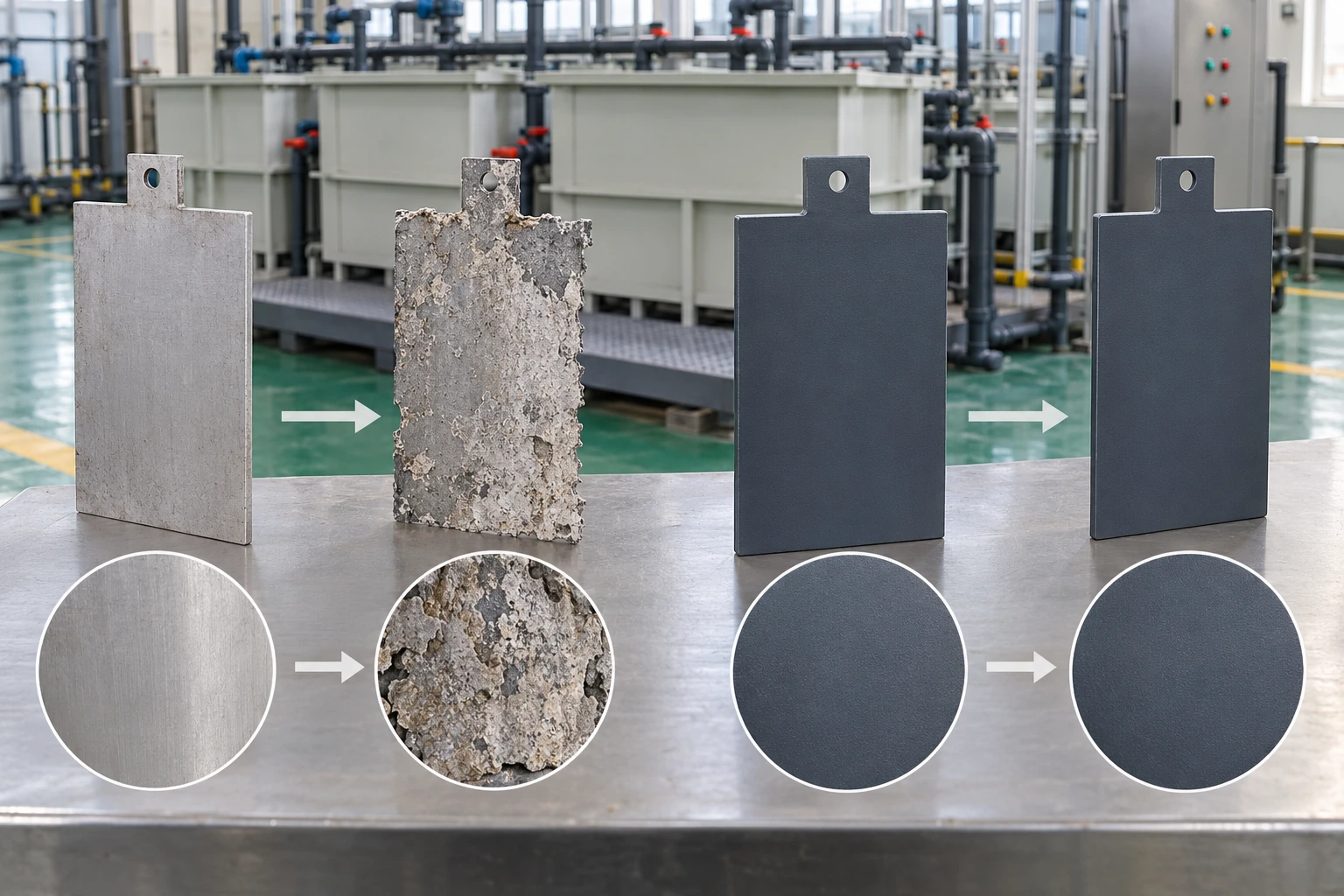
A Titanium electrode route does not create sacrificial metal coagulant by itself; conventional EC dissolves an intentionally consumable anode. Released iron or aluminum species hydrolyze and can destabilize colloids or form flocs.
Trace coagulant back to its source
A sacrificial anode releases metal ions that hydrolyze; cathodic gas can assist flotation in some layouts. Follow the solids through treatment. Record captured sludge after settling, flotation, or filtration.
- Identify sacrificial anode metal and how its dissolution enters the water balance.
- Include floc separation and sludge characterization in the treatment boundary.
| Check | Decision |
|---|---|
| Anode role | Releases coagulant metal |
| Downstream duty | Captures resulting floc |
Metal-ion generation alone does not prove a dissolved contaminant has been removed. Key Takeaway: Track contaminant mass across both liquid and solids fractions.
3. What does a Titanium electrode do during electrooxidation?

A Titanium electrode with a compatible coating can serve as an EO anode, but its reaction duty differs from sacrificial dissolution. EO may oxidize compounds at the surface or form solution-phase oxidants.
Separate direct and mediated oxidation
Direct oxidation acts near an anode, while mediated oxidation uses solution-phase oxidants; active-chlorine pathways depend on chloride and other mediators follow different chemistry. Check the measured target endpoint. A COD decrease alone does not prove mineralization or by-product control.
- Record whether the target is surface reactive or exposed to a soluble mediator.
- Track residual oxidant and transformation products when chemistry warrants screening.
| Check | Decision |
|---|---|
| Direct path | Reaction near anode surface |
| Mediated path | Oxidant reacts in solution |
An EO electrode selection depends on reaction pathway and water chemistry together. Key Takeaway: Match coating and substrate review with the intended anodic reaction.
4. Which targets help choose a Titanium electrode route?

A Titanium electrode decision should follow target phase and endpoint, not a broad claim that electrochemistry removes all pollutants. EC often suits destabilization and capture duties, while EO may suit oxidation of dissolved compounds.
Sort targets by phase and endpoint
A custom electrode review can compare target speciation, suspended load, and outlet criteria. Use a representative sample matrix. Separate soluble and particulate results before fixing a drawing.
- List each target as dissolved, colloidal, particulate, or mixed under actual feed conditions.
- Specify whether success means capture, conversion, reduced toxicity, or another verified endpoint.
| Check | Decision |
|---|---|
| Dominant target | Likely review emphasis |
| Mixed phases | Separate mechanism evidence |
A process route can look successful on one metric while leaving another target unchanged. Key Takeaway: Ask for target-specific evidence rather than a single headline removal value.
5. When can Titanium electrode oxidation follow coagulation?
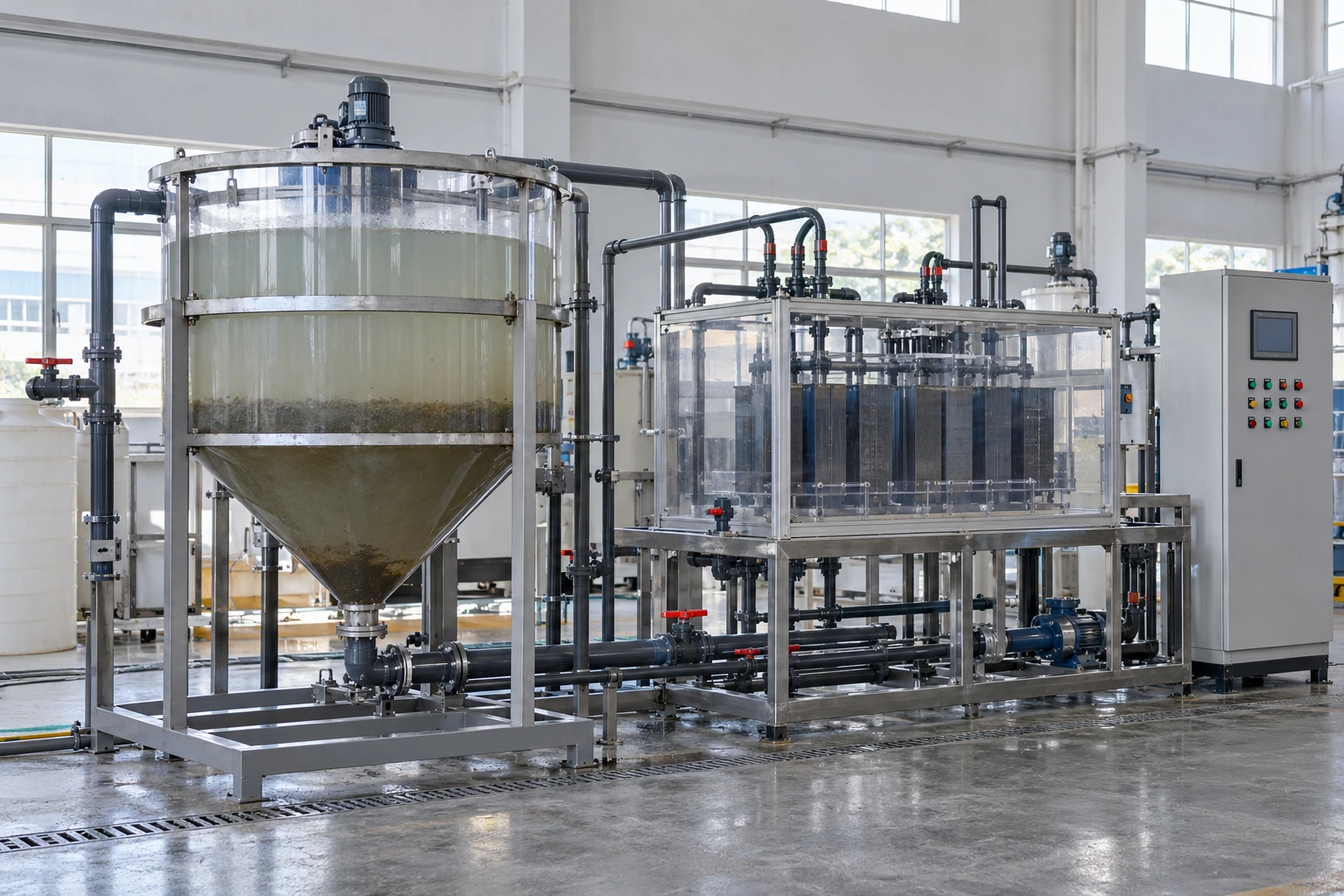
A Titanium electrode may appear in a treatment train after coagulation when clarified water still contains oxidizable compounds. The sequence has two distinct reaction and separation duties.
Use a sequence only when each stage earns its place
Upstream EC can move material into floc, while downstream EO can oxidize remaining targets after a defined separator. Keep each treatment stage visible. Test each contribution before generalizing combined performance.
- Define EC outlet solids and chemistry before sizing a downstream EO step.
- Sample between stages so each unit's contribution remains visible.
| Check | Decision |
|---|---|
| EC stage | Floc generation and capture |
| EO stage | Oxidation of remaining targets |
A hybrid train adds equipment and monitoring duties along with another removal mechanism. Key Takeaway: Test a staged process only when each stage has a measurable job.
6. Why isn't a Titanium electrode a sacrificial coagulant?
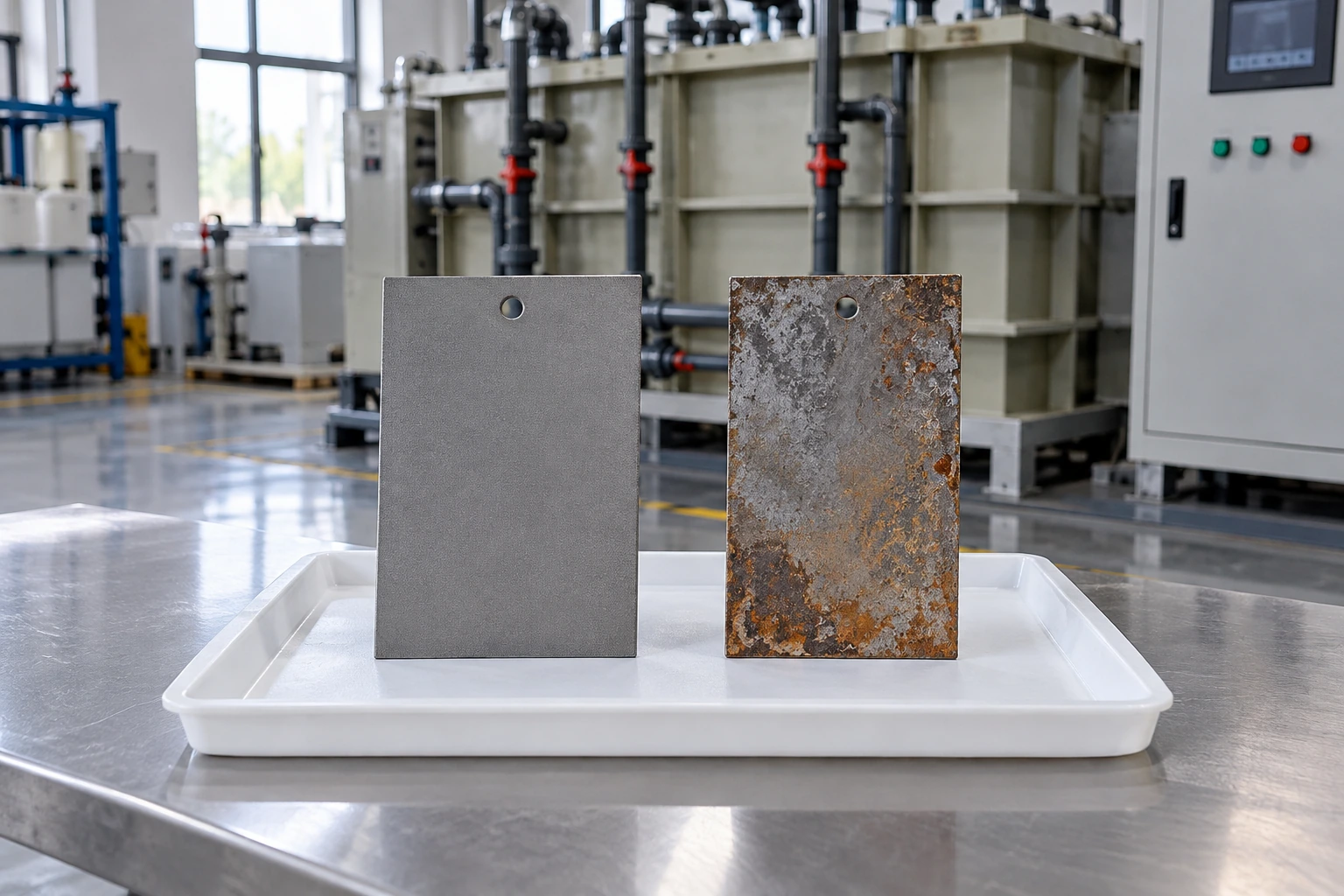
A Titanium electrode is not a universal sacrificial coagulant source because its titanium substrate and applied coating serve a different electrode purpose. Conventional EC intentionally consumes metal to supply ions.
Do not confuse substrate with coagulant feed
Coated titanium can support oxidation duty; sacrificial iron or aluminum supplies coagulant metal. Keep material roles clearly separate. Confirm product, coating, polarity, and duty before comparing materials.
- State whether the electrode should dissolve, remain dimensionally stable, or catalyze a defined reaction.
- Separate substrate identity from coating composition and process function.
| Check | Decision |
|---|---|
| Sacrificial plate | Metal-ion source |
| Coated titanium | Application-specific anode |
The material name alone cannot establish its electrochemical function. Key Takeaway: Specify reaction duty and expected material role in the same request.
7. How do cell duties change around a Titanium electrode?

A Titanium electrode project carries different operating records from EC because oxidation and coagulation create different process outputs. EC teams watch metal consumption and solids; EO teams track charge, water chemistry, and oxidation evidence.
Plan around different residual streams
EC creates metal-bearing sludge; EO may leave oxidants or transformation products, while both routes can face deposits and changing feed. Build the logbook around each mechanism. Track liquid and solids balances beside electrical readings.
- Include electrode consumption and sludge data where sacrificial metal is used.
- Include residual oxidant and by-product screening where the selected chemistry warrants it.
| Check | Decision |
|---|---|
| EC records | Metal and sludge balance |
| EO records | Oxidant and target response |
Operational burden follows reaction products, not the shared use of electrical current. Key Takeaway: Assign a sampling and waste-handling owner for every process stream.
8. Where can a Titanium electrode fit an oxidation cell?

A Titanium electrode may suit an EO cell when electrode form, mounting, electrical contact, and chemistry fit the specified duty. Product geometry alone cannot establish treatment performance.
Review electrode interfaces before system scope
Available forms include plate, mesh, rod, tube, or drawing-based assemblies; in hypochlorite-generation systems, chloride delivery also affects electrode duty. Keep product claims within scope. A product review does not certify a full treatment train.
- Provide a dimensioned drawing, connection details, and wet operating orientation.
- Keep cell design, power supply, controls, and downstream treatment within their owners' scopes.
| Check | Decision |
|---|---|
| Drawing review | Checks fit and interfaces |
| Process validation | Checks treatment response |
Electrode fit can be reviewed without implying a turnkey plant capability. Key Takeaway: Separate component selection from system design and process validation.
9. How can a Titanium electrode pilot separate mechanisms?

A Titanium electrode pilot should distinguish coagulant capture from oxidation rather than combine all removal into one result. Each route needs measurements matched to its mechanism.
Measure both water and material leaving the cell
For EC, track anode loss and sludge; for EO, track target concentration, residual oxidant, and selected by-products. Use paired samples for each stage. Match tests with feed variation and planned separation.
- Use influent, interstage, liquid-effluent, and solids samples where the train includes EC.
- Record current, voltage, flow or batch volume, pH, and test method with each sample set.
| Check | Decision |
|---|---|
| EC pilot | Metal, solids, liquid target |
| EO pilot | Target, residual, chemistry |
Mechanism-specific measurements make pilot results more useful for design decisions. Key Takeaway: Agree on sample locations and analytical endpoints before a pilot begins.
10. What data should buyers send for a Titanium electrode review?

A Titanium electrode review becomes actionable when buyers share the treatment objective, water data, cell boundary, and evidence needed for an electrode decision. ARY Titanium's scope covers titanium electrode forms and drawing- or sample-based review.
Send a process brief, not only a pollutant name
Share process choice, electrode dimensions, feed chemistry, solids, flow mode, and acceptance test with your inquiry. Make the process boundary explicit. To request a product review, contact us today with a drawing and those process details.
- Attach process flow, electrode drawing, and representative water analysis.
- Mark which performance criteria belong to a separate system integrator or treatment study.
| Check | Decision |
|---|---|
| Buyer input | Duty, drawing, water data |
| Next decision | Product fit or pilot scope |
A bounded brief prevents a component review from turning into an unsupported treatment guarantee. Key Takeaway: Request a product review after defining the process duty and evidence gap.
Frequently Asked Questions
Can I use a titanium electrode as a sacrificial coagulant source? Usually no; coated titanium serves a different duty than an intentionally dissolving metal anode.
What's the best way to choose between electrocoagulation and electrooxidation? Start with the target phase and endpoint. Compare floc capture needs with direct or mediated oxidation needs using representative water.
How do I know if a combined EC-EO train helps? Use stage-specific samples to establish whether each process contributes under the tested conditions.
Can I compare COD removal alone across both processes? No; COD cannot show whether material entered sludge, changed chemically, or reached mineralization.
How do I know if coated titanium fits my EO cell? Review coating, geometry, current connection, electrolyte, and target reaction together. Confirm treatment results with application-specific tests.