
A titanium electrode does not choose which ions leave water in electrodialysis; selective membranes and process conditions govern that separation. A buyer focused only on electrode material can overlook the membrane pair that controls ion passage. This guide separates membrane selectivity, terminal duty, and the data needed for a useful trial. Start with a Titanium electrode drawing and a complete feed-ion profile.
1. Can a Titanium electrode Choose Which Ion Moves?
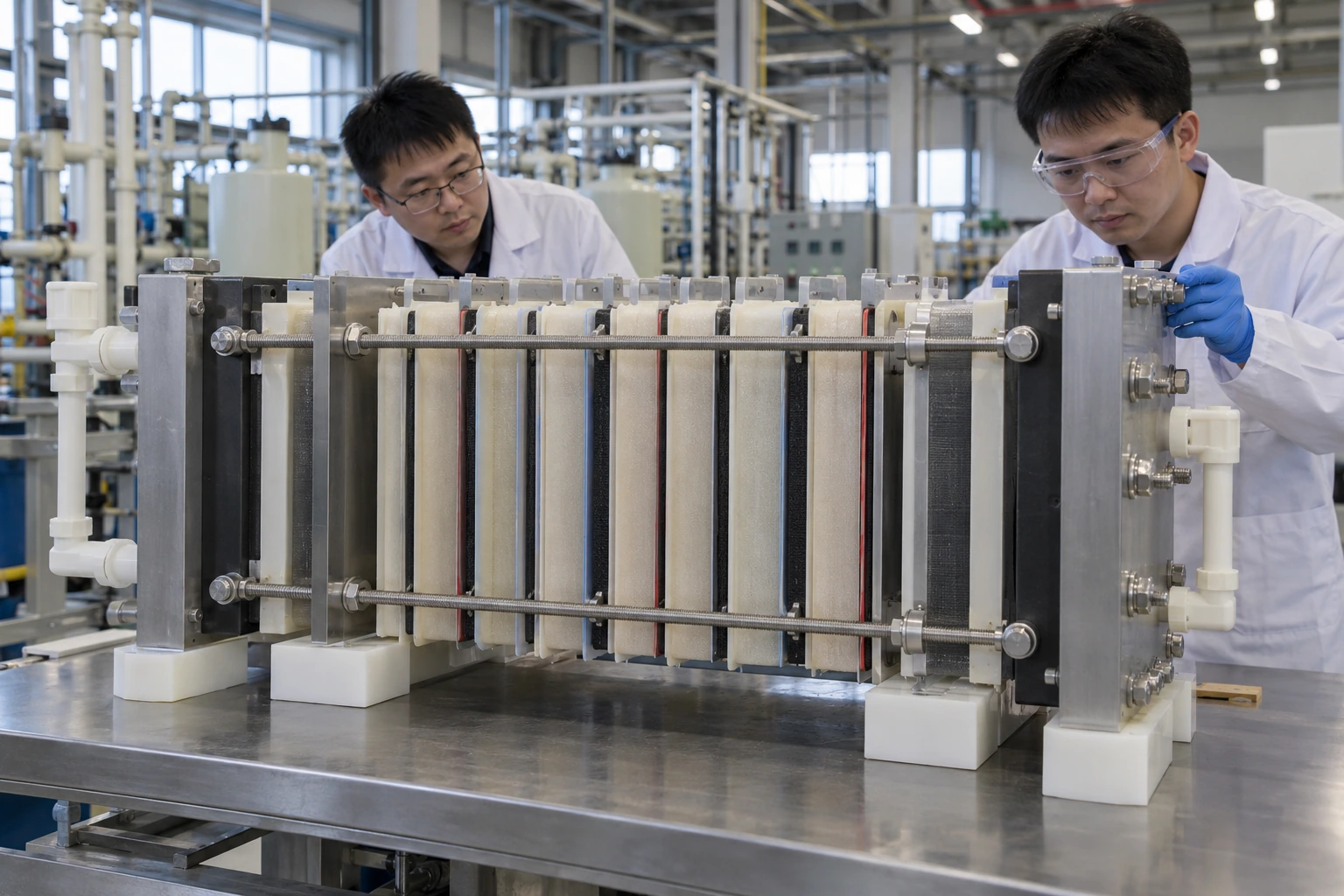
A Titanium electrode does not select target ions in ED; cation- and anion-exchange membranes govern preferred passage through a stack.
Assign selectivity to the membrane
Follow the separator. CEMs favor cation transport and AEMs favor anion transport under an applied electrical field. A terminal electrode closes the current path, but its material does not determine whether nitrate, chloride, or another ion crosses a membrane.
- Identify the membrane type and orientation beside every process channel.
- Separate membrane selection from terminal-electrode material review.
| Check | Decision |
|---|---|
| Membrane | Sets preferred charge direction and transport behavior |
| Terminal electrode | Supports current transfer and electrode reactions |
Ion removal follows membrane and process behavior rather than the electrode name. Key Takeaway: Begin a target-ion discussion with the membrane stack configuration.
2. How Do Membranes Guide Ions Around a Titanium electrode?

A Titanium electrode is at a stack end while membranes guide ions through repeating diluate and concentrate compartments.
Read membrane orientation
Map charge signs before flow arrows. Fixed charged groups in an ion-exchange membrane favor counter-ion movement and limit co-ion passage. Selectivity is not a perfect wall; solution composition and membrane properties affect how well the preferred transport holds.
- Mark AEM and CEM positions across one repeating cell pair.
- Show where each ion enters, crosses, or remains in the process channels.
| Check | Decision |
|---|---|
| AEM | Favors anion transport |
| CEM | Favors cation transport |
A repeated pair creates alternating concentrate and diluate channels. Key Takeaway: Ask for membrane type and orientation before comparing removal targets.
3. What Sets Ion Transport Near a Titanium electrode?

A Titanium electrode provides a terminal boundary; electric potential, concentration gradients, membrane properties, and flow shape ion transport nearby.
Look beyond applied voltage
Transport has several drivers. The electric field moves charged species, while concentration gradients support diffusion across liquid and membrane phases. Feed chemistry, ion mobility, temperature, current regime, and boundary-layer conditions can shift observed separation.
- Record the feed's major cations, anions, pH, conductivity, and temperature.
- Keep flow and electrical conditions beside each measured product result.
| Check | Decision |
|---|---|
| Electrical driver | Potential and current through the stack |
| Chemical and hydraulic drivers | Composition, gradients, and channel flow |
Voltage alone cannot describe a membrane's selectivity under changing feed conditions. Key Takeaway: Tie every selectivity claim to a defined feed and operating window.
4. How Does a Membrane Set Selection Around a Titanium electrode?

A membrane's selectivity governs target-ion movement around a Titanium electrode; changing the terminal plate does not replace membrane selection.
Match membrane behavior with the target
Name the competing ions. A membrane pair may move a group of similarly charged species; a custom stack-interface review can compare the target and membrane together. Valence, hydration, concentration, and membrane chemistry affect competition, so a target-ion claim needs feed and product data.
- List ions that should move and ions that should remain, including competing species.
- Ask whether the selected membrane is designed for broad charge transport or a narrower separation.
| Check | Decision |
|---|---|
| Target ion | Define charge, concentration, and desired destination |
| Competing ions | Describe species that may share the same membrane path |
An ion label without its competitors gives an incomplete separation objective. Key Takeaway: Compare membrane data against the full ionic mixture.
5. What Does a Titanium electrode Control in ED?

A Titanium electrode influences current transfer and terminal reactions, while membrane permselectivity controls preferred ion passage.
Keep electrode work in scope
Separate current from sorting. The terminal surface affects its electrochemical interface and may influence voltage losses or rinse behavior. It does not act like an ion-specific membrane, so a new coating cannot be assumed to produce selective nitrate or salt removal.
- Specify terminal geometry, coating, connection, and rinse environment independently.
- Review membrane type, target ions, and product criteria in a separate section of the process request.
| Check | Decision |
|---|---|
| Electrode criteria | Current path, reaction surface, and compatibility |
| Membrane criteria | Counter-ion preference, co-ion passage, and water transfer |
Keeping component functions separate helps avoid the wrong corrective action. Key Takeaway: Ask whether a measured problem belongs to membrane behavior or electrode duty.
6. How Do pH and Competing Ions Reach a Titanium electrode?

A Titanium electrode sees the stack's terminal solution, while pH and competing ions alter species charge, membrane transport, and current balance.
Account for feed chemistry
Speciation changes the question. pH can change whether some dissolved compounds carry charge, while competing ions share available membrane pathways. A feed with mixed salts may behave differently from a simple single-salt test, even with identical electrode geometry.
- Provide feed composition across expected operating conditions, not a single headline salinity.
- Track pH and concentration changes at diluate, concentrate, and rinse sample points.
| Check | Decision |
|---|---|
| Feed data | Ion identities, concentration range, pH, and temperature |
| Stack data | Membrane type, current, flow, and sample location |
A simple electrolyte test cannot represent every multicomponent feed. Key Takeaway: State which chemistry conditions the trial is intended to cover.
7. How Can Tests Separate Membrane and Titanium electrode Effects?

A Titanium electrode comparison should hold membrane and feed conditions visible so testing can separate terminal effects from membrane behavior.
Design a comparison that answers one question
Change one interface at a time. A practical study can compare approved electrode samples while retaining the same membrane arrangement and documented process conditions. Separate test runs are needed if the membrane, feed, or current setting also changes.
- Record membrane identity, assembly orientation, feed preparation, and operating state for each run.
- Measure inlet and outlet chemistry alongside current, voltage, flow, pH, and temperature.
| Check | Decision |
|---|---|
| Controlled factor | One defined electrode or membrane variable |
| Observed response | Ion balance, conductivity, voltage, and flow data |
A clean comparison avoids attributing a membrane change to the terminal electrode. Key Takeaway: Agree on test ownership and measurement methods before sample production.
8. When Can Titanium electrode Design Matter in Water Treatment?

A Titanium electrode may be part of a water-treatment electrodialysis stack, but its design does not establish which ions the process removes.
Connect treatment claims with evidence
Define the product boundary. Electrodialysis can transfer charged species between streams, yet performance depends on feed, membranes, electrical duty, and recovery choices. Review water-treatment applications, then connect any removal statement to measured feed and product composition.
- Describe product use, concentrate destination, and any required downstream treatment.
- Avoid interpreting conductivity reduction as proof that one specific ion was removed.
| Check | Decision |
|---|---|
| Application scope | Source water, product target, and concentrate route |
| Evidence scope | Species-specific measurements and operating conditions |
Conductivity is a useful process signal but does not identify every species. Key Takeaway: Set ion-specific acceptance criteria before making a treatment claim.
9. What Should Buyers Specify for a Titanium electrode Pair?

A Titanium electrode request should distinguish electrode details from membrane selection, feed chemistry, and target-ion performance requirements.
Make the specification testable
Write the target as a balance. State which ions should move, which should remain, expected concentration ranges, and sampling points. Add the membrane type, current conditions, flow paths, and electrode interfaces so reviewers can identify gaps without promising performance.
- Include feed and product analyses plus a list of competing ions.
- Attach the stack drawing and mark electrode requirements separately from membrane criteria.
| Check | Decision |
|---|---|
| Separation input | Ion targets, competitors, pH, and product use |
| Component input | Membrane model, electrode geometry, and terminal duty |
A measurable target lets engineering review separate process performance from component supply. Key Takeaway: Ask for a written list of assumptions before accepting a trial result.
10. How Should a Titanium electrode System Trial Be Reviewed?

A Titanium electrode system trial should define membrane behavior and terminal duty as separate questions with matched sampling and operating records.
Review the whole measurement chain
Let measurements locate a cause. Compare feed, diluate, concentrate, and rinse records with membrane identity and electrical state. For a project discussion, contact us today with the stack drawing, feed analysis, target-ion list, and planned acceptance method.
- Keep sampling ports and stream names consistent across drawings and logs.
- Separate electrode acceptance from membrane selectivity and system treatment guarantees.
| Check | Decision |
|---|---|
| Electrode review | Geometry, coating, connection, and rinse exposure |
| Process review | Membranes, feed chemistry, ion balance, and product data |
A shared data map lets each supplier review the part within its actual process boundary. Key Takeaway: Document open process assumptions before interpreting a pilot result.
Frequently Asked Questions
Can I choose nitrate removal by changing the titanium electrode? No. Ion transfer depends mainly on membrane behavior and process conditions; electrode material does not provide nitrate-specific selection.
What's the best membrane for selective electrodialysis? A suitable membrane depends on target ions, competing species, feed chemistry, and required product quality. Ask for data under comparable conditions.
How do I know if my membrane is selective enough? Compare species-specific feed and outlet measurements with membrane data and actual operating conditions.
Can I remove salt with a titanium electrode and no membranes? A terminal electrode alone does not perform ED separation; membrane stack and process circuit create ion-transfer paths.
How do I know if conductivity proves one ion was removed? Conductivity reflects the combined ionic content of a sample; species-specific analysis is needed for an ion-specific claim.