
A lower chlorine reading does not prove Titanium electrode failure; dilution, measurement error, storage loss or changed reactions may explain it. Your outlet sample comes back weaker even though current appears unchanged. Replacing the anode before checking flow and sample history can leave the real problem untouched. Build a matched production-and-flow comparison, then test each plausible loss mechanism.
1. Does lower concentration prove Titanium electrode failure?

Lower concentration does not by itself prove Titanium electrode failure because product flow and sampling conditions can change the reading. Production rate and concentration need separate evaluation.
Has the product become weaker or production fallen?
Pair concentration with flow. Record both at the same process boundary and time. Compare the analytical basis consistently, including whether results are expressed as available chlorine or another defined quantity.
- State concentration units and chemical basis.
- Measure product flow under matching conditions.
| Check | Decision |
|---|---|
| Concentration falls with higher flow | Dilution may contribute |
| Production rate also falls | Investigate generation or losses |
Resolve the mass-rate question before assigning cause. Key Takeaway: A weaker sample is not automatically a weaker electrode.
2. How do you balance Titanium electrode production and flow?

A Titanium electrode production balance combines concentration and flow on a consistent basis, then compares useful output with electrical duty. Units and boundaries must agree before calculations are meaningful.
Are your measurements describing the same stream?
Keep units visible. For a hypothetical example, 2 g/L at 100 L/h gives 200 g/h on the stated analytical basis. That arithmetic describes a stream, not a promised electrode rating.
- Use contemporaneous concentration and flow values.
- Include dilution or recirculation in the boundary.
| Check | Decision |
|---|---|
| Concentration multiplied by volumetric flow | Mass rate on the stated basis |
| Mixed units or boundaries | Invalid comparison |
Check the balance before interpreting a trend. Key Takeaway: Use mass rate to distinguish dilution from reduced delivered production.
3. Can testing errors hide Titanium electrode output?

Testing errors can conceal Titanium electrode output through incorrect dilution, unsuitable method range, stale reagents or inconsistent sampling. Validate the analytical process before changing operating settings.
Could the sample be outside the method's range?
Review the full test procedure. Ask the laboratory to confirm dilution, interferences and quality-control checks. A repeated result from the same flawed procedure does not establish accuracy.
- Record sampling time and preservation conditions.
- Retain method and reagent details.
| Check | Decision |
|---|---|
| Unverified analytical result | Weak basis for hardware changes |
| Quality-controlled result | Stronger diagnostic input |
Check measurement reliability early in the investigation. Key Takeaway: Do not tune production around an unverified assay.
4. How does brine feed affect Titanium electrode production?

Brine changes can affect Titanium electrode production through conductivity, chloride availability and impurity-related effects. Actual feed measurements are more useful than assuming the preparation recipe remained unchanged.
What reached the cell during the weak run?
Sample the operating feed. Include conductivity, temperature and relevant chemistry in a custom cell review. Review dilution controls, source water and salt-batch changes alongside electrical data.
- Retain inlet samples where practical.
- Record actual feed and product flow.
| Check | Decision |
|---|---|
| Recipe unchanged | Does not prove delivered feed unchanged |
| Measured inlet conditions | Supports a meaningful baseline comparison |
Trace production changes back through feed preparation. Key Takeaway: A stable current cannot compensate for every feed variation.
5. Can cathodic reactions consume Titanium electrode product?
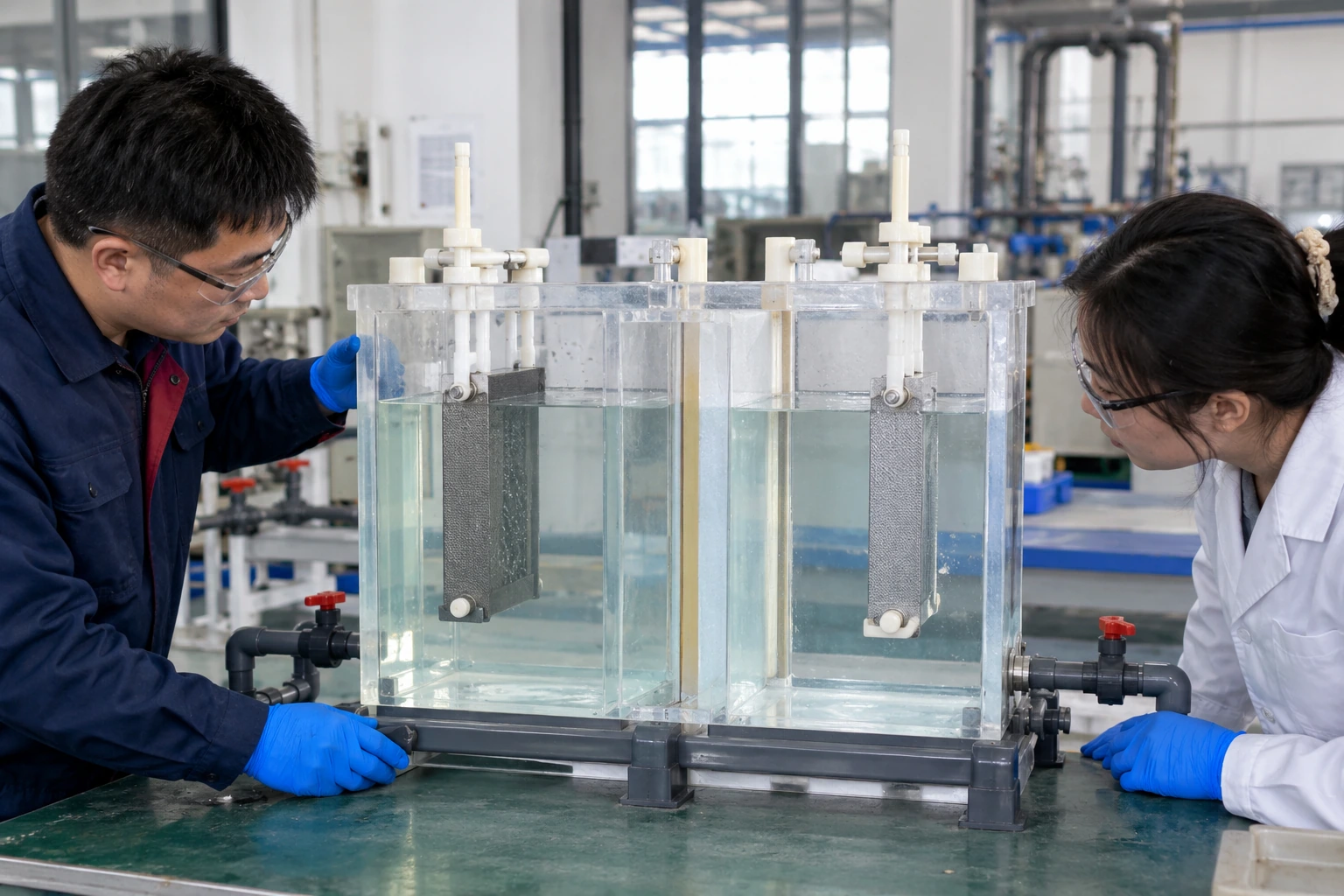
Cathodic reactions can consume oxidizing products in some Titanium electrode cell conditions, reducing useful recovered output. The significance depends on chemistry, compartment design and operating duty.
Could generated product be lost inside the cell?
Review competing pathways. Discuss electrode pairing, mixing and transport with the process designer. Do not infer a specific loss fraction without a suitable test or validated model.
- Compare relevant compartment or outlet samples.
- Record cell architecture and circulation pattern.
| Check | Decision |
|---|---|
| Generation reaction | Produces intended oxidant |
| Competing reaction | May reduce recovered useful output |
Use a process balance to test the proposed explanation. Key Takeaway: Net delivered output can differ from gross electrochemical generation.
6. Does storage change Titanium electrode product readings?

Storage can change Titanium electrode product readings because hypochlorite composition evolves with time and conditions. A delayed tank sample may not represent fresh cell-outlet output.
Where and when was the sample taken?
Separate fresh output from stored inventory. Compare defined outlet and storage samples using an appropriate analytical method. Record time, temperature and relevant storage conditions without assuming a universal decay rate.
- Label sample age and location.
- Keep fresh-output and stored-product criteria separate.
| Check | Decision |
|---|---|
| Fresh outlet sample | Closer to generation boundary |
| Storage sample | Includes downstream history |
Use the sample location to define your claim. Key Takeaway: A storage loss should not automatically be assigned to the electrode.
7. Can flow bypass reduce Titanium electrode yield?
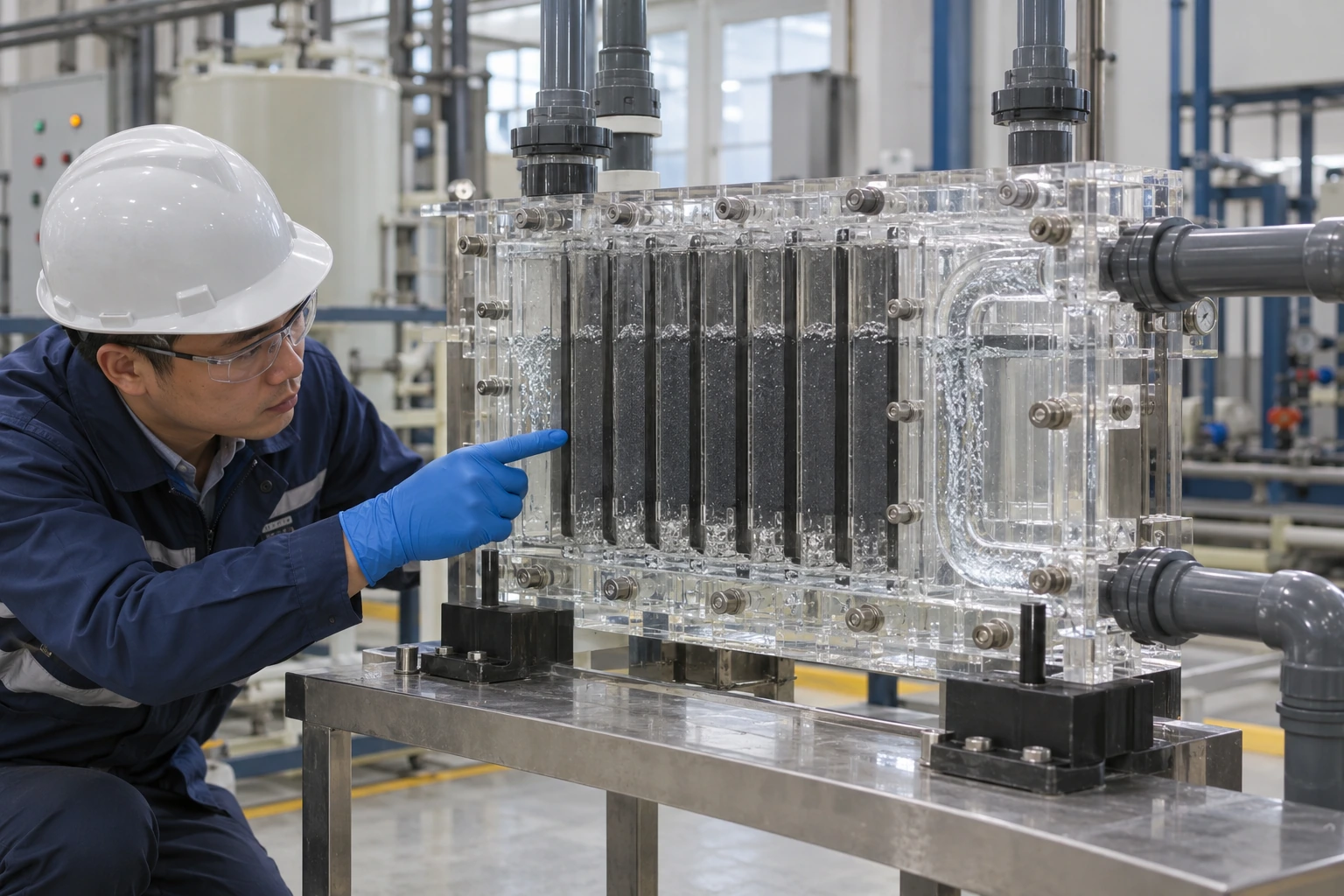
Flow bypass can reduce Titanium electrode useful yield when liquid avoids intended reaction channels or changes residence conditions. Total flow alone cannot identify how much passed through the active region.
Is the flow following the intended route?
Inspect the hydraulic configuration. Check as-built valves, seals and manifold paths under approved maintenance procedures. Compare pressure and flow records with the stable baseline.
- Record recent assembly or valve changes.
- Identify possible parallel and bypass paths.
| Check | Decision |
|---|---|
| Main flow reading | Combined stream only |
| Channel-specific evidence | Supports useful-flow assessment |
Investigate distribution before increasing power. Key Takeaway: Hydraulic faults can look like reduced electrode activity.
8. When is Titanium electrode coating loss plausible?
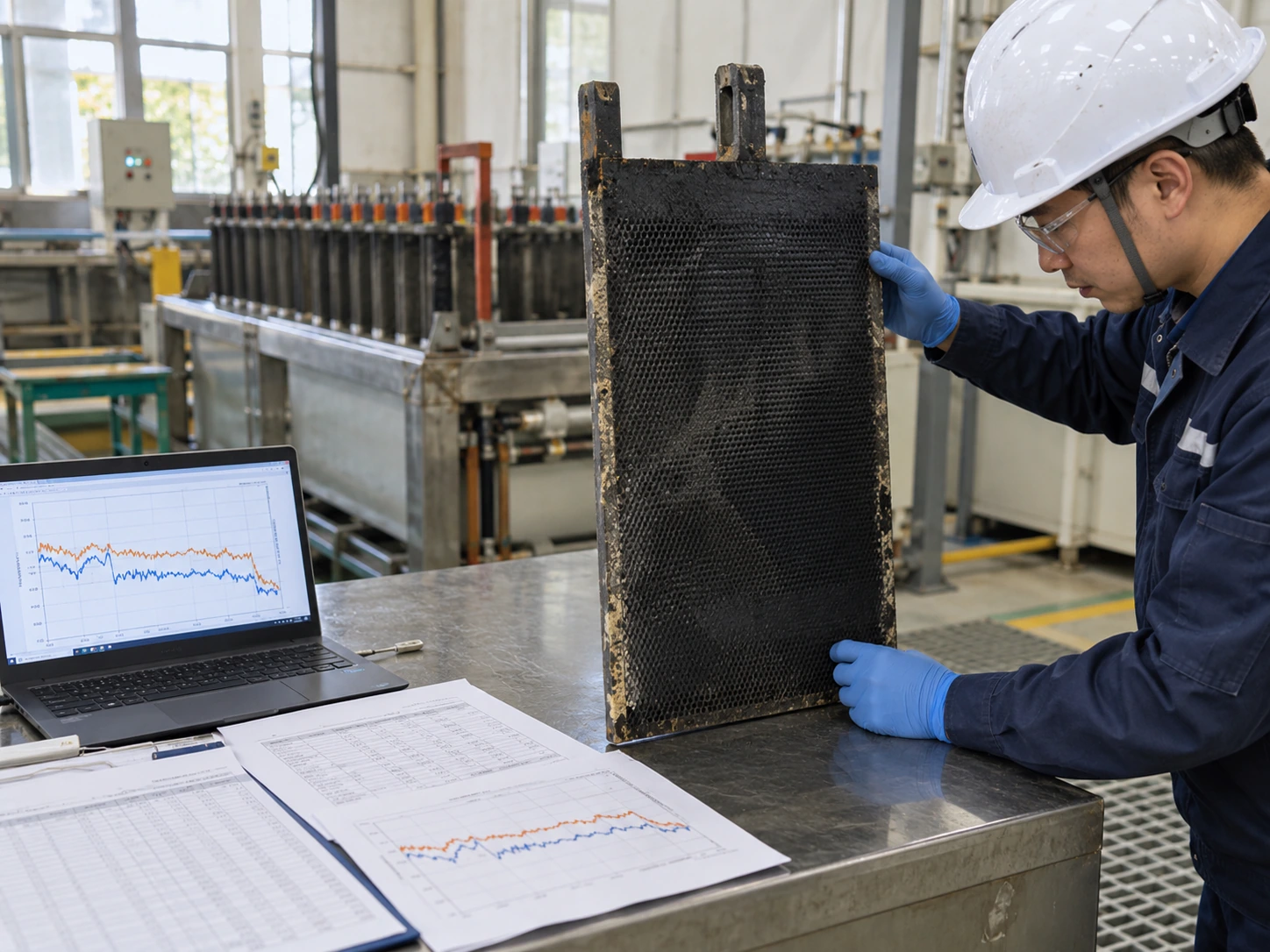
Titanium electrode coating loss becomes more plausible after matched feed, flow, temperature and measurement checks leave a persistent output deficit. Surface and electrical evidence should support that finding.
What remains after other explanations are tested?
Use a controlled comparison. In water-treatment duty, review voltage-current behavior alongside product output and sample condition. Avoid claiming a specific remaining life from one weak production run.
- Compare both electrodes and connection condition.
- Record any approved cleaning or maintenance effect.
| Check | Decision |
|---|---|
| Uncontrolled operating changes | Diagnosis remains uncertain |
| Matched conditions with surface evidence | Supports a narrower material review |
Keep cause assignments proportional to the evidence. Key Takeaway: Coating diagnosis should follow a process review, not replace it.
9. How do you run a Titanium electrode recovery trial?

A Titanium electrode recovery trial should test a defined corrective action while keeping other conditions and measurement methods consistent. Confirm both restored output and acceptable equipment behavior.
Did the correction address the mechanism?
Write a before-and-after basis. Compare useful production rate under matched electrical and feed conditions. If several changes were made together, document that limitation rather than assigning success to one component.
- Use consistent sample points and analytical methods.
- Retain voltage, current, flow and temperature trends.
| Check | Decision |
|---|---|
| Single defined correction | Supports a focused assessment |
| Several simultaneous corrections | Limits causal attribution |
Verify restoration against the agreed baseline. Key Takeaway: A recovery claim needs matched output evidence.
10. What Titanium electrode evidence separates loss mechanisms?

Useful Titanium electrode diagnostic evidence includes feed, fresh outlet and storage measurements plus electrical and hydraulic records. This separates dilution, analytical error, downstream loss and plausible electrode changes.
Send a production balance with the incident
Bring the paired measurements. When you contact us today, we can review electrode operating requirements and sample evidence within your process brief. Our position favors verified causes before replacement recommendations.
- Include analytical basis and sample timing.
- State which loss mechanisms remain untested.
| Check | Decision |
|---|---|
| Matched process data | Supports cause screening |
| Component evidence | Supports electrode review |
Choose the next test that separates remaining explanations. Key Takeaway: Diagnose delivered output before purchasing another anode.
Frequently Asked Questions
Can I raise current when chlorine concentration drops? Not before diagnosing the change. Dilution or testing errors may explain the reading, and higher current can exceed approved duty.
How do I know if dilution caused the drop? Compare concentration and flow together. Use the same sampling boundary and chemical reporting basis.
What's the best sample location for electrode output? Use the defined cell-outlet boundary for generation assessment. Storage samples answer a different question because they include downstream history.
Can I assume stable current means stable chlorine production? No. Useful current efficiency, feed conditions and internal or downstream losses can change delivered output.
Can I estimate coating life from a weak sample? No. One sample cannot separate operating, analytical and material causes or establish remaining service life.