
Choose a monopolar or bipolar Titanium electrode cell by its electrical path, chemistry and maintenance requirements, rather than compactness alone. Your equipment drawing may show similar parallel plates while hiding very different current paths. Ordering those plates as interchangeable parts can leave a coating face, terminal or seal unsuitable. Start with the stack circuit and define each wetted surface before comparing quotations.
1. How does a monopolar Titanium electrode cell work?

A monopolar Titanium electrode cell connects its electrodes directly to the external electrical circuit, often grouping like-polarity electrodes through busbars. Actual wiring and current distribution depend on the cell design.
Where does each plate get its current?
Trace the external connections. Mark every powered electrode and its intended polarity on a drawing. Count parallel branches explicitly rather than assuming each plate carries identical current.
- Identify busbar groups and branch paths.
- Record current-sharing assumptions.
| Check | Decision |
|---|---|
| Directly connected plate | External circuit defines polarity |
| Parallel branches | Current distribution needs verification |
Use the circuit drawing as your purchasing reference. Key Takeaway: A plate count alone cannot define electrical duty.
2. How does a bipolar Titanium electrode stack work?
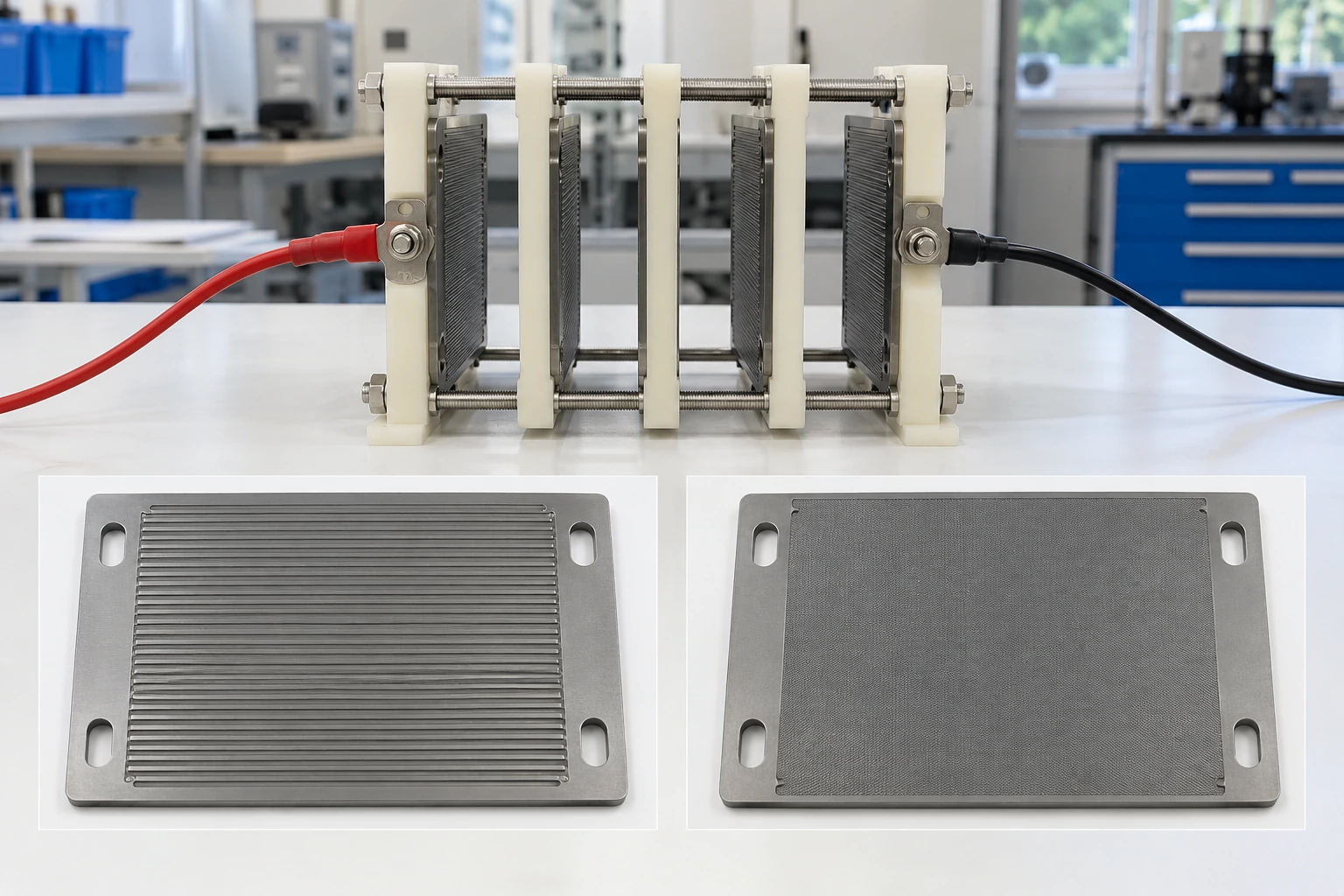
A bipolar Titanium electrode stack uses internal conductive elements with anodic and cathodic faces while external power commonly connects through end electrodes. Suitability depends on face-specific materials and a qualified stack design.
Which face performs which reaction?
Follow the series path. Ask for a sectional drawing identifying each reaction face, separator and terminal. A generic fully coated plate is not automatically a suitable bipolar element.
- Identify anodic and cathodic face treatments.
- Distinguish internal elements from end electrodes.
| Check | Decision |
|---|---|
| Internal bipolar element | Opposite faces perform different roles |
| End electrode | Interfaces with external power |
Face-level specifications prevent mistaken substitutions. Key Takeaway: Qualify the complete bipolar element, not its outline alone.
3. What changes in Titanium electrode power requirements?

Titanium electrode architecture changes required supply voltage and current because series and parallel paths combine differently. Compare total power using measured operating conditions, not architecture labels.
Will your existing rectifier fit?
Check the operating envelope. Confirm expected voltage range, current capacity and isolation requirements with the equipment designer. A more compact stack can still require a different power supply.
- State series-cell count and parallel branches.
- Include startup and approved operating extremes.
| Check | Decision |
|---|---|
| More series stages | Voltage requirements accumulate |
| More parallel branches | Supply-current requirements accumulate |
Use the actual circuit before sizing power equipment. Key Takeaway: Neither architecture guarantees lower energy use without comparable test data.
4. Does each Titanium electrode face need the same coating?

Different Titanium electrode faces may need different treatments when their reaction roles differ, especially in bipolar construction. Coating suitability must cover the intended polarity and chemistry of each face.
Can both faces share one specification?
Specify reactions by surface. Include face identity and any reversal duty in a custom engineering review. Do not assume a coating chosen for anodic service qualifies cathodic exposure.
- Mark face orientation permanently through approved identification.
- Define coating and uncoated boundary regions.
| Check | Decision |
|---|---|
| Same nominal metal | Does not prove equal surface duty |
| Face-specific specification | Supports correct manufacturing review |
Resolve surface roles before releasing drawings. Key Takeaway: The same plate can contain two different material-qualification problems.
5. How do Titanium electrode manifolds affect current?

Conductive liquid manifolds can create unwanted current paths between Titanium electrode stack compartments. Their significance depends on geometry, electrolyte conductivity and electrical arrangement.
What else connects your cells electrically?
Include the liquid pathways. Ask the stack designer to assess bypass or shunt currents through shared manifolds. Do not apply a simple series-cell model while ignoring connected electrolyte routes.
- Show shared feed and return passages.
- Record conductivity across the operating range.
| Check | Decision |
|---|---|
| Solid electrical path | Shown by plate connections |
| Liquid electrical path | May connect compartments through manifolds |
Review electrical and hydraulic drawings together. Key Takeaway: A manifold can influence more than fluid distribution.
6. What seals does a Titanium electrode stack need?

A Titanium electrode stack needs seals and frames that maintain intended liquid boundaries, spacing and electrical isolation under approved conditions. A leak-free static assembly alone does not establish operational suitability.
What must remain separated?
Define every boundary. Identify liquid, gas and electrical interfaces before choosing a seal system. Have responsible designers approve material compatibility and assembly procedures.
- Record gasket lands and compression requirements.
- Distinguish frame and membrane functions.
| Check | Decision |
|---|---|
| Sealing boundary | Controls fluid containment |
| Insulating boundary | Controls unintended electrical contact |
Check each function against the complete operating duty. Key Takeaway: Seals and frames are part of cell performance, not incidental hardware.
7. How do you monitor a Titanium electrode stack?

Titanium electrode stack monitoring should detect meaningful changes without assuming total stack voltage identifies a single failing element. The monitoring design depends on safe accessible sensing points.
Can one total reading locate a fault?
Preserve segment information where designed. Qualified engineers can specify suitable voltage, flow and temperature measurements. Never add improvised live taps to a stack to chase an unexplained reading.
- Keep approved measurement boundaries documented.
- Compare trends at matched operating conditions.
| Check | Decision |
|---|---|
| Total stack reading | Useful system signal |
| Approved segment data | Can narrow fault location |
Select monitoring during design, before faults occur. Key Takeaway: Diagnostic access needs an engineered measurement arrangement.
8. Which Titanium electrode layout is easier to service?

A monopolar Titanium electrode arrangement may offer direct access to individual plates, while a bipolar stack may require more coordinated disassembly. Actual serviceability depends on the specific mechanical design.
What will maintenance have to remove?
Walk through a replacement task. Include access, lifting, seal replacement and recommissioning when reviewing water-treatment applications. Compare complete maintenance steps rather than counting fasteners alone.
- Identify replaceable units and alignment features.
- Record required spare seals and fixtures.
| Check | Decision |
|---|---|
| Accessible individual plates | Potentially narrower replacement scope |
| Integrated sealed stack | Potentially broader reassembly scope |
Validate service claims against an actual maintenance plan. Key Takeaway: Procurement should compare restoration work as well as purchase price.
9. How should Titanium electrode architectures be compared?

Titanium electrode architectures should be compared at equivalent useful output, feed conditions and operating boundaries. Different area conventions or product definitions can make efficiency comparisons misleading.
Are the quotations answering the same requirement?
Normalize the comparison. Ask each proposal to state output quality, measured energy boundary and maintenance assumptions. Reject an attractive figure whose operating basis remains unspecified.
- Use consistent product and energy units.
- Include auxiliary equipment where relevant.
| Check | Decision |
|---|---|
| Equal nominal current | May not mean equal production |
| Equal useful output basis | Supports a fairer system comparison |
Compare the delivered process result. Key Takeaway: Architecture selection needs a system-level acceptance basis.
10. What Titanium electrode drawings should you request?

A Titanium electrode request should include circuit, section, manifold and surface-treatment drawings alongside chemistry and service expectations. These documents make architecture-specific differences visible before manufacturing begins.
Build a reviewable stack specification
Send the interfaces together. When you contact us today, we can review drawing-based electrode scope against your chosen cell concept. We favor clear component boundaries over vague claims that one layout suits every process.
- Provide end-electrode and internal-element details.
- State who approves complete stack design.
| Check | Decision |
|---|---|
| Electrode documentation | Defines supplied components |
| System documentation | Defines integration and acceptance |
Agree on responsibilities before comparing quotations. Key Takeaway: Choose an architecture only after its interfaces and operating basis are clear.
Frequently Asked Questions
Can I replace monopolar plates with bipolar plates? Not as a direct substitution. Circuit, surface treatment, sealing and manifold behavior all require design review.
What's the best architecture for low energy consumption? Neither wins by name alone. Compare useful output and total measured energy under equivalent operating conditions.
How do I know if a plate is bipolar? Use its design documentation. An internal bipolar element has distinct anodic and cathodic functions on opposing faces.
Can I reuse my existing rectifier? Possibly, after electrical review. Required voltage, current, control and isolation may change with architecture.
Can I buy electrode components without a complete cell? Yes, where scope is defined. Supply drawings and operating requirements, and retain a responsible designer for system integration.