
A Titanium electrode can handle pulse-reverse plating only when its coating and complete assembly are qualified for the actual forward and reverse waveform. Your rectifier may offer a reverse program that looks like a convenient route to better deposits. Enabling it without material review exposes both electrodes to a changed reaction duty. Specify peaks, durations and charge balance before interpreting a successful coupon test as production approval.
1. Can any Titanium electrode run pulse-reverse plating?
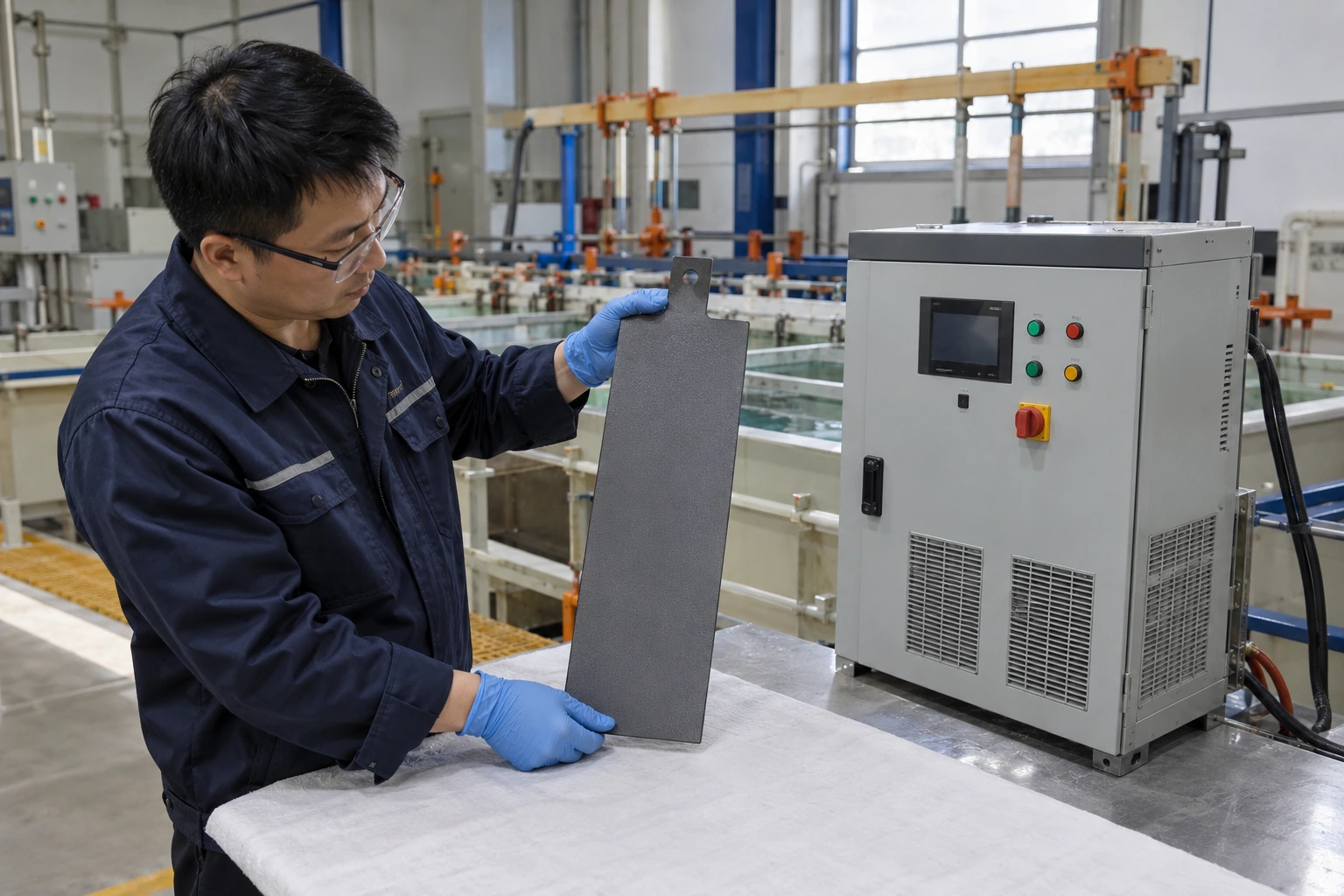
Not every Titanium electrode coating is suitable for pulse-reverse plating because reverse periods can expose the surface to a different reaction role. Qualification must cover the actual chemistry and waveform.
What does pulse-compatible really cover?
Ask for the tested duty. A broad statement about pulse capability may refer only to one-polarity pulses. Require clarification about whether current reverses through your electrode and for how long.
- Identify coating and substrate specification.
- Distinguish pulsed DC from reverse-polarity duty.
| Check | Decision |
|---|---|
| Pulsed DC approval | May exclude reverse current |
| Waveform-specific approval | Addresses the intended exposure |
Resolve the polarity question before testing. Key Takeaway: Rectifier features do not establish coating compatibility.
2. What reverses during Titanium electrode pulse operation?

During reverse periods, the normally anodic Titanium electrode may become cathodic while the workpiece changes reaction role. The complete circuit determines what each surface experiences.
Which surfaces change reaction role?
Trace the measured current direction. Include workpiece, companion electrode and any special current paths. Do not infer duty solely from a recipe name on the controller.
- Mark normal and reverse polarity on a diagram.
- Record whether all electrodes share the same waveform.
| Check | Decision |
|---|---|
| Controller recipe label | May omit circuit detail |
| Measured current path | Defines actual electrode exposure |
Use the circuit and waveform together. Key Takeaway: Qualify every surface whose polarity changes.
3. Why do Titanium electrode peak and average currents differ?

Titanium electrode peak and average currents differ because pulse duration and off-time change the time-weighted current. With reversal, a signed average can hide large forward and reverse excursions.
What does a modest average conceal?
Report both directions separately. Specify forward peak, reverse peak and their durations alongside cycle timing. Average current alone cannot describe peak current density or reverse exposure.
- Use an explicit active-area basis.
- State duty cycle and waveform shape.
| Check | Decision |
|---|---|
| Average current | Summarizes charge over time |
| Peak and duration | Describe individual pulse exposure |
Keep the full waveform with trial results. Key Takeaway: A low average is not proof of mild instantaneous duty.
4. How does reverse charge affect Titanium electrode qualification?

Reverse charge affects Titanium electrode qualification because it describes accumulated exposure during reverse periods, beyond peak amplitude alone. For a defined waveform, charge follows current integrated over time.
How much reverse exposure does one cycle contain?
Include the charge balance. Supply waveform timing and repetition data in a custom application review. When using rectangular-pulse approximations, state that assumption rather than treating every real waveform as rectangular.
- Report forward and reverse charge bases.
- Include ramps, overshoot and dead time where relevant.
| Check | Decision |
|---|---|
| Peak only | Leaves duration undefined |
| Peak with time history | Supports exposure calculation |
Use measured data when idealized settings differ. Key Takeaway: Waveform duration belongs in the coating review.
5. What coating data does a Titanium electrode trial need?

A Titanium electrode pulse trial needs coating identity, qualified polarity range and supplier-reviewed exposure conditions. An MMO or platinum label alone does not establish tolerance to every reverse program.
What evidence applies to this coating?
Request application-specific limits. Share electrolyte, temperature and waveform before asking for a recommendation. Keep published results for another coating formulation separate from evidence for your supplied part.
- Record coating and sample batch identity.
- Define the acceptance and stop criteria.
| Check | Decision |
|---|---|
| Generic coating family | Insufficient duty definition |
| Reviewed sample specification | Supports a targeted trial |
Tie the trial to a traceable surface system. Key Takeaway: Qualify the supplied coating, not a material-family name.
6. Can pulse duty change Titanium electrode bath behavior?

Pulse duty can change Titanium electrode bath behavior through time-dependent reactions, transport and additive exposure. Better deposit appearance does not establish unchanged bath chemistry or product quality.
What should be measured beyond appearance?
Use the plating acceptance plan. Evaluate the deposit properties and bath analyses relevant to your product. Avoid promising universal improvements in throwing power, morphology or throughput without matched evidence.
- Control bath composition and agitation.
- Measure agreed deposit and contamination criteria.
| Check | Decision |
|---|---|
| Visual coupon improvement | Limited evidence |
| Qualified product tests | Addresses the intended manufacturing requirement |
Judge the process by its product specification. Key Takeaway: An attractive coupon is only one part of plating qualification.
7. How should Titanium electrode pulse measurements be made?
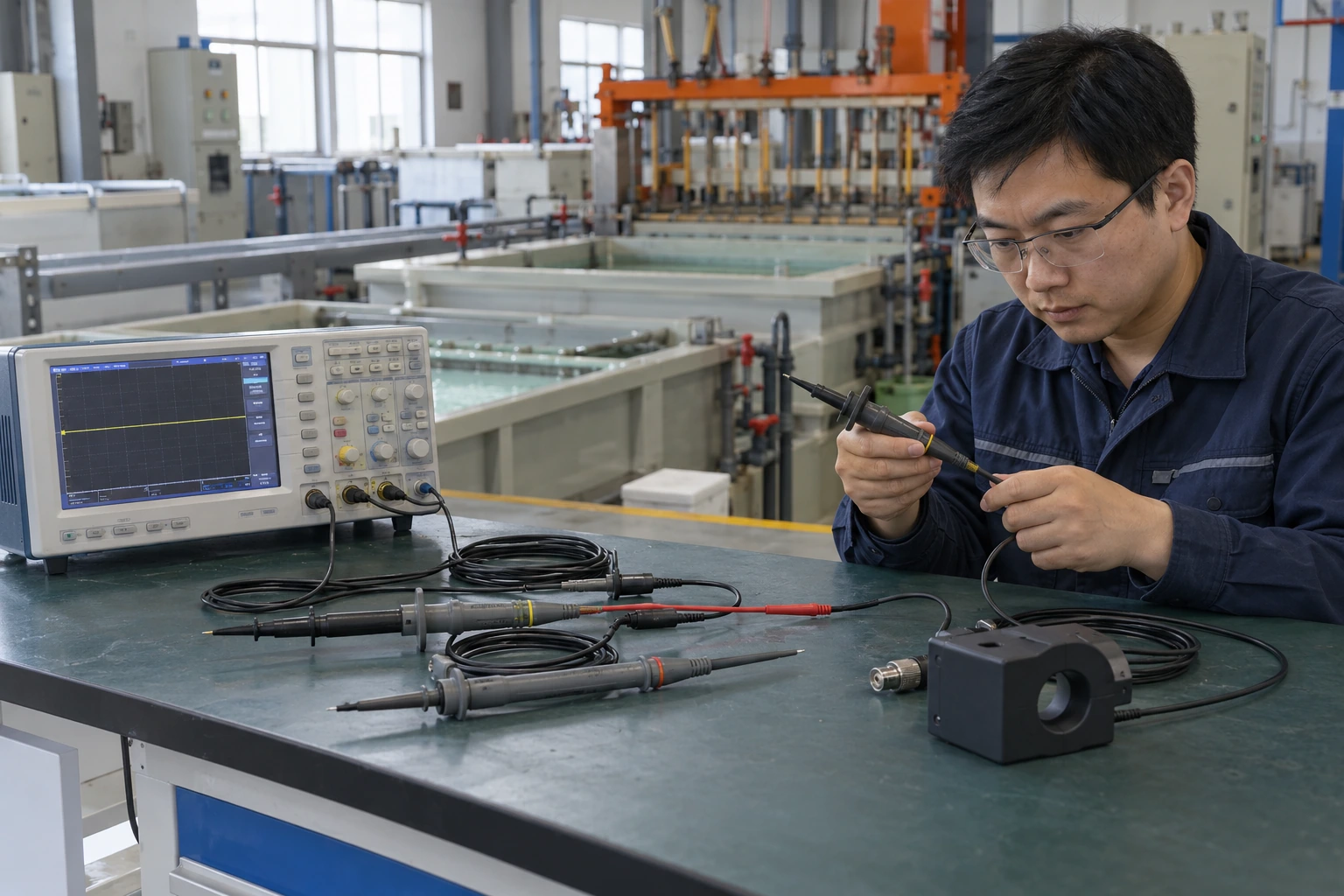
Titanium electrode pulse measurements need instrumentation that resolves the relevant time scale without clipping peaks or creating unsafe electrical connections. Qualified personnel should design the measurement arrangement.
Can your logger see the pulse?
Check bandwidth and range. Record current and voltage with appropriate isolation and sensing points. A process display that averages many cycles cannot verify peak duty by itself.
- Retain probe and transducer details.
- Store raw traces and acquisition settings.
| Check | Decision |
|---|---|
| Slow average readout | Does not establish peaks |
| Qualified waveform capture | Supports actual-duty verification |
Compare measured and commanded waveforms before interpreting the trial. Key Takeaway: Pulse qualification requires time-resolved evidence.
8. What must a Titanium electrode pulse trial compare?
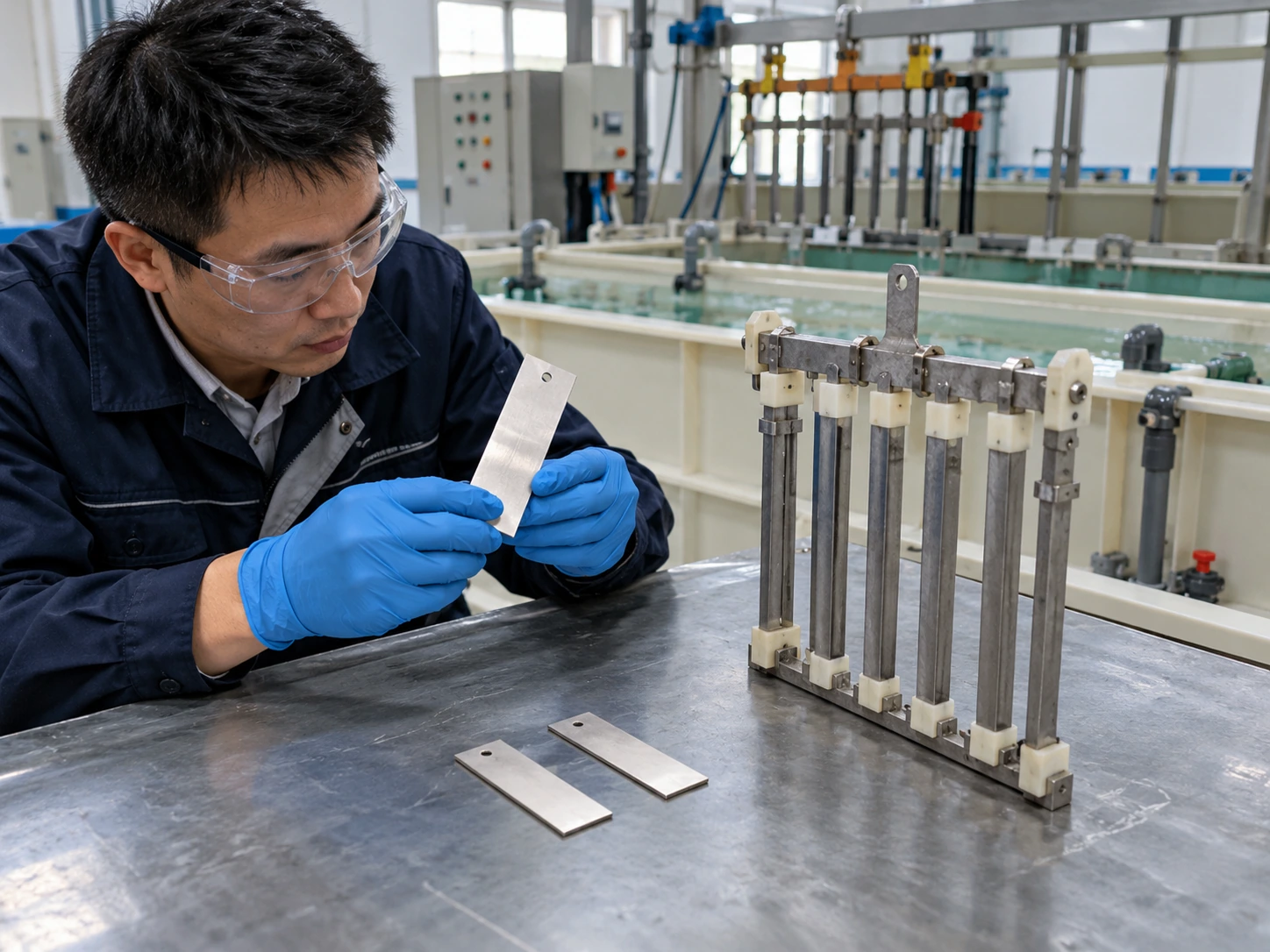
A Titanium electrode pulse trial should compare defined programs under matched geometry, chemistry and sample history. Changes to anode area or agitation alongside waveform changes confound the result.
What makes the comparison transferable?
Freeze the hardware basis. Review drawing-based electrode options against your released trial drawing before testing. Record current basis, coupon position and sampling methods consistently across runs.
- Use comparable workpieces and electrodes.
- State repeat runs and observed variability.
| Check | Decision |
|---|---|
| Uncontrolled hardware change | Weakens waveform attribution |
| Matched comparison | Supports a narrower process finding |
Keep claims tied to the conditions actually compared. Key Takeaway: A controlled trial is more useful than an unexplained better-looking deposit.
9. What signs end a Titanium electrode pulse trial?

A Titanium electrode pulse trial should end when approved stop criteria are reached, including abnormal electrical behavior, material changes or failed product criteria. Those criteria belong in the protocol before energization.
What would make you stop the test?
Agree on observations and action. Define inspection intervals and fault responses with responsible engineers. Do not extend an unstable trial merely to reach a planned running time.
- Preserve waveform and event records.
- Photograph sample condition before approved cleaning.
| Check | Decision |
|---|---|
| Within agreed envelope | Continue under protocol |
| Stop criterion reached | Stop and review evidence |
Keep test duration subordinate to defined limits. Key Takeaway: A qualified trial needs a controlled ending as well as a controlled start.
10. What Titanium electrode waveform details should you send?

A Titanium electrode pulse-reverse request should include measured waveform, chemistry, active area and product acceptance requirements. These inputs let suppliers assess actual exposure instead of guessing from average current.
Send the waveform, not just the program name
Bring a complete duty record. When you contact us today, we can review electrode material and drawing requirements for your intended pulse trial. Our position favors traceable qualification over blanket pulse-reverse compatibility claims.
- Attach forward and reverse timing data.
- State which performance claims the trial must support.
| Check | Decision |
|---|---|
| Defined waveform | Supports material review |
| Defined product criteria | Supports process acceptance |
Agree on a sample test before production release. Key Takeaway: Approve pulse duty through measured exposure and application-specific evidence.
Frequently Asked Questions
Can I reverse an MMO anode periodically? Only with explicit qualification. Anodic service approval does not automatically cover cathodic intervals.
What's the best reverse-pulse setting? No universal setting applies. Coating, bath, workpiece and product requirements need a controlled process-development plan.
Can I use average current density for the whole specification? No. Include peak values, polarity, duration and the declared active-area basis.
How do I know if the programmed waveform reaches the cell? Measure it with suitable qualified instrumentation. Cabling, control limits and transients can change delivered duty.
Can I use a short coupon trial to prove long electrode life? No. It supports only the tested conditions and endpoints, unless a justified durability program provides broader evidence.