
Choose between a Titanium electrode and graphite anode by reaction chemistry, product requirements and complete cell compatibility. A material switch may promise cleaner operation while changing spacing, current distribution or analytical results. Buying on material reputation alone leaves those interfaces unresolved. Compare the actual supplied electrodes under matched duty before approving a substitution.
1. When should a Titanium electrode replace graphite?
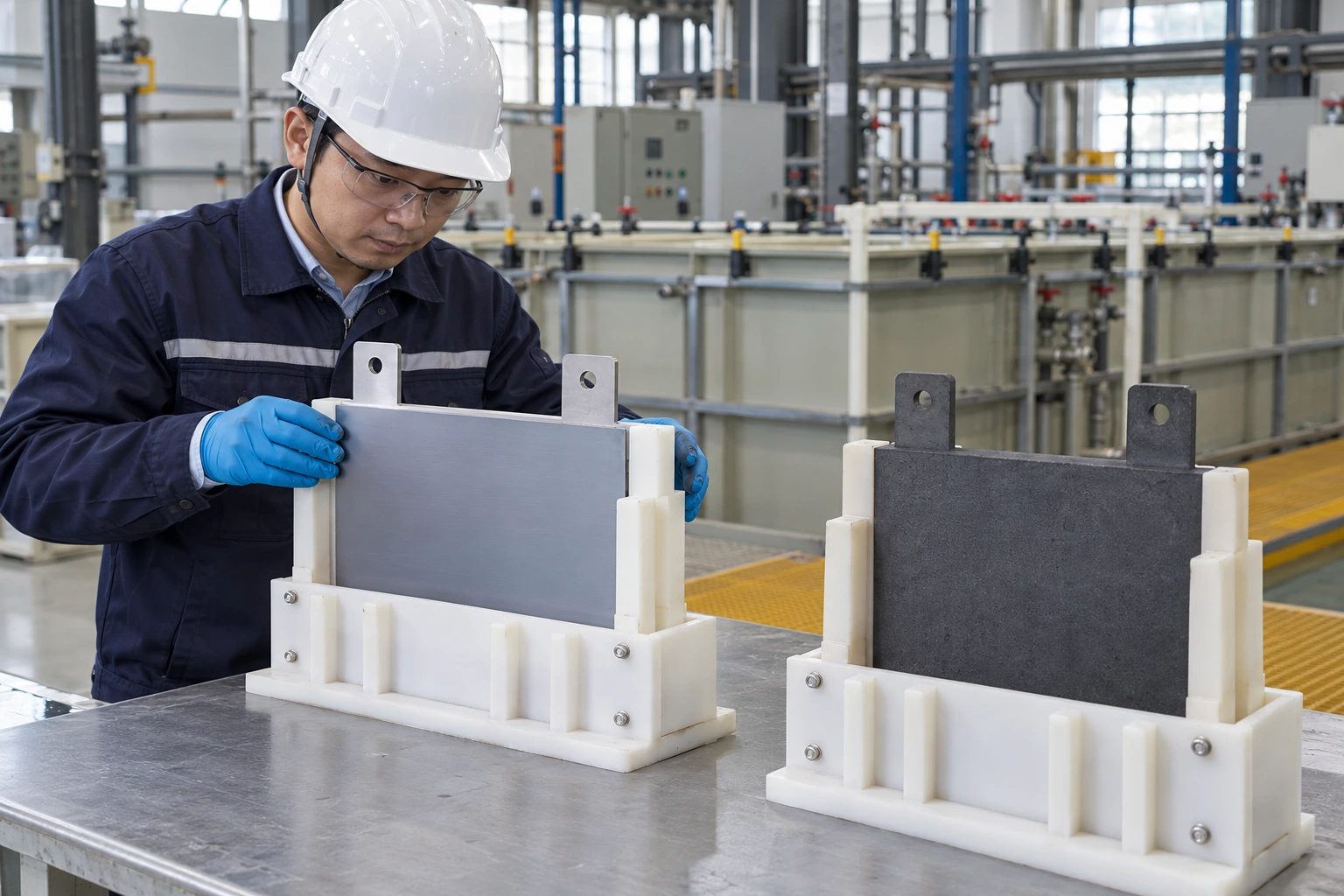
A Titanium electrode should replace graphite only when its coating and assembly meet the intended reaction and product requirements. Material identity alone cannot establish interchangeability.
What should the replacement improve?
Define the purchasing objective. Name the specific concern, such as maintenance burden or product contamination. Keep the current process baseline available so the trial can test that concern directly.
- State the reason for substitution.
- Record accepted baseline performance.
| Check | Decision |
|---|---|
| General material preference | Weak selection basis |
| Defined process objective | Supports a focused comparison |
Choose evidence around the actual problem. Key Takeaway: Approve a replacement against named requirements rather than broad material claims.
2. How do Titanium electrode and graphite surfaces differ?
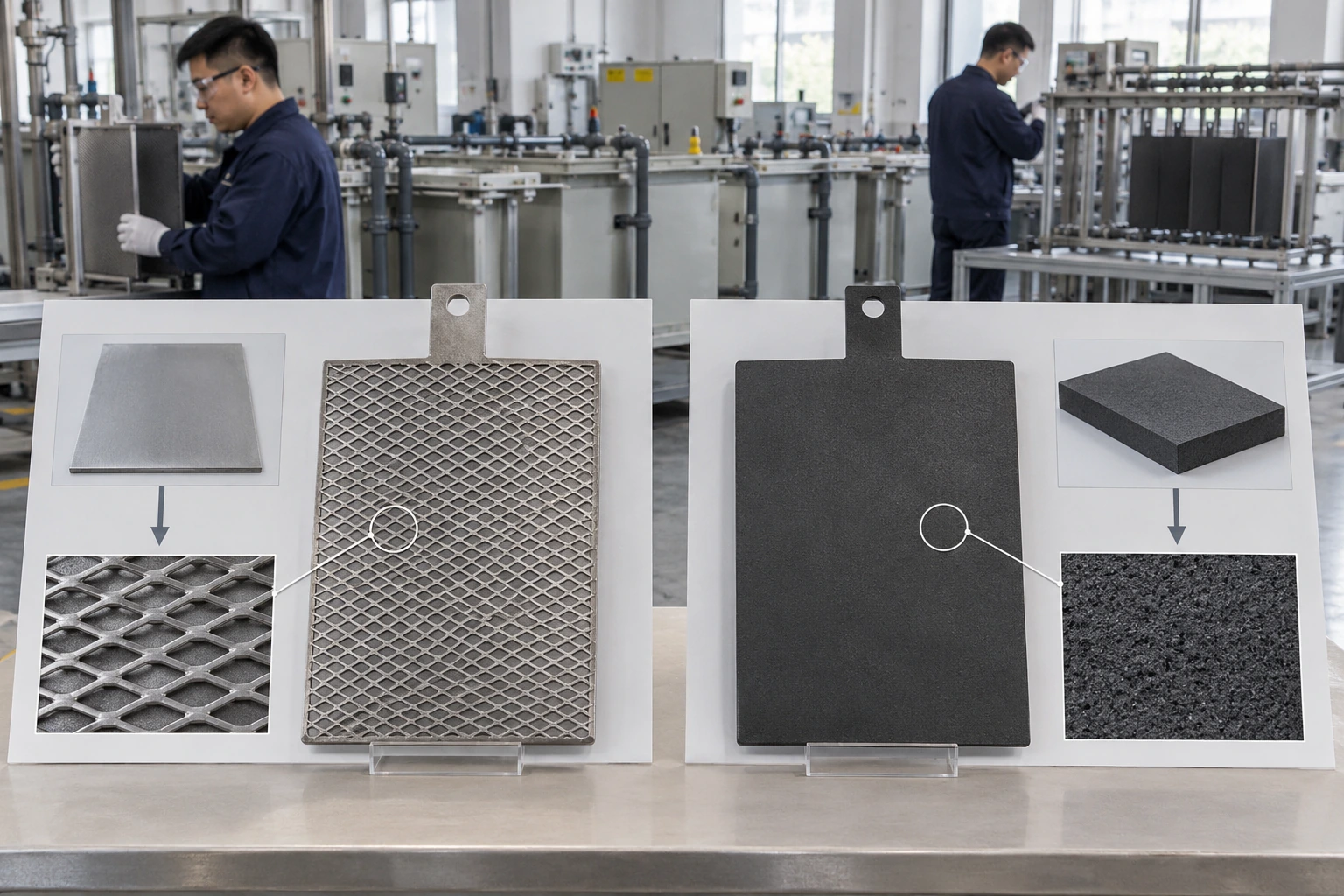
A coated Titanium electrode combines a titanium support with a specified active surface, while graphite serves through its own material surface. Each must be assessed for the actual electrochemical duty.
Which surface performs the reaction?
Separate support and reaction material. Do not compare bare titanium behavior with a qualified catalytic coating as if they were the same electrode. Identify the supplied graphite grade and coating system.
- Record complete material specifications.
- Identify any surface treatments.
| Check | Decision |
|---|---|
| Titanium substrate | Support material |
| Qualified active surface | Reaction-specific specification |
Compare finished electrode systems. Key Takeaway: A meaningful comparison needs more detail than two material names.
3. Can graphite particles affect Titanium electrode comparisons?

Graphite particles or other material release may matter in a Titanium electrode substitution study when product purity or filtration is affected. Actual release depends on conditions and needs measurement.
What does the product specification require?
Use controlled sampling. Compare feed, blanks and process output with suitable methods. Do not assume that every impurity came from the electrode or that a replacement eliminates all sources.
- Define relevant particles and analytes.
- Keep sampling boundaries consistent.
| Check | Decision |
|---|---|
| Material-release concern | A hypothesis to test |
| Controlled product analysis | Provides application evidence |
Investigate sources before attributing an improvement. Key Takeaway: Product cleanliness needs measurement across the complete wetted system.
4. Does a Titanium electrode always use less energy?
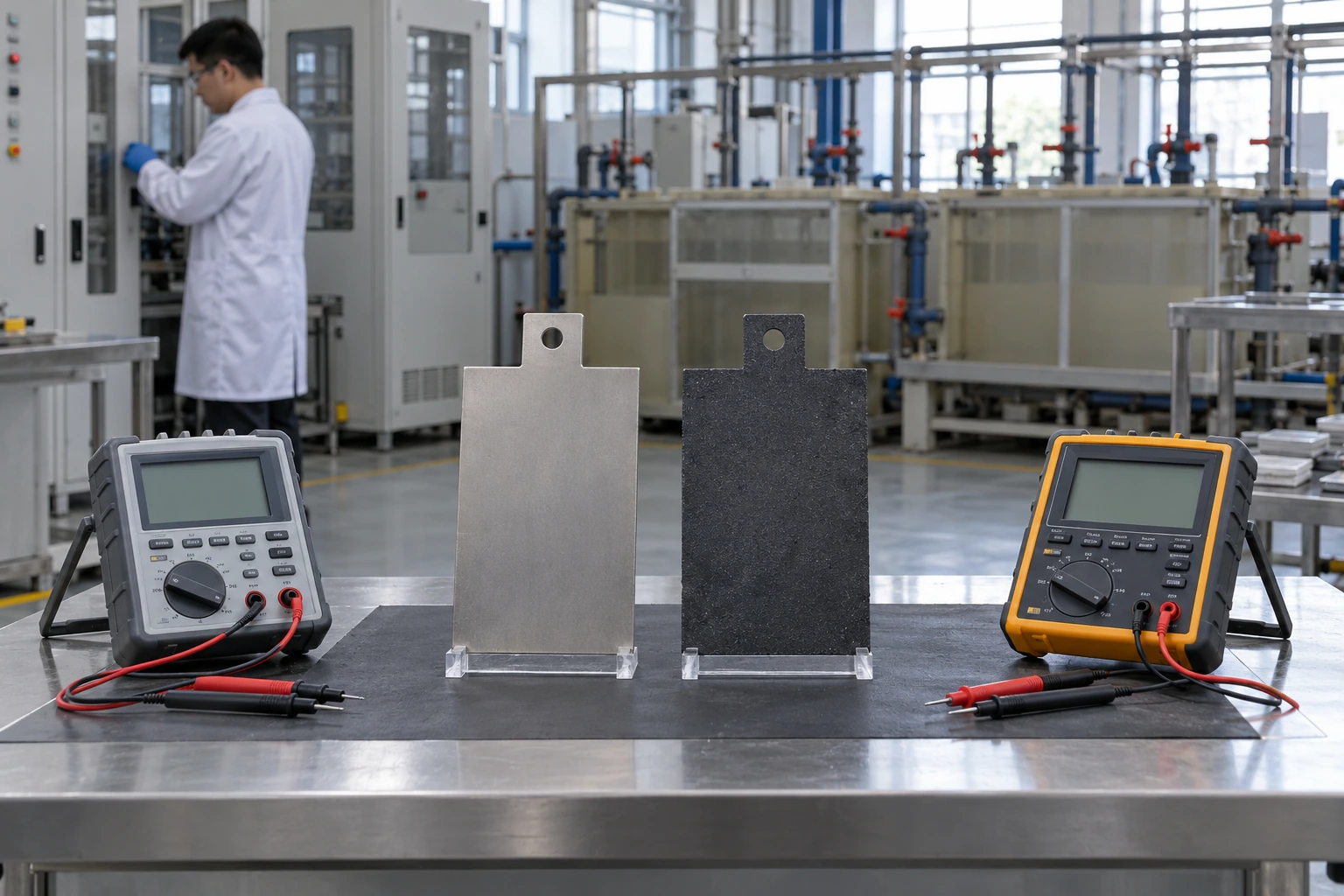
A Titanium electrode does not always use less energy than graphite because coating, chemistry, geometry and useful yield all influence consumption. Comparable system boundaries are required.
What does the quoted saving include?
Compare accepted output. Include voltage, current and product measurements in a custom application review. Keep auxiliary loads and any geometry changes visible rather than crediting every difference to the anode material.
- Use matched energy boundaries.
- Measure useful product independently.
| Check | Decision |
|---|---|
| Lower voltage | One observed electrical difference |
| Lower specific energy | Requires a complete output-based comparison |
Evaluate the ratio relevant to your process. Key Takeaway: Energy claims should follow a controlled operating comparison.
5. How does chemistry affect Titanium electrode selection?
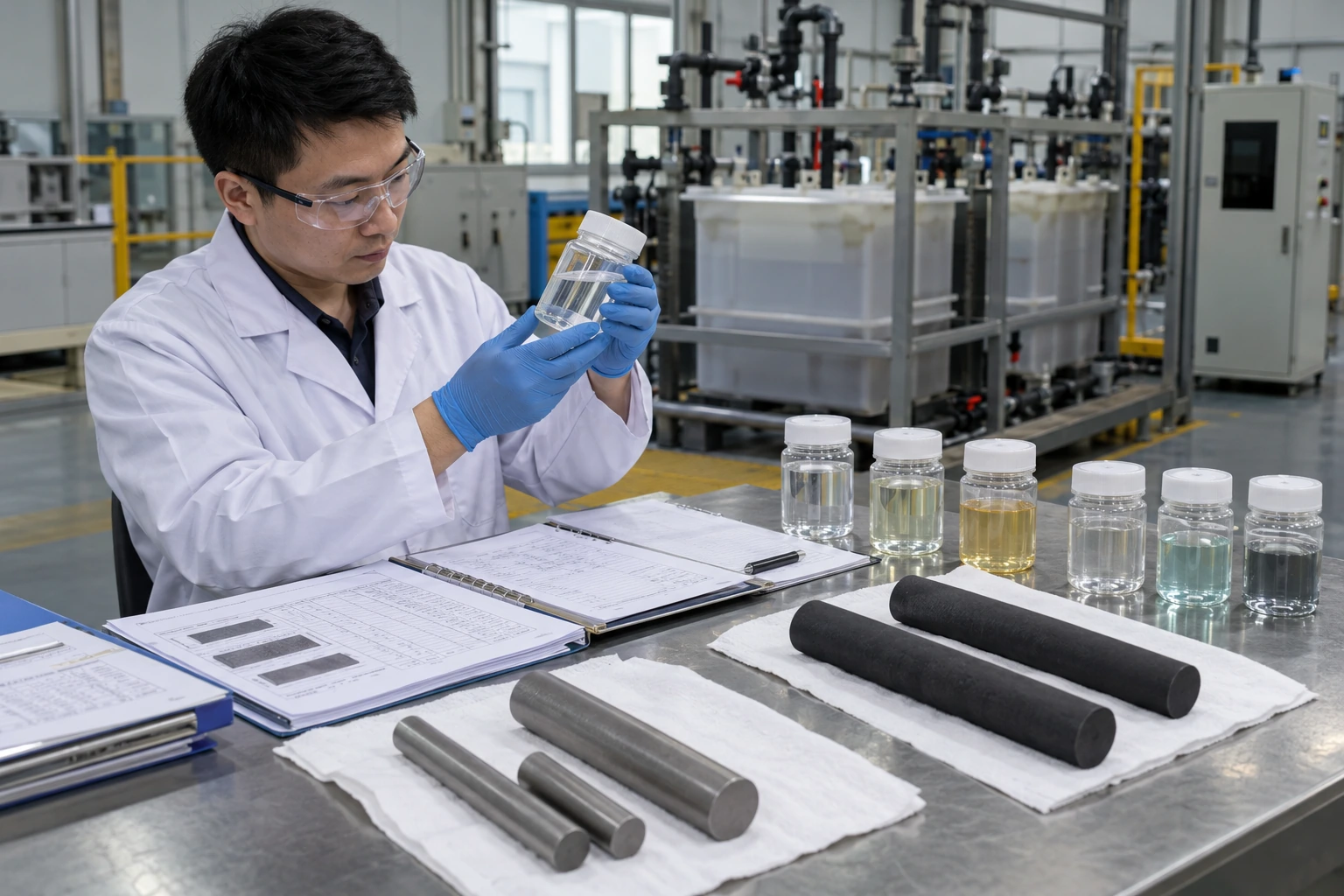
Chemistry determines Titanium electrode coating suitability and graphite behavior, so a successful substitution in one bath may not transfer to another. Temperature, impurities and polarity belong in the review.
Is the proposed coating suited to this reaction?
Send the actual feed analysis. Include normal variation and cleaning exposure. Avoid adopting another plant's material choice without checking differences in duty and product requirements.
- State reaction and polarity.
- Record relevant impurities and temperature.
| Check | Decision |
|---|---|
| Generic application label | Limited compatibility information |
| Defined operating chemistry | Supports material review |
Qualify the combination used in your cell. Key Takeaway: Anode selection is chemistry-specific rather than universal.
6. Can a Titanium electrode fit an existing graphite cell?
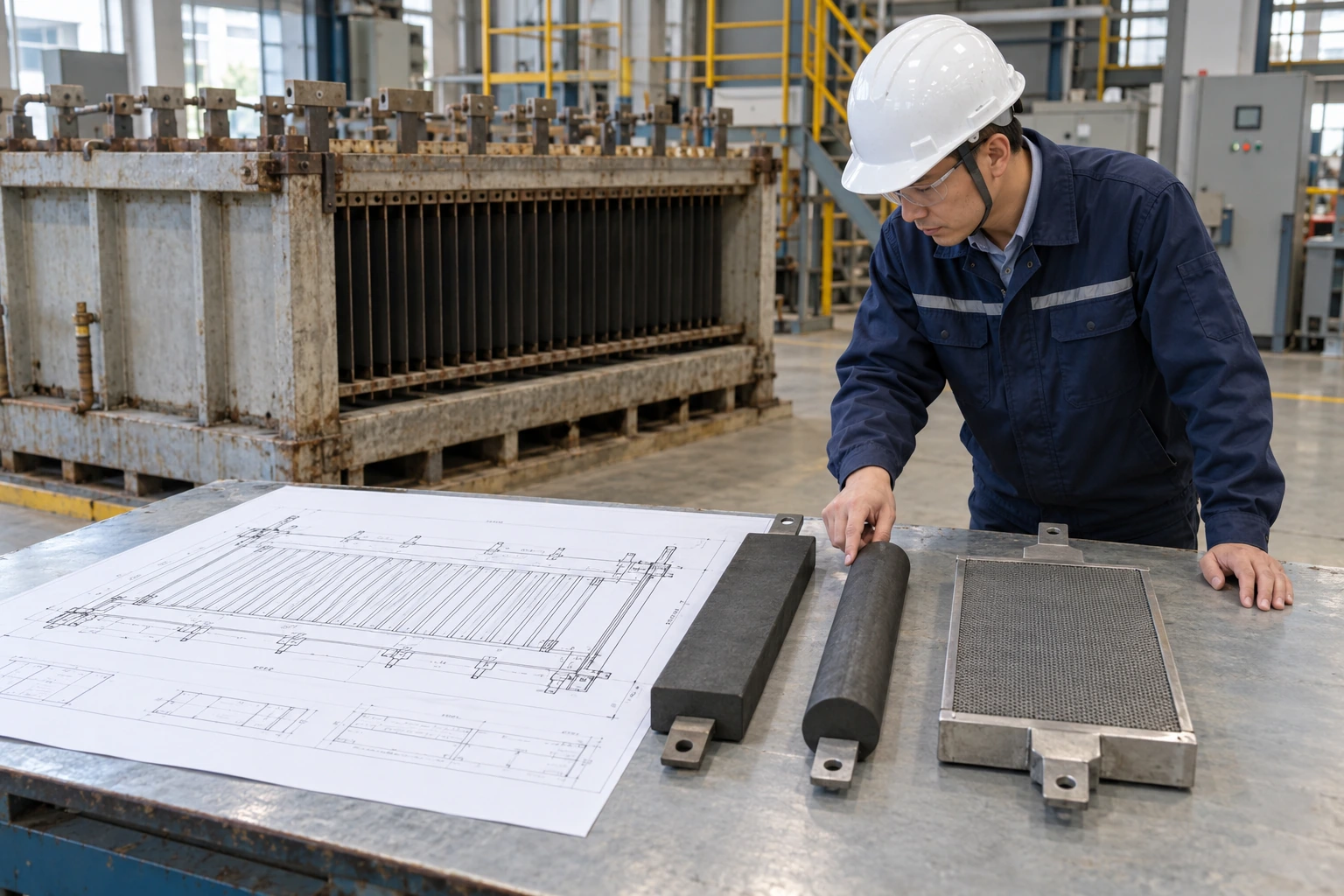
A Titanium electrode may require mechanical changes when replacing a graphite anode because thickness, supports and connection geometry can differ. Physical installation must be reviewed independently of coating suitability.
Will the existing fixture remain valid?
Check the complete interface. Compare mounting points, spacing and liquid boundaries against the legacy drawing. Do not force a thinner or lighter component into unsupported positions merely because it fits the opening.
- Review supports and terminal positions.
- Record as-built cell dimensions.
| Check | Decision |
|---|---|
| Outline fits | One mechanical check |
| Interfaces qualified | Broader installation evidence |
Resolve assembly changes before testing. Key Takeaway: A material retrofit can also be a mechanical redesign.
7. What changes in Titanium electrode current distribution?
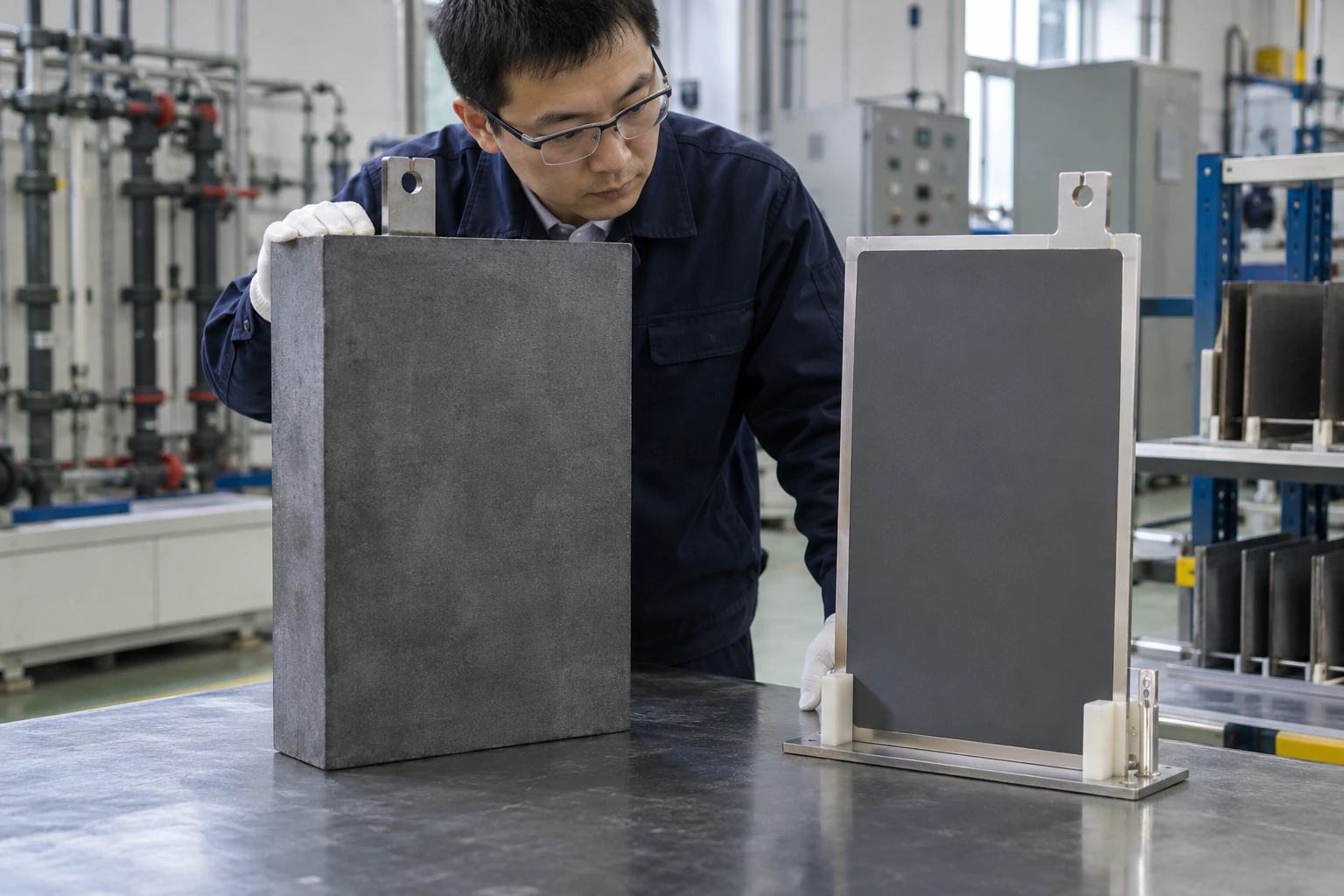
Changing from a graphite block to a Titanium electrode plate can alter active geometry and current distribution. Equal total current does not establish equal local loading.
Where does current reach the product?
Review the field geometry. Record anode shape, spacing and connection arrangement. Qualified designers should assess distribution when uniformity or local current density controls acceptance.
- Use consistent area conventions.
- Check workpiece and electrode positions.
| Check | Decision |
|---|---|
| Equal current | Same total electrical quantity |
| Equivalent distribution | Needs geometry-specific evidence |
Compare operating geometry with the material change. Key Takeaway: A replacement trial should account for changed current paths.
8. How do you compare Titanium electrode maintenance costs?

Titanium electrode maintenance costs should be compared with graphite on a defined operating and replacement basis. Unverified lifetime assumptions can dominate an otherwise careful cost estimate.
Which costs are actually documented?
Use records from the intended service. For drawing-based electrode options, include cleaning, inspection, handling and downtime requirements. Keep estimates clearly separate from measured maintenance history.
- List included maintenance tasks.
- State replacement-life assumptions.
| Check | Decision |
|---|---|
| Documented task history | Observed operating evidence |
| Assumed future life | Uncertain planning input |
Test sensitivity to unverified assumptions. Key Takeaway: Compare complete maintenance scope without inventing service-life savings.
9. What trial should qualify a Titanium electrode substitution?

A Titanium electrode substitution trial should measure the specific requirements driving replacement under controlled conditions. Product quality, electrical behavior and material condition may all need acceptance checks.
What would prove a successful substitution?
Write the pass criteria. Keep chemistry and measurement methods consistent, while documenting unavoidable geometry changes. Use a limited trial for bounded findings rather than an unrestricted performance claim.
- Retain traceable sample identities.
- Define stop conditions and follow-up checks.
| Check | Decision |
|---|---|
| Attractive single result | Limited acceptance evidence |
| Requirement-based trial | Supports a defined decision |
Judge success against the approved test objective. Key Takeaway: A replacement is qualified when the relevant requirements are demonstrated.
10. What Titanium electrode substitution data should you send?
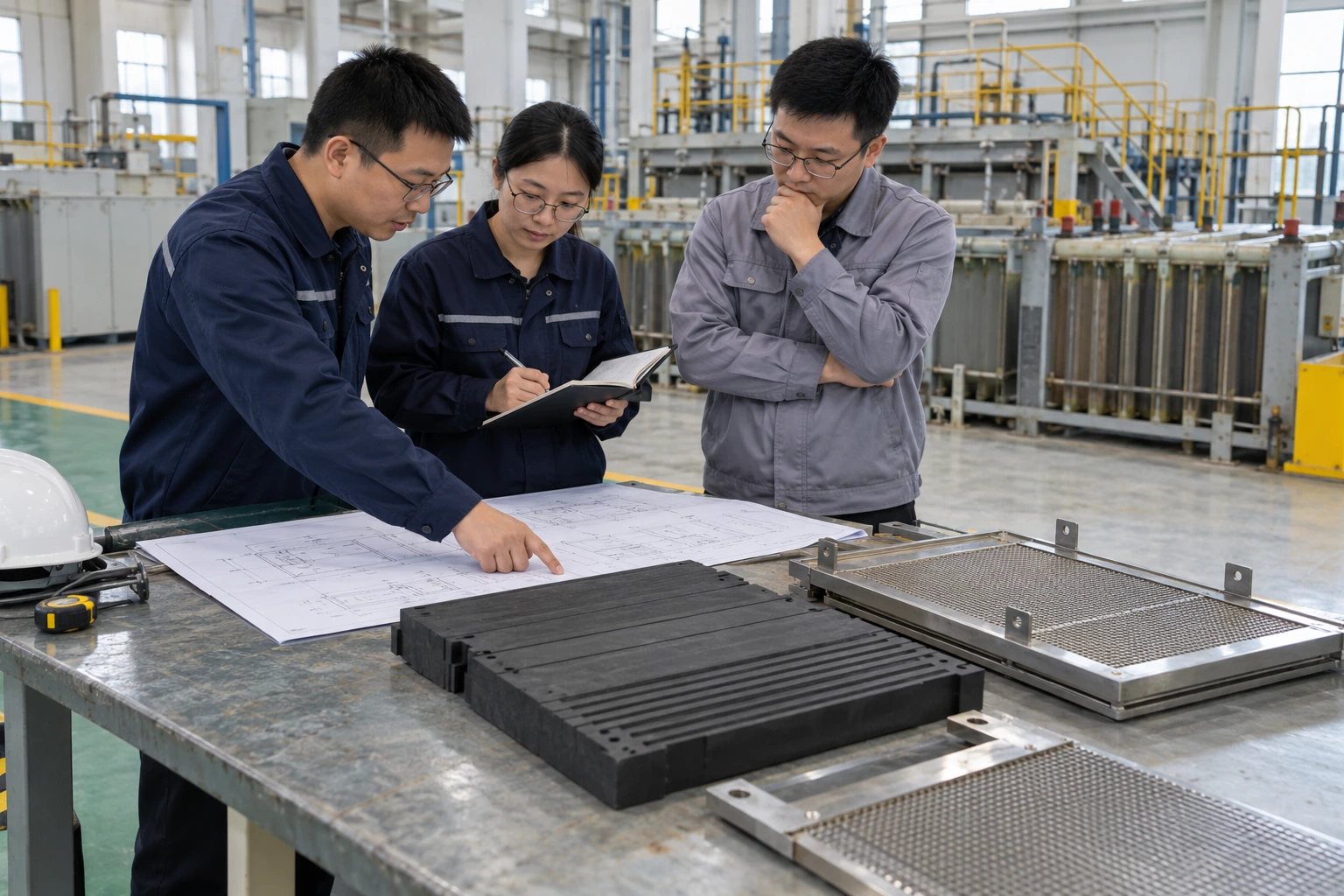
A Titanium electrode substitution brief needs legacy geometry, material details, chemistry and the intended improvement. This prevents a comparison based only on catalogue descriptions.
Send the existing process baseline
Bring the problem you want solved. When you contact us today, we can review electrode requirements and drawing-based alternatives. We favor measured application fit over blanket claims about material superiority.
- Provide the legacy anode specification.
- Separate required changes from optional ones.
| Check | Decision |
|---|---|
| Baseline supplied | Makes comparison concrete |
| Acceptance defined | Makes a trial useful |
Agree on a focused sample-validation plan. Key Takeaway: Select a replacement through the requirements of your process.
Frequently Asked Questions
Can I replace graphite with coated titanium directly? Only after reviewing chemistry, geometry, connections and product requirements.
What's the best coating for a graphite replacement? Choose for the actual reaction and electrolyte rather than the old material name.
Can I assume product contamination will disappear? No. Test relevant sources across feed, hardware, sampling and electrodes.
How do I know if energy savings are real? Compare measured energy per accepted output under equivalent boundaries.
Can I compare cost using purchase price alone? No. Include qualified maintenance, installation and replacement assumptions.