
Cell Design & Operation
Engineering guidance on electrode geometry, current, flow, connections, cell integration, controls, and operating conditions.
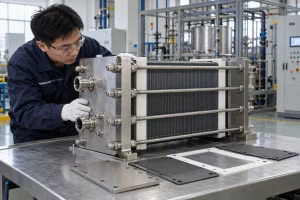
What Pressure Can a Titanium Electrode Cell Handle?
A membrane-stack pressure limit belongs to the assembled boundary, including channels, supports, seals, and frames. This guide separates absolute and differential pressure from titanium plate strength and outlines buyer questions….
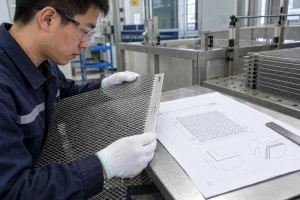
How Do Titanium Electrode Mesh Edges Affect Fit?
Specify mesh edge condition through assembly fit, strand geometry, coating sequence, inspection stage, and safe supplier handling….

How Flat Must a Titanium Electrode Plate Be?
Set plate flatness from stack function, assembly state, contact zones, measurement setup, and a drawing-defined acceptance method….
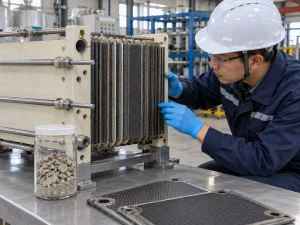
How Can a Titanium Electrode Cell Handle Feed Particles?
Particle filtration can protect narrow flow paths, but a particle filter does not remove every dissolved salt or metal. Match feed testing and filtration scope to the cell….

Can a Titanium Electrode Scale from Batch to Continuous?
Batch and continuous electrolysis create different feed, inventory, and sampling boundaries. Compare mode-specific evidence before carrying a laboratory result into a flow process….

How Does a Titanium Electrode Affect Mass Transfer?
Mass transfer links wastewater flow and species delivery at an electrode surface. See how boundary layers, current limits, channel geometry, and test data guide cell review….
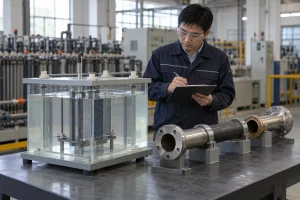
How Do You Check Titanium Electrode Stray Current Paths?
Investigate unintended electrical paths without confusing process isolation with protective grounding or relying on improvised live tests….
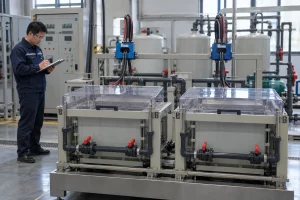
How Do Parallel Titanium Electrode Cells Share Current?
Review parallel-cell current sharing through branch measurements, lead geometry, feed conditions and a defined system-validation plan….

Does Titanium Electrode Mesh Orientation Matter?
Specify expanded-mesh direction, open area and current-entry geometry so a mesh electrode can be reproduced and tested consistently….